G20 Summit: Significance Of African Union Joining And India's Goals Therein
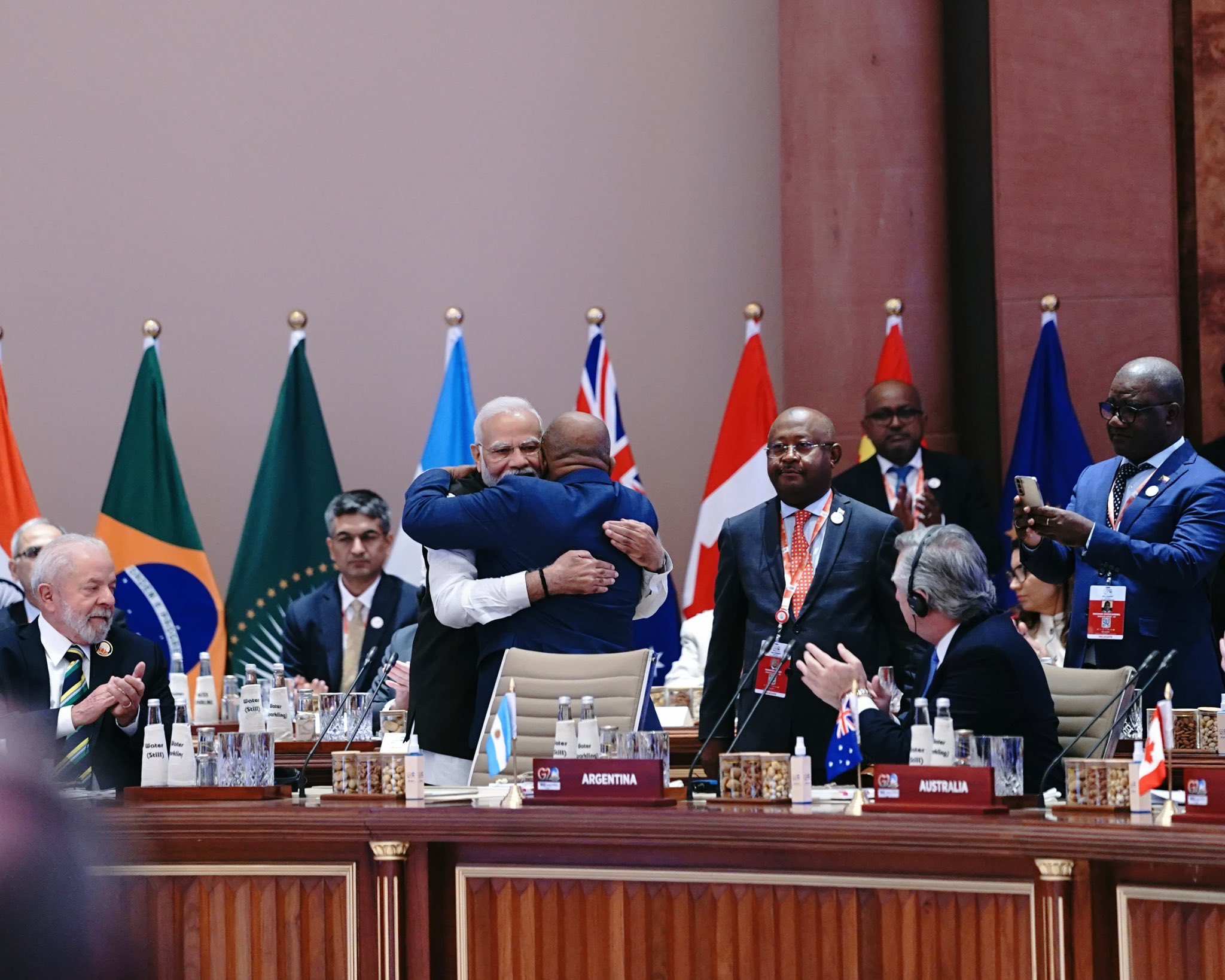
The G20 nations have agreed to grant the African Union permanent membership status. The move would give the 55-member African Union, which is currently classified as an “invited international organization,” the same status as the European Union.
This means Africa's premiere regional bloc would now get representation in the high table of global diplomacy. India, along with other countries, have been pushing for more African involvement in international matters.
Earlier, only South Africa, the continent's third-largest economy, was part of the G20. Now, the African Union, which itself has a rotating presidency, will have a permanent presence in future G20 meetings.
Prime Minister Narendra Modi invited the head of the African Union and President of Comoros Azali Assoumani to take his seat, as a permanent member of the G20 as the first session of the Summit commenced on Saturday.
"With support from all of you, I invite African Union to join G20," Modi said amid thunderous applause by world leaders at the Summit.
Also in attendance in the G20 Summit in New Delhi is Nigerian President Bola Tinubu and Egyptian leader Abdel Fattah El-Sisi.
For a #G20, which is more inclusive and more vocal for Global South!
September 9, 2023
PM @narendramodi warmly invites President @_AfricanUnion & Comoros Azali Assoumani to join other G20 leaders as African Union becomes a permanent member of the G20.
A key outcome of #G20India. pic.twitter.com/ScLTGkQ4G1India's Goals In Africa
The African Union's inclusion to the club is a big win for India, which has been championing the cause of 'Global South', a reference to developing countries who don't particularly enjoy representation at top global forums.
It also lends India huge diplomatic clout in Africa, which has become the playground for major powers like the U.S., Russia, China and European countries, all vying for political and economic influence in the resource-rich continent.
"Voicing the concerns of the Global South has always been at the core of G20 India's agenda. Marking a historic moment at the G20 Summit, PM Narendra Modi welcomes the African Union as a permanent member of the G20 Family," said Amitabh Kant, India's G20 Sherpa.
In 2015, India hosted the India-Africa Summit in New Delhi with much fanfare, and was able to get the participation of dozens of African leaders.
PM Modi hosted Egyptian President Abdel Fatah El-Sisi for the Republic Day celebration earlier this year.
At the latest BRICS summit in Johannesburg in August, the present members -- Brazil, Russia, India, China and South Africa -- decided to add Egypt and Ethiopia, along with Argentina, Iran, Saudi Arabia and the United Arab Emirates as new members of the grouping.
India has plans to actively engage with Africa in matters of climate change mitigation, trade and technology and infrastructure development.
Honoured to welcome the African Union as a permanent member of the G20 Family. This will strengthen the G20 and also strengthen the voice of the Global South. pic.twitter.com/fQQvNEA17o
September 9, 2023Africa – New Chessboard Of Great Power Competition
China has been aggressively pursuing its own economic interests in the resource-rich continent through investments in infrastructure and mining under the 'Belt and Road Initiative'. Though, it has faced criticism for burdening African countries with debt, much like Sri Lanka.
Russia, occupied in the Ukraine war, has remained actively involved in African politics through proxies like the mercenary group Wagner. It has supported the recent string of military coups in the Sahel region of Western African, which has toppled leaders seen close to the West, especially the region's former colonial power France.
Europe, that has for years grappled with rising migration from Africa and the Middle East, has also been reinvigorating its relationships in the continent. The conflict-ridden Sahel region has become a virtual chessboard between Russia and Europe (under French primacy) to install friendlier regimes.
The vast deposits of rare Earth metals like lithium and chromium and other minerals like nikel, gold, cobalt, uranium and copper on the continent have attracted attention from all key global players. These resources are essential to drive the green transition.
China and the U.S. are jostling for influence among African countries to gain access to these lucrative resources.
India's Play And Maritime Security
The lack of enough deposits of such minerals in India would also motivate New Delhi to scout for deals to enter the African mining industry.
In contrast to the predatory nature of China, India seeks to engage with Africa through shared goals like sustainable development, access to healthcare and greater digitisation. It has already earned much goodwill among African states for its leadership during the Covid-19 pandemic when it delivered vaccines and other aid while the West and China fumbled in their response.
Even in counter-terrorism, India has actively engaged with Africa which faces threats from groups like Al Qaeda, ISIS, among others. It has held joint counter-terror exercises with several African countries.
A broad outreach through multilateral platforms, while championing their participation in international matters, can enable India gain significant influence.
Moreover, since the east coast of Africa spans the Western Indian Ocean, a security dimension also adds up for New Delhi. It has established close maritime links with countries like Madagascar, Kenya and Mauritius.
Waters near the Horn Of Africa, a conflict-ridden zone, has seen increased Chinese presence under anti-piracy operations. It has its sole foreign naval base at Djibouti, a tiny country at the junction of Red Sea and Indian Ocean, that also hosts American, French and Japanese forces.
In view of security and access to trade, Africa's eastern periphery holds great importance for India's own maritime ambitions and economic interests.

-
Getting To Work Costs Women More | The Reason Why

It is not just about women paying more than men. It is about women paying much more in cities than in villages.
-
AI Bias In Investing Cannot Be Eliminated, But It Can Be Governed
Framing is a particularly important example as identical financial information presented in terms of gains rather than losses can lead an LLM to reach a different assessment.
-
Joining The Dots | Dark Skies, Steady Diya: Why Hope Holds This Diwali
With war, a weak rupee and foreign outflows weighing on sentiment, policymakers at the NDTV World Summit and market veterans at NDTV Profit Ignite: Diwali Edition offered the same advice: stay invested and filter out the noise.
-
The Curious Case of Equitas Small Finance Bank And A CEO Who Quit For Stock
PN Vasudevan believes persistent investor concerns over a perceived conflict of interest had become a governance overhang on Equitas Small Finance Bank's stock, even as the lender improved profitability and asset quality.
-
Talking Points This Week: AI Cash Burn, A Tiger Comeback And An India That Still Finds Its Own Path
India is not immune to higher oil or tighter global liquidity, yet its earnings base is broader, its domestic policy levers are still available.
-
Foreign Investors Own Half Of HDFC Bank and ICICI Bank. An LTCG Cut Could Matter Most Here
Foreign portfolio investors have US$115 billion parked in HDFC Bank, ICICI Bank. If the government cuts long-term capital gains tax, Jefferies says returning foreign money could land here first.
-
'Never Seen This Level Of Negativity': Sandeep Tandon Says The Next Rally May Be Closer Than You Think
Veteran investor Sandeep Tandon says foreign selling is easing, large-caps are due a comeback and mid-caps are crowded, while he turns positive on gold, power and pharma this Diwali.
-
Indians Stay With Family, Not In Hotels | The Reason Why
India still lacks enough clean, reliable and affordable hotels for budget-conscious travellers.
-
The Economic Imperative: Analysing The Material Driving Force Behind India-Canada Strategic Reset
This economic complementarity is further reinforced by deep institutional investment ties and talent mobility, which form the bedrock of the bilateral framework.
-
Medicine Pricing: Where Must Profit Stop?
India must confront excessive margins, hidden incentives and regulatory gaps that threaten the integrity of medicine.










