G20 Adopts Crypto Framework, Second Report On Multilateral Bank Reform
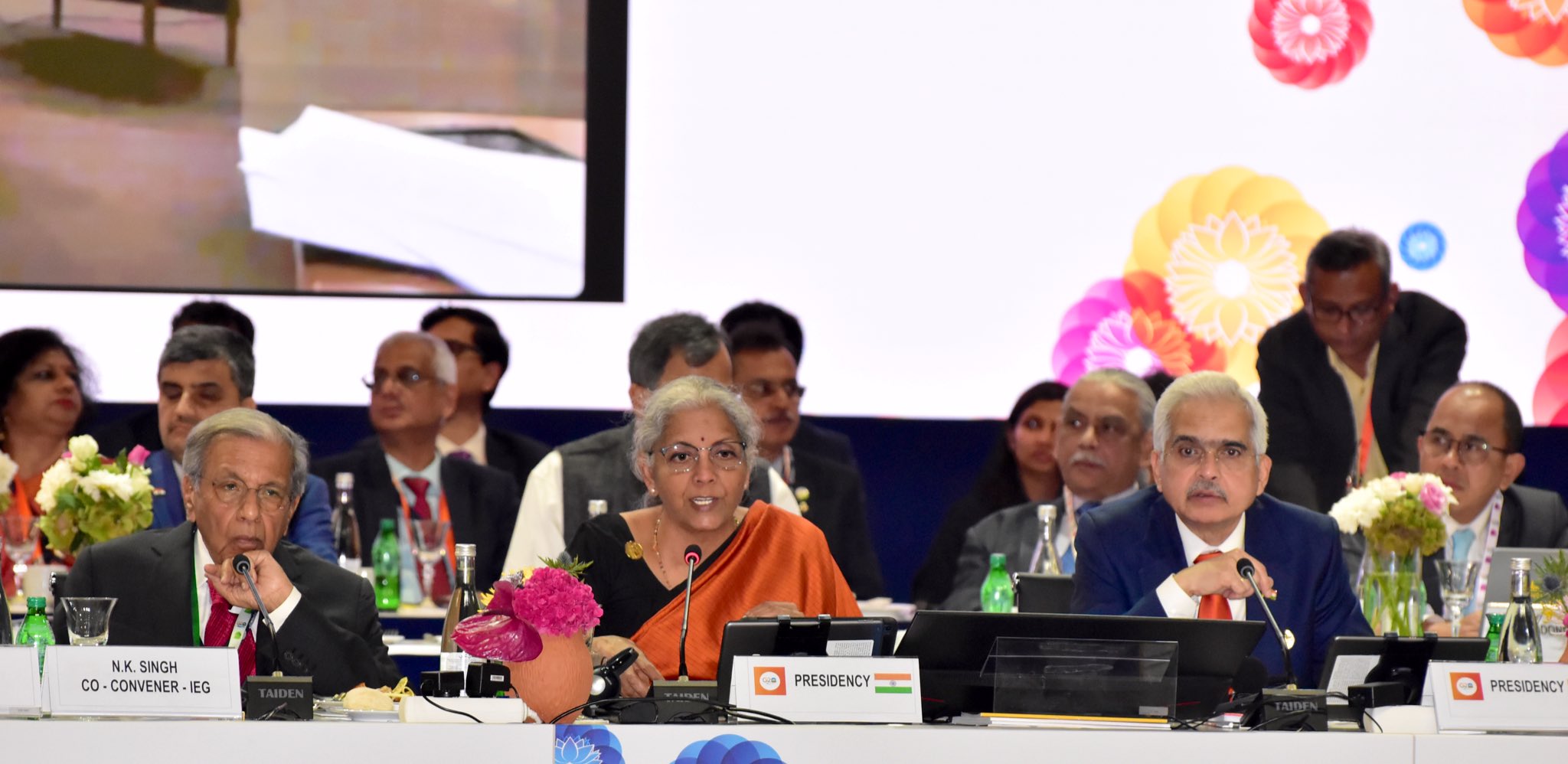
The G20 finance ministers have agreed to adopt the group's roadmap for crypto assets, along with taking up the second report of the independent expert group on strengthening multilateral development banks.
The leaders have also sought the International Monetary Fund and Financial Stability Board to provide updates on the implementation of the crypto roadmap and assent to implement the Financial Action Task Force's revised guidelines for trust and other legal arrangements.
These decisions were taken at the fourth G20 Finance Ministers and Central Bank Governor's meeting under India's presidency underway in Marrakesh, Morocco.
"Together with the actions and approaches agreed to in July 2023 and called for by leaders in September 2023, these outcomes will contribute to our continued efforts towards prioritising the well-being of our people and planet and strengthening global development for all," the communiqué released on Friday read.
This also marks the first finance heads communique since the start of India's G20 presidency, as previous meetings have ended with a chair's summary.
"I am given the understanding now that globally all of us are on the same page about the way in which regulations can happen," Indian Finance Minister Nirmala Sitharaman said, while speaking on the new crypto roadmap at the post-presidency press conference. She added that countries will now work out their own specific legislation.
The roadmap allows for monitoring the progress and the implementation of regulatory activities, cross-border information sharing and conveying the decision of the G20 roadmap to jurisdictions that are beyond G20 and FSB membership, she said.
Communique Exludes Israel-Hamas Conflict
The communique bears no mention of the Israel-Hamas conflict or its economic impact.
However, Sitharaman mentioned that the Middle Eastern crisis, fuel prices and fragmentation of global supply chains remain major concerns for emerging markets.
"...the concerns and uncertainties are about peace, fuel concerns affecting food security aspects and therefore, the inflation to that end and the fragmentation of supply chains—these were the three concerns thinking about the near future," she said.
Second Volume On MDB Reform
Under India's presidency, an IEG was formed, which was co-convened by former 15th Finance Commission Chairperson, NK Singh and former United States Secretary of the Treasury, Larry Summers, to look at strengthening and reforming the mandate of multilateral development institutions.
Volume 1 of the report, unveiled at the last FMCBG meeting in July 2023, calls for a triple agenda and an additional spend of $3 trillion towards climate action and achieving sustainable development goals. Volume 2 is not yet available for public viewing.
At the Marrakesh meeting, the leaders agreed that 'transformative changes' are required in the vision of MDBs, in their operating models, and in their financing capacities.
"We encourage MDBs to enhance private capital mobilisation through supporting enabling conditions, innovative risk-sharing instruments and new partnerships to maximise their development impact. This, along with the implementation of all appropriate CAF recommendations, would maximise the leverage effect of potential capital increases," the communiqué said.
The Capital Adequacy Framework for MDBs was mandated by the 2021 G20 Italian presidency. Its measures, including those under implementation, are said to yield an estimated additional lending headroom of $200 billion over the next decade.
The G20 finance grouping also agreed that from now on, one of the finance working groups—the International Financial Architecture Working Group—would work with the MDBs on the IEG recommendations, which would be taken up in April 2024.
The World Bank and IMF are also expected to furnish the G20 with the work undertaken to support efforts at enhancing domestic resource mobilisation in emerging markets and developing economies, considering each country's needs.
FATF Guidance On Trusts
Emerging from the meeting is also a global agreement on revised standards on beneficial ownership transparency proposed by the FATF.
"We welcome the positive developments in FATF towards revising its standards on asset recovery and reinforcing global asset recovery networks, so as to enhance global efforts to recover criminal proceeds promptly and effectively," the communiqué said.

-
Navigating Friction And Energy Realities: An Analysis Of Marco Rubio's October Visit To India

Occurring at a critical juncture marked by stalled trade negotiations and escalating geopolitical pressures over global energy supplies, the visit offers a profound window into modern US-India relations.
-
India Exports Capital. Why Not Export Trusteeship?
The big question, then, is whether India can build an institution that global borrowers, investors, banks, and lawyers can trust, even without an Indian connection.
-
France's Economy & Politics Are In Crisis | The Reason Why
Let's look at how the French economy and politics evolved under Nicolas Sarkozy, Franois Hollande and Emmanuel Macron.
-
You May Inherit The Business. You Must Earn Its Credibility.
Succession tests the founder's ability to share authority as much as it tests the next generation's readiness to assume it.
-
Signing Deals Is One Thing; Making Them Work Is Another | The Week In Whys
Sometimes, things don't turn out as planned. Indian companies have lost some bids to rivals, some projects won't produce until 2030.
-
FOMC Wall, PERM Suspension, Hospital Stocks | Talking Points This Week
A PERM suspension would directly affect green-card sponsorship rather than H-1B visas, so the near-term earnings impact could remain relatively limited. The key question is whether this marks a new phase in US scrutiny of Indian IT.
-
Everything, Everywhere, All At Once: Dalal Street's Week To Forget | Joining The Dots
Visa curbs, a Starlink spat and cancer drug caps: what connects this week's shocks for Indian markets
-
India Is Going Abroad For Critical Minerals. But It May Take Years To Pay Off | The Reason Why
Although India's steps are in the right direction, they remain modest compared with India's growing dependence.
-
When Everyone Has AI, What Gives You An Edge?
India's young workforce is entering an uncertain world of work where powerful AI tools are becoming widely accessible. The advantage will belong to those who combine deep expertise with digital fluency, and the distinctly human capabilities that technology cannot manufacture.
-
Wrong Labels, High Pesticide Residues Holding Back Agri Exports | The Reason Why
India needs stronger domestic food-safety and labelling standards, with best practices becoming part of everyday business for farmers, traders and food companies.










