Erdogan’s Putin Meeting Was More About Damage Control Than Grain
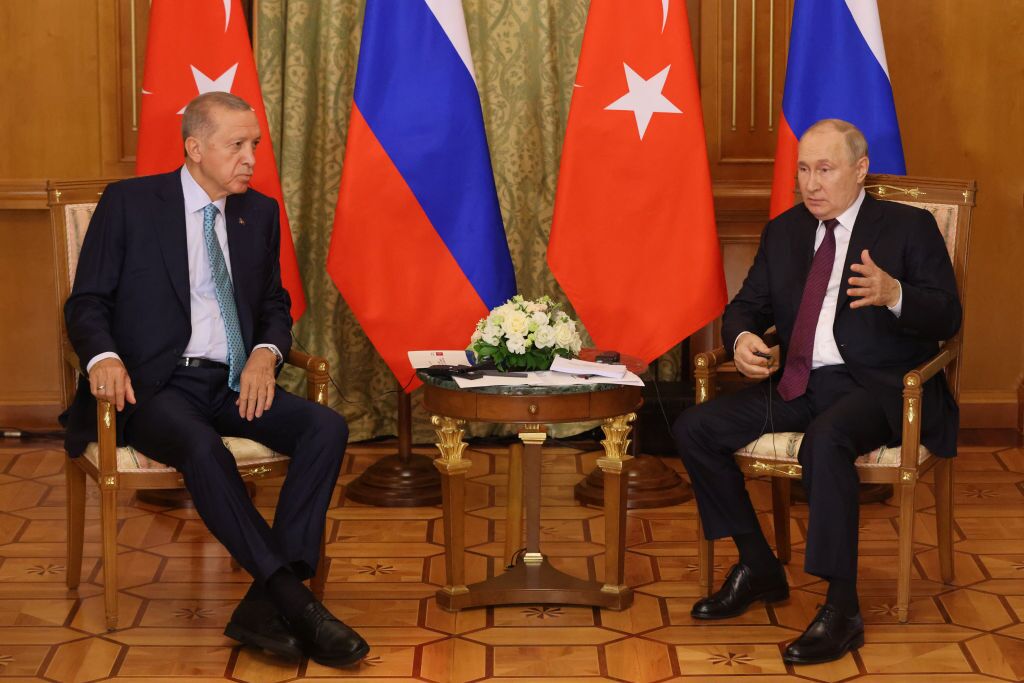
(Bloomberg Opinion) -- It's hard to think of President Recep Tayyip Erdogan, a strongman whose bizarre ideas on economics have brought his country close to catastrophe, as a pragmatist. But that's how to understand his foreign policy swings, and why he's stuck in a loveless triangle with Russia and NATO.On Monday, Erdogan went to see Russia's President Vladimir Putin in the Black Sea resort of Sochi, with much of his government in tow. He stated the obvious on his way in: “Everyone,” he said, was watching whether they could revive the grain deal that allowed Ukraine to export 33 million tons of wheat and other cereals by sea in a year of war, stabilizing global food prices and vastly boosting Turkey's status on the world stage.That agreement was brokered by Erdogan last summer and ended by Putin on July 17. It showed no signs of life on Monday after their 90-minute meeting. Instead, the two men pushed forward with a separate and deeply cynical plan to salvage Putin's image in the global south, under which Qatar buys 1 million tons of Russian grain for processing in Turkey and distribution to select African states.Erdogan's visit to Sochi wasn't just about grain. It was an attempt at damage control because, after using Putin to help get re-elected earlier this year, the Turkish leader's been making nice with the Kremlin's arch enemies in the US and Europe. Seen from Moscow, that's betrayal.Until he won his vote on May 28, Erdogan had used Turkey's veto as a member of the North Atlantic Treaty Organization to keep Sweden from joining the bloc, accusing it of harboring Kurdish “terrorists.” That could hardly have been more welcome in the Kremlin, or more irritating to Turkey's NATO allies. Amid a stream of anti-Western rhetoric, Erdogan accused his political opponents of taking orders from Washington.Putin returned the favor, letting Erdogan announce Russia's agreement of a two-month extension of the Ukrainian grain deal, on the eve of Turkey's first-round vote. Erdogan's main rival for the Turkish presidency accused Russia of election interference, including a deep-fake smear campaign.But with the election behind him, Erdogan has swung hard toward the West, not only greenlighting Sweden's NATO bid, but also hinting he'd do the same for Ukraine, which is not unlike showing a red rag to a bull. Having killed the grain deal in July, Russia then drove home its displeasure, sending troops to board a Turkish cargo vessel and broadcasting footage of the crew as they were forced to kneel at gunpoint.It isn't useful to understand any of this as Erdogan throwing his lot back in with the West. His goal is to establish Turkey as a regional power in an emerging multipolar world, able to compete at the same table as the US, the European Union, China, India, and Russia, among a growing list. That means punching way above Turkey's weight and playing stronger powers against each other.By and large, Erdogan has pulled that off, if at enormous cost to Turkey's democracy. But by the time he was re-elected a few months ago, his balancing act looked in danger of collapse as the realities of Turkey's dependence on Western markets hit home. By December, the value of the lira had more than halved and inflation was running at 65%, because Erdogan insisted the central bank cut interest rates in the face of rising prices. As foreign creditors fled, he relied on shell games and loans from wealthy Gulf nations to plug the hole. It wasn't enough.Erdogan now knows his economic experiment of cutting interest rates to tame inflation failed, and that Turks are lining up to trade their diminished currency for US dollars, not Russian rubles or Chinese renminbi, says Huseyin Bacgi, a Russia specialist who heads Ankara's Foreign Policy Institute. “Turkey needs the west because the money is still in the west,” he said.So too are the F-16 upgrade kits and jets that Turkey needs to strengthen its aging air force, until it can build state of the art combat aircraft of its own. And however much Erdogan may bait NATO, Russia's invasion of Ukraine has proved the alliance's value for Turkish security, just as Turkey's geography and control of access to the Black Sea have underscored its importance to the alliance. Still, if Turkey needs NATO, US F-16s, European markets and an end to the war on Ukraine that doesn't turn the Black Sea into a Russian lake, Erdogan also needs Russian trade (up more than 80% last year as Turkey stood aside from joining Western sanctions), cheap Russian gas, Russian tourism (up nearly 150% this year), as well as Putin himself, a fellow strongman and combatant against US dominance and European liberal values.For Erdogan, divorce from either side of this unhappy triangle would be brutal.
More From Bloomberg Opinion:
- Russia Weaponizing Wheat Won't Hurt the World: Javier Blas
- Erdogan Just Doomed Turkey's Hope of EU Membership: Bobby Ghosh
- Turkey Braces for the Shock of Normal: Daniel Moss
This column does not necessarily reflect the opinion of the editorial board or Bloomberg LP and its owners.
Marc Champion covers global politics. He was previously Istanbul bureau chief for the Wall Street Journal. He was also an editor at the Financial Times, the editor-in-chief of the Moscow Times and a correspondent for the Independent in Washington, the Balkans and Moscow. He is based in London.
More stories like this are available on bloomberg.com/opinion
©2023 Bloomberg L.P.

-
Navigating Energy Crossroads: S Jaishankar's Call For Diversified Supply Chains At G20 Ministerial Meeting

As geopolitical fault lines continue to test maritime trade routes and commodity flows, Jaishankar's message remains pertinent: true economic resilience requires open markets, protected transit lines, and a genuine commitment to multilateral cooperation rather than coercion.
-
Indians Are Travelling, But Not Every Journey Is A Holiday | The Week In Whys
Pilgrims, patients and working women are the real travellers, and the system hasn't quite caught up with them.
-
Getting To Work Costs Women More | The Reason Why
It is not just about women paying more than men. It is about women paying much more in cities than in villages.
-
AI Bias In Investing Cannot Be Eliminated, But It Can Be Governed
Framing is a particularly important example as identical financial information presented in terms of gains rather than losses can lead an LLM to reach a different assessment.
-
Joining The Dots | Dark Skies, Steady Diya: Why Hope Holds This Diwali
With war, a weak rupee and foreign outflows weighing on sentiment, policymakers at the NDTV World Summit and market veterans at NDTV Profit Ignite: Diwali Edition offered the same advice: stay invested and filter out the noise.
-
The Curious Case of Equitas Small Finance Bank And A CEO Who Quit For Stock
PN Vasudevan believes persistent investor concerns over a perceived conflict of interest had become a governance overhang on Equitas Small Finance Bank's stock, even as the lender improved profitability and asset quality.
-
Talking Points This Week: AI Cash Burn, A Tiger Comeback And An India That Still Finds Its Own Path
India is not immune to higher oil or tighter global liquidity, yet its earnings base is broader, its domestic policy levers are still available.
-
Foreign Investors Own Half Of HDFC Bank and ICICI Bank. An LTCG Cut Could Matter Most Here
Foreign portfolio investors have US$115 billion parked in HDFC Bank, ICICI Bank. If the government cuts long-term capital gains tax, Jefferies says returning foreign money could land here first.
-
'Never Seen This Level Of Negativity': Sandeep Tandon Says The Next Rally May Be Closer Than You Think
Veteran investor Sandeep Tandon says foreign selling is easing, large-caps are due a comeback and mid-caps are crowded, while he turns positive on gold, power and pharma this Diwali.
-
Indians Stay With Family, Not In Hotels | The Reason Why
India still lacks enough clean, reliable and affordable hotels for budget-conscious travellers.










