Corporate America Hoards Cash for Tariffs Over Buying Back Stock

(Bloomberg) --US companies last month announced the fewest stock buybacks, in dollar terms, since the Covid pandemic, an early sign of cash hoarding from worries about economic growth and the impact of a global trade war.
The value of announced buybacks in the US reached $39.1 billion in March, the lowest dollar value since October 2020 and the lowest for March since 2019, according to data compiled by Birinyi Associates. That's a worrisome sign for investors since buybacks offer a crucial pillar of support for the US stock market, which is already down significantly from February's all-time highs and is facing pressure from the Trump administration's tariffs, which will be announced Wednesday afternoon.
“No one knows what will happen with tariffs,” said Jeffrey Yale Rubin, president of Birinyi Associates. “So how are corporate executives supposed to plan for cash flows? It's a lot easier to slow buybacks than cut dividends until companies know more about the trade outlook.”
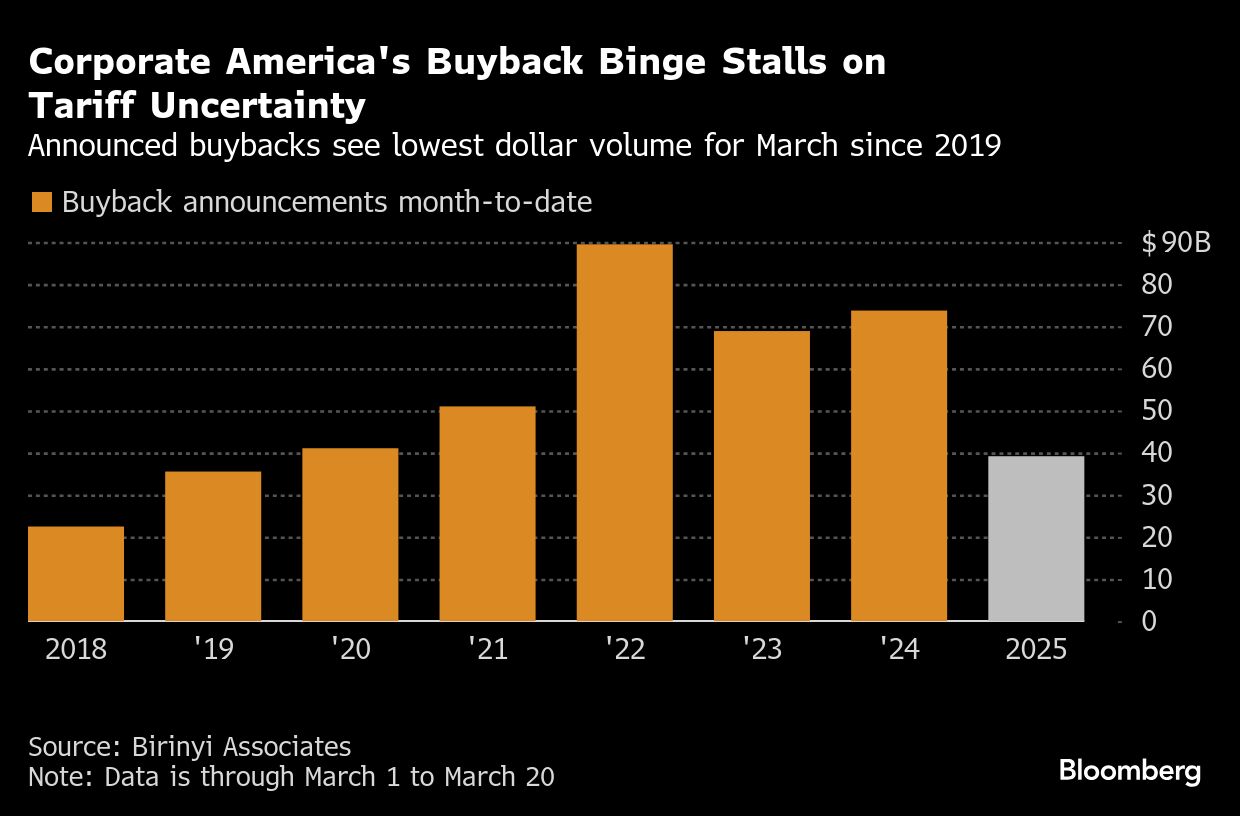
A weak pipeline of planned stock repurchase programs is evidence of waning confidence among corporate executives. And with the Federal Reserve signaling it plans to hold off on interest rate cuts until inflation cools further, a revival in corporate buybacks could be needed for equity markets to rebound.
Corporations, which had been stingy on share buybacks in recent years, resumed their purchases at a blistering pace in 2024, putting up the second-highest annual dollar value on record. The wave of buying was due to stronger than expected earnings and improving operating margins.
But President Donald Trump's tariffs could raise both inflation and unemployment, creating a big challenge for US companies, which had been counting on tax cuts and deregulation to spur growth. And with US trade partners threatening to retaliate and stoke a trade war, it's unclear what the outlook for share repurchases is for this year. Upcoming earnings reports from some of America's biggest companies, starting with JPMorgan Chase & Co. on April 11, are likely to provide the first clues.

-
Talking Points This Week: Tech Nerves, FII Buying, And A Faraway Banking Shock

The global markets are not shining this Diwali. The exception in the large markets is, India.
-
Midterm Rally Lasted A Day. The Hard Reality Of A Divided US May Last Two Years | Opinion
Between a contested AI boom, a debt ceiling that arrives in 2027 and a president with every incentive to act alone, the next two years may prove more volatile than the first day's rally suggests.
-
Blue Wave Will Derail the AI Trade but Won't Dismantle the AI Era | Unhedged Position
The Democrats' sweep of the US Congress will see politics collide with economic forces both over the long and short term.
-
It's Time To Take The GST Council's Bet On Trust Global
Payment records can prove India's services exports, and clear, proportionate rules can bring foreign digital sellers into the tax net.
-
Opinion | India at 38: From Innovation Overperformer to Innovation Powerhouse
India now has 453 VC-backed deep science startups, 18 of them late-stage, after 117 percent growth since 2020. Laurus Labs, at USD 9.3 billion, is the most valuable deep science company in any middle-income economy outside China.
-
Navigating Energy Crossroads: S Jaishankar's Call For Diversified Supply Chains At G20 Ministerial Meeting
As geopolitical fault lines continue to test maritime trade routes and commodity flows, Jaishankar's message remains pertinent: true economic resilience requires open markets, protected transit lines, and a genuine commitment to multilateral cooperation rather than coercion.
-
Indians Are Travelling, But Not Every Journey Is A Holiday | The Week In Whys
Pilgrims, patients and working women are the real travellers, and the system hasn't quite caught up with them.
-
Getting To Work Costs Women More | The Reason Why
It is not just about women paying more than men. It is about women paying much more in cities than in villages.
-
AI Bias In Investing Cannot Be Eliminated, But It Can Be Governed
Framing is a particularly important example as identical financial information presented in terms of gains rather than losses can lead an LLM to reach a different assessment.









