China’s Mixed Economic Data Fuels Concerns About Recovery
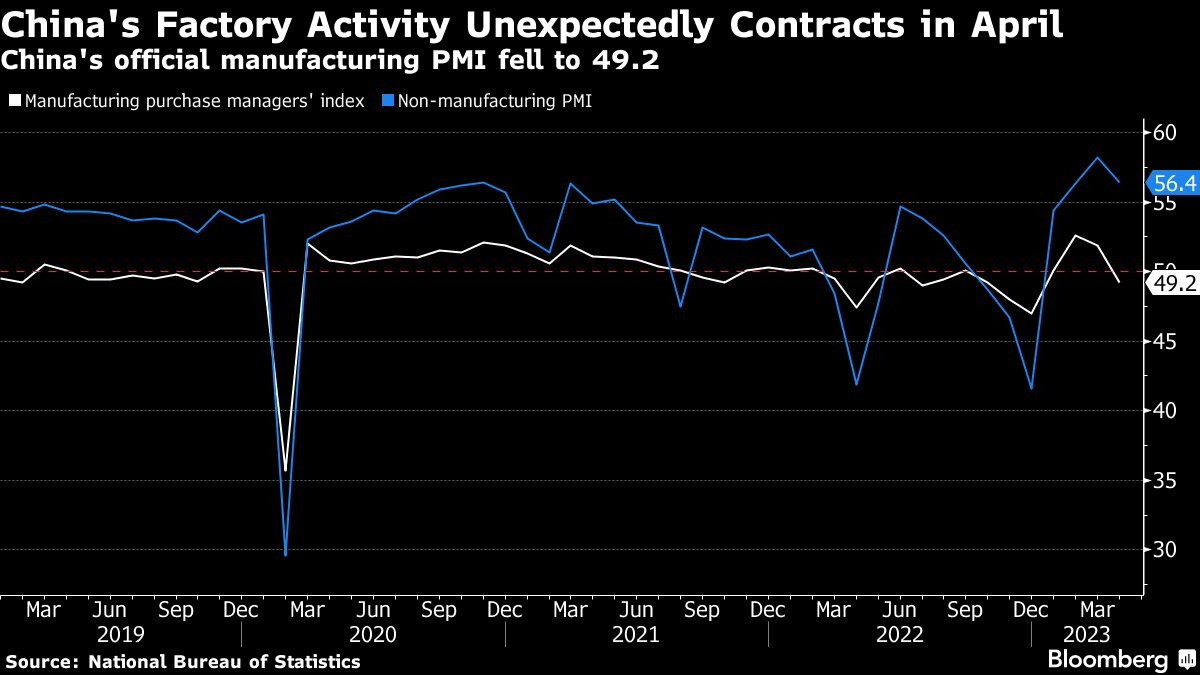
(Bloomberg) -- China's economic recovery remains patchy, with latest indicators pointing to a contraction in manufacturing, while consumers splurge over the holidays and the housing market continues to rebound.
Purchasing managers' indexes released Sunday showed an unexpected decline in factory activity in April, weighed down by weaker global demand for Chinese exports. Chinese consumers, though, continued to spend on travel and shopping.

The data suggest China's recovery remains lopsided, with the production side of the economy lagging the rebound in consumption. That underscores Chinese leaders' cautious growth outlook at a meeting Friday and the need for more policy stimulus.
The mixed PMI figures suggest “China's post-Covid recovery has somewhat lost steam and calls for continued policy support,” said Zhou Hao, chief economist at Guotai Junan International Holdings Ltd.
The Communist Party's Politburo — the top decision-making body led by President Xi Jinping — left its economic policy stance relatively unchanged on Friday, saying the economy still suffers from insufficient demand.
What Bloomberg Economics Says...
The big surprise in China's April PMI survey – manufacturing fell back into contraction — raises doubt about the strength and durability of the recovery. The key factory sector is shrinking despite strong government spending and robust demand in pockets of the services industries. Bottom line: the recovery is probably too narrow to be sustainable — and risks losing steam. This worrisome outlook increases the case for more policy support.
For the full report, click here
Chang Shu and David Qu
The manufacturing PMI index fell to 49.2 from 51.9 in March — the first time since December it was below the 50 mark, which signals a contraction. Sub-indexes for new orders, new export orders and manufacturing employment were all below 50.
A non-manufacturing index of activity in the services and construction sectors slid to 56.4 from 58.2 in March, suggesting still strong expansion in those industries as consumer spending and government expenditure rose.
Holiday spending figures on the first day of the five-day Labor Day break underscored the recovery in consumption.
Some 19.7 million railway trips were made across the country on Saturday, the highest on record for a single day, local media The Paper reported, citing official data. Traffic is expected to be 20% higher than in 2019, before the pandemic struck.
Shoppers were out in force on Saturday too, with major retail and catering companies seeing sales jump 21% from a year ago, according to Ministry of Commerce data cited by state broadcaster CCTV.
The housing market also continues to recover from very weak levels a year ago. The value of new home sales by the 100 biggest real estate developers climbed 31.6% from April last year, according to preliminary data from China Real Estate Information Corp. That compares with a 29.2% increase in March.
The world's second-largest economy expanded at the fastest pace in a year last quarter, with economists expecting growth this quarter to be even stronger. Several major banks raised their annual growth forecasts to about 6% or higher, expecting the economy to outperform Beijing's target of around 5%.
This weekend's data will likely keep policymakers cautious, though.
“These mixed signals will likely keep the pressure on the government to continue its supportive fiscal and monetary policies” in the second quarter, said Zhang Zhiwei, chief economist at Pinpoint Asset Management Ltd.
More stories like this are available on bloomberg.com
©2023 Bloomberg L.P.

-
Ten Things I Learnt This Samvat

Patience can be a trap. Cheap stocks can stay cheap. Leverage can wipe you out. What did Samvat 2082 teach us? Niraj Shah writes on 10 lessons from the year gone by.
-
Talking Points This Week: Tech Nerves, FII Buying, And A Faraway Banking Shock
The global markets are not shining this Diwali. The exception in the large markets is, India.
-
Midterm Rally Lasted A Day. The Hard Reality Of A Divided US May Last Two Years | Opinion
Between a contested AI boom, a debt ceiling that arrives in 2027 and a president with every incentive to act alone, the next two years may prove more volatile than the first day's rally suggests.
-
Blue Wave Will Derail the AI Trade but Won't Dismantle the AI Era | Unhedged Position
The Democrats' sweep of the US Congress will see politics collide with economic forces both over the long and short term.
-
It's Time To Take The GST Council's Bet On Trust Global
Payment records can prove India's services exports, and clear, proportionate rules can bring foreign digital sellers into the tax net.
-
Opinion | India at 38: From Innovation Overperformer to Innovation Powerhouse
India now has 453 VC-backed deep science startups, 18 of them late-stage, after 117 percent growth since 2020. Laurus Labs, at USD 9.3 billion, is the most valuable deep science company in any middle-income economy outside China.
-
Navigating Energy Crossroads: S Jaishankar's Call For Diversified Supply Chains At G20 Ministerial Meeting
As geopolitical fault lines continue to test maritime trade routes and commodity flows, Jaishankar's message remains pertinent: true economic resilience requires open markets, protected transit lines, and a genuine commitment to multilateral cooperation rather than coercion.
-
Indians Are Travelling, But Not Every Journey Is A Holiday | The Week In Whys
Pilgrims, patients and working women are the real travellers, and the system hasn't quite caught up with them.
-
Getting To Work Costs Women More | The Reason Why
It is not just about women paying more than men. It is about women paying much more in cities than in villages.









