China And India Funnel $24 Billion To Putin With Energy Spree
(Bloomberg) -- Russia has pocketed $24 billion from selling energy to China and India in just three months following its invasion of Ukraine, showing how higher global prices are limiting efforts by the US and Europe to punish President Vladimir Putin.
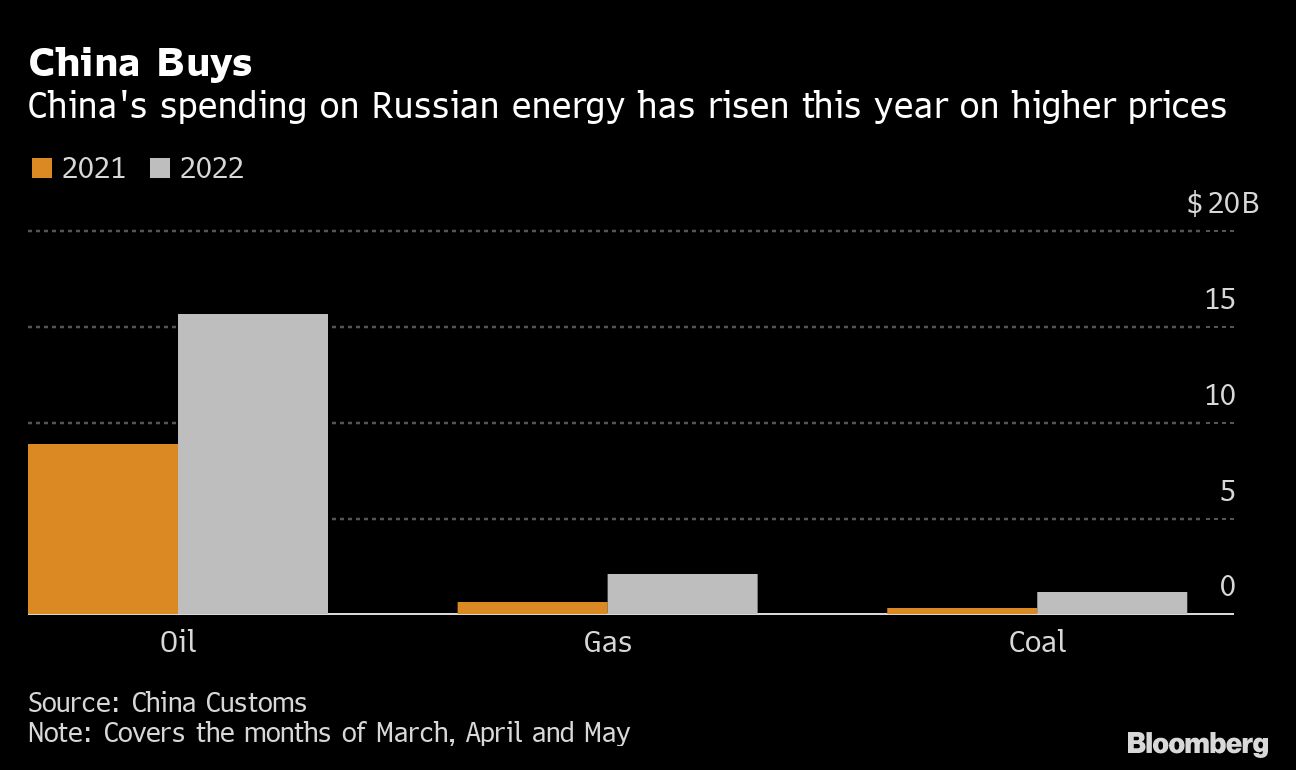
China spent $18.9 billion on Russian oil, gas and coal in the three months to the end of May, almost double the amount a year earlier, latest customs data show. Meanwhile, India shelled out $5.1 billion in the same period, more than five times the value of a year ago. That's an extra $13 billion in revenue from both countries compared to the same months in 2021.

The higher spending is helping make up for decreased purchases from the US and some other nations that have halted or slowed buying to punish Russia for the war. The bans have sent prices for alternative supplies soaring and spurred crippling inflation that threatens to send major economies into recession.
“China is already buying essentially everything that Russia can export via pipelines and Pacific ports,” said Lauri Myllyvirta, lead analyst at the Centre for Research on Energy and Clean Air, who has been tracking Russian energy flows since the war broke out. “India has been the main buyer of the cargoes out of the Atlantic that Europe doesn't want anymore.”

That spree is unlikely to end anytime soon, with energy prices much higher than they were at this time last year, even accounting for the steep discounts to global benchmarks Russia is offering to entice purchasers. On a volume basis, China's imports continued a slow uptick in June, while India may have incentive to boost purchases even further in the coming months as a European Union ban on Russian oil takes effect, Myllyvirta said.
China and India still trail Europe as a bloc in terms of overall sales this year, according to Myllyvirta's research. Europe's purchases will continue to shrink, though, as import bans on coal and oil come into effect and as Russia cuts off gas supplies to some European buyers.
Russia has long-standing trade and strategic relationships with China and India, and along with offering steep price discounts is also accepting payments in local currency to help keep trade flows to the countries strong this year.

China is the world's biggest energy importer and has dedicated pipelines for Siberian oil and gas. Even as its energy consumption was curbed over the first half of 2022 -- partly due to Covid-19 lockdowns -- it spent far more on Russian energy due to higher prices and small increases in volumes.
India's increase in spending after the war has been far more dramatic, as it doesn't share a land border with Russia and its ports are normally too far away for cost-efficient shipping. In addition to big jumps in oil and coal, India also imported three cargoes of Russian liquefied natural gas since the war began, compared to one in the same period last year, according to Bloomberg ship-tracking data.

“Historically, India has taken very little Russian oil, but the war in Ukraine and Russian-origin oil embargoes by the Europe Union have led to a rebalancing in oil trade flows,” Wei Cheong Ho, a Rystad Energy analyst, said in a research note last month.
More stories like this are available on bloomberg.com
©2022 Bloomberg L.P.

-
A New Samvat Wishlist: Inclusive Prosperity And Human Development

India has strengthened its economic foundations through infrastructure, digital access and enterprise. Its next growth chapter must deepen productivity, create better livelihoods and widen participation in prosperity.
-
Love, Sex Aur Dhokha: The Audacious Plot To Spy On Jensen Huang
A Taipei dinner, a Singapore chip buyer and a suspected Chinese asset: inside the alleged spy operation that got close to NVIDIA's Jensen Huang.
-
Ten Things I Learnt This Samvat
Patience can be a trap. Cheap stocks can stay cheap. Leverage can wipe you out. What did Samvat 2082 teach us? Niraj Shah writes on 10 lessons from the year gone by.
-
Talking Points This Week: Tech Nerves, FII Buying, And A Faraway Banking Shock
The global markets are not shining this Diwali. The exception in the large markets is, India.
-
Midterm Rally Lasted A Day. The Hard Reality Of A Divided US May Last Two Years | Opinion
Between a contested AI boom, a debt ceiling that arrives in 2027 and a president with every incentive to act alone, the next two years may prove more volatile than the first day's rally suggests.
-
Blue Wave Will Derail the AI Trade but Won't Dismantle the AI Era | Unhedged Position
The Democrats' sweep of the US Congress will see politics collide with economic forces both over the long and short term.
-
It's Time To Take The GST Council's Bet On Trust Global
Payment records can prove India's services exports, and clear, proportionate rules can bring foreign digital sellers into the tax net.
-
Opinion | India at 38: From Innovation Overperformer to Innovation Powerhouse
India now has 453 VC-backed deep science startups, 18 of them late-stage, after 117 percent growth since 2020. Laurus Labs, at USD 9.3 billion, is the most valuable deep science company in any middle-income economy outside China.
-
Navigating Energy Crossroads: S Jaishankar's Call For Diversified Supply Chains At G20 Ministerial Meeting
As geopolitical fault lines continue to test maritime trade routes and commodity flows, Jaishankar's message remains pertinent: true economic resilience requires open markets, protected transit lines, and a genuine commitment to multilateral cooperation rather than coercion.









