Charting the Global Economy: Factories Slow Down From US to Asia
(Bloomberg) --
Manufacturing from the US to Asia is very much in a slowdown as factories continue to struggle with supply snarls, labor shortages and elevated materials costs.
A measure of US manufacturing activity weakened in June to a two-year low, and several regional Federal Reserve surveys indicated business activity shrank. Factory purchasing managers' gauges across Asia eased, with South Korea, Thailand and India among those showing the biggest declines, according to S&P Global.
Similar indexes in Poland, Spain and Italy also showed weaker activity compared to May.
Here are some of the charts that appeared on Bloomberg this week on the latest developments in the global economy:
US

Consumer spending fell in May for the first time this year and prior months were revised lower, suggesting an economy on somewhat weaker footing than previously thought amid rapid inflation and Fed interest-rate hikes.

Regional Fed manufacturing surveys have taken on a grimmer tone, with four of five indicating business activity shrank in June. Separately, a measure of overall manufacturing slid to a two-year low as new orders contracted, restrained by lingering supply constraints and some softening in demand.

The pandemic housing boom is careening to a halt as the fastest-rising mortgage rates in at least half a century upend affordability for homebuyers, catching many sellers wrong-footed with prices that are too high.
Europe

Confidence in the euro-area economy slipped as households become more pessimistic amid fears a Russian energy cutoff will spark a recession. At the same time, they're less worried about inflation than they were a month ago, though there's a split between core and peripheral euro-area countries.

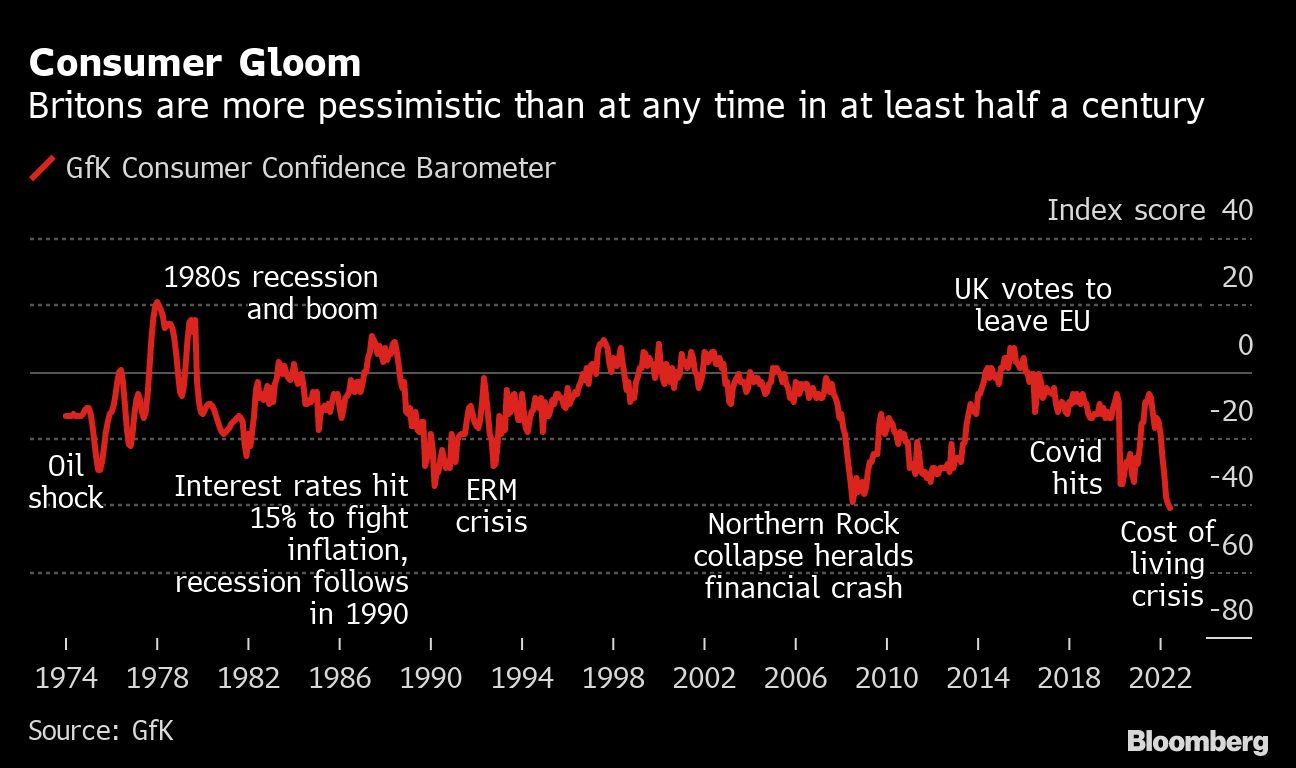
After suffering from unprecedented shocks in recent years, the UK is succumbing to more intractable problems marked by plodding growth, surging inflation and a series of damaging strikes.
Asia

China's economy showed some improvement in June as Covid restrictions were gradually eased, although the recovery remains muted. That's the outlook based on Bloomberg's aggregate index of eight early indicators for this month. The overall gauge returned to the neutral level after deteriorating for two straight months.

Japan's factory output shrank at the fastest pace since the height of the pandemic as the lagged impact of China's virus lockdowns continued to disrupt supply chains and economic activity in the region. The weakness in manufacturing extended across Asia, particularly in South Korea, Thailand, India and Taiwan.
Emerging Markets

Colombia's central bank delivered its biggest interest rate increase in over two decades. Policy makers are bracing for another spike in annual inflation that's already above 9%.

Two years after Argentina emerged from its latest default, a debt crisis in brewing once again. This time, the immediate trouble is in the local bond market, where creditors have become reluctant to roll over maturing government bonds.

Zambia's inflation rate dropped below 10% for the first time in almost three years in June, bucking a global trend of record consumer-price growth. Optimism over the nation's economy since the election of Hakainde Hichilema as president in August, a potential debt restructuring and a $1.4 billion bailout package from the International Monetary Fund has seen a rally in the local currency, which has helped contain prices.
World

Differences in underlying inflation trends call for different policy outlooks among the world's top central banks, according to Bloomberg Economics. The Fed will have to go well into restrictive territory, the Bank of England may go a little above neutral and the European Central Bank might not even get that far.
More stories like this are available on bloomberg.com
©2022 Bloomberg L.P.

-
A New Samvat Wishlist: Inclusive Prosperity And Human Development

India has strengthened its economic foundations through infrastructure, digital access and enterprise. Its next growth chapter must deepen productivity, create better livelihoods and widen participation in prosperity.
-
Love, Sex Aur Dhokha: The Audacious Plot To Spy On Jensen Huang
A Taipei dinner, a Singapore chip buyer and a suspected Chinese asset: inside the alleged spy operation that got close to NVIDIA's Jensen Huang.
-
Ten Things I Learnt This Samvat
Patience can be a trap. Cheap stocks can stay cheap. Leverage can wipe you out. What did Samvat 2082 teach us? Niraj Shah writes on 10 lessons from the year gone by.
-
Talking Points This Week: Tech Nerves, FII Buying, And A Faraway Banking Shock
The global markets are not shining this Diwali. The exception in the large markets is, India.
-
Midterm Rally Lasted A Day. The Hard Reality Of A Divided US May Last Two Years | Opinion
Between a contested AI boom, a debt ceiling that arrives in 2027 and a president with every incentive to act alone, the next two years may prove more volatile than the first day's rally suggests.
-
Blue Wave Will Derail the AI Trade but Won't Dismantle the AI Era | Unhedged Position
The Democrats' sweep of the US Congress will see politics collide with economic forces both over the long and short term.
-
It's Time To Take The GST Council's Bet On Trust Global
Payment records can prove India's services exports, and clear, proportionate rules can bring foreign digital sellers into the tax net.
-
Opinion | India at 38: From Innovation Overperformer to Innovation Powerhouse
India now has 453 VC-backed deep science startups, 18 of them late-stage, after 117 percent growth since 2020. Laurus Labs, at USD 9.3 billion, is the most valuable deep science company in any middle-income economy outside China.
-
Navigating Energy Crossroads: S Jaishankar's Call For Diversified Supply Chains At G20 Ministerial Meeting
As geopolitical fault lines continue to test maritime trade routes and commodity flows, Jaishankar's message remains pertinent: true economic resilience requires open markets, protected transit lines, and a genuine commitment to multilateral cooperation rather than coercion.









