Britain Set to Break From Eurozone With Cooling Core Inflation
(Bloomberg) -- Britain's underlying price pressures are set to diverge with those in the eurozone, with signs of cooling inflation intensifying the debate over whether the Bank of England should halt its cycle of interest rate increases.
Forecasters expect figures due Wednesday will show core inflation – which excludes volatile food and energy prices – easing to 5.7% in February from 5.8% the month before. A second straight cooling in the UK contrasts with the nations sharing the euro, where core inflation has picked up in each of the last three months.
The figures will feed into the BOE's knife-edge decision over whether to back another rate rise on Thursday. Expectations for a quarter-point hike from the current 4% faded rapidly last week after the troubles at Silicon Valley Bank and Credit Suisse Group AG rattled markets worldwide.
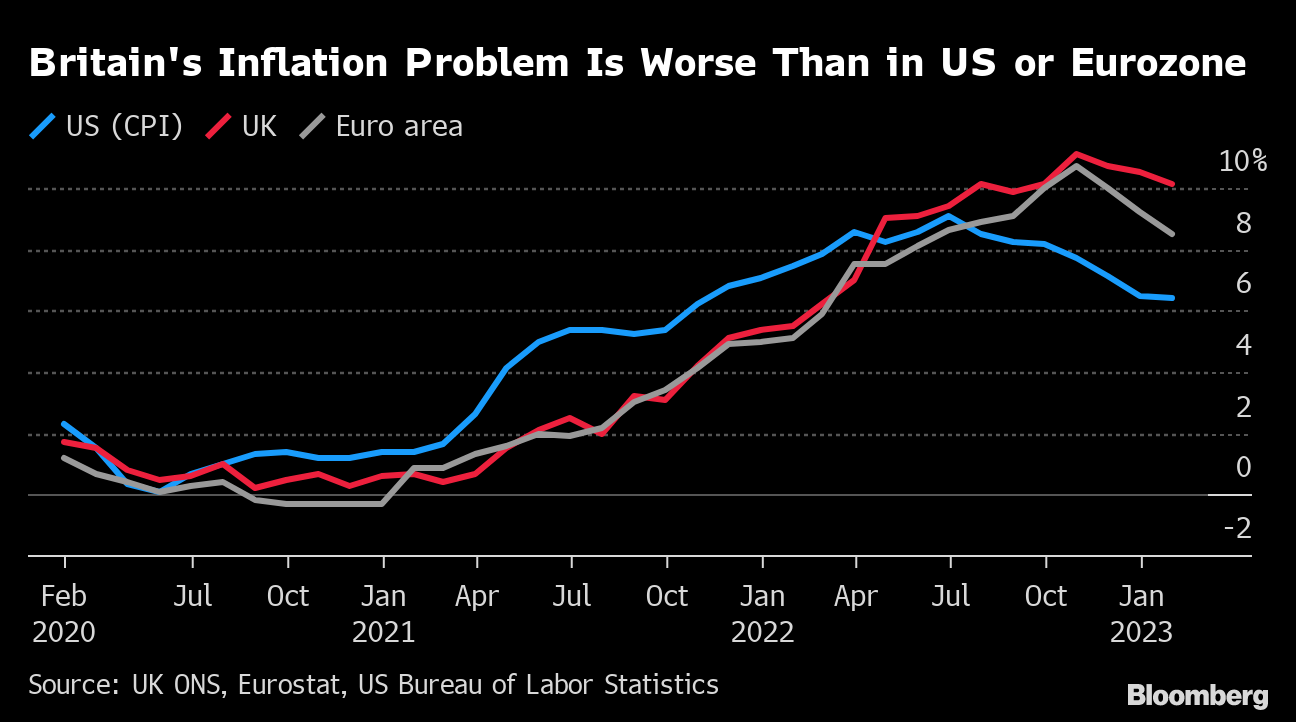
Forecasters have also predicted that Wednesday's data will show the headline rate of inflation edging down into single digits for the first time in six months, falling to 9.9%.
“Core services CPI inflation and private-sector wage growth have undershot the Monetary Policy Committee's forecast, while financial conditions have tightened markedly since the MPC's last meeting in early February,” said Samuel Tombs, chief UK economist at Pantheon Macroeconomics. “We think that the committee will vote 6-3 in favour of keeping Bank Rate at 4%.”
Most economists expect the BOE's nine-strong Monetary Policy Committee to push ahead with a quarter-point increase to 4.25% at Thursday's meeting. That decision, which was near certain two weeks ago, now is on a knife edge with money markets putting the chances close to 50-50.
Investors are leaning toward just one more hike this year, a sharp retrenchment from expectations earlier this month that rates could hit 5%.
The BOE's decision is due just a day after the US Federal Reserve's meeting, where market concerns also are set to dominate. While the European Central Bank shrugged off the turmoil to press ahead with a rate rise last week, the BOE could take its cue from the US central bank's decision on Wednesday.
BOE Governor Andrew Bailey was already striking a more dovish tone than his counterparts at the Fed and ECB even before financial stability concerns spiked.
“Heightened financial stability risks with the collapse of Silicon Valley Bank and emerging uncertainty around global banking stability may warrant a more measured response,” said Sanjay Raja, chief UK economist at Deutsche Bank. The BOE could “err on the side of caution” and leave its key rate unchanged.
BOE officials expect inflation to fall rapidly this year after hitting a peak of 11.1% in October, which marked the highest in 41 years.
Morgan Stanley UK economist Bruna Skarica predicted that the BOE will hold policy steady and pointed to recent inflation data suggesting that “the disinflationary process has started in the UK.”
Others see a hike as the most likely outcome this week, despite falling inflation.
“We currently expect a majority of the MPC to vote for a 25 basis point rise this month,” said Andrew Goodwin, chief UK economist at Oxford Economics. “Much depends on market movements over the next few days. If markets worsen, a rate rise could be delayed to May or canceled altogether.”
Ross Walker at NatWest thinks it's conceivable that rates remain unchanged but “we expect more conventional macroeconomic considerations will prevail” and deliver an increase.
Forecasters at Goldman Sachs even expect inflation to be below the BOE's 2% target by the end of the year.
--With assistance from and .
More stories like this are available on bloomberg.com
©2023 Bloomberg L.P.

-
Blue Wave Will Derail the AI Trade but Won't Dismantle the AI Era | Unhedged Position

The Democrats' sweep of the US Congress will see politics collide with economic forces both over the long and short term.
-
It's Time To Take The GST Council's Bet On Trust Global
Payment records can prove India's services exports, and clear, proportionate rules can bring foreign digital sellers into the tax net.
-
Opinion | India at 38: From Innovation Overperformer to Innovation Powerhouse
India now has 453 VC-backed deep science startups, 18 of them late-stage, after 117 percent growth since 2020. Laurus Labs, at USD 9.3 billion, is the most valuable deep science company in any middle-income economy outside China.
-
Navigating Energy Crossroads: S Jaishankar's Call For Diversified Supply Chains At G20 Ministerial Meeting
As geopolitical fault lines continue to test maritime trade routes and commodity flows, Jaishankar's message remains pertinent: true economic resilience requires open markets, protected transit lines, and a genuine commitment to multilateral cooperation rather than coercion.
-
Indians Are Travelling, But Not Every Journey Is A Holiday | The Week In Whys
Pilgrims, patients and working women are the real travellers, and the system hasn't quite caught up with them.
-
Getting To Work Costs Women More | The Reason Why
It is not just about women paying more than men. It is about women paying much more in cities than in villages.
-
AI Bias In Investing Cannot Be Eliminated, But It Can Be Governed
Framing is a particularly important example as identical financial information presented in terms of gains rather than losses can lead an LLM to reach a different assessment.
-
Joining The Dots | Dark Skies, Steady Diya: Why Hope Holds This Diwali
With war, a weak rupee and foreign outflows weighing on sentiment, policymakers at the NDTV World Summit and market veterans at NDTV Profit Ignite: Diwali Edition offered the same advice: stay invested and filter out the noise.
-
The Curious Case of Equitas Small Finance Bank And A CEO Who Quit For Stock
PN Vasudevan believes persistent investor concerns over a perceived conflict of interest had become a governance overhang on Equitas Small Finance Bank's stock, even as the lender improved profitability and asset quality.










