Russia Rushes To Sell $1.5 Billion As Eurobond Payment Nears
(Bloomberg) -- Russia's central bank will offload 150 billion rubles ($1.5 billion) of foreign exchange in the domestic market, in what it said is a temporary acceleration of previously planned sales that should take some pressure off the ruble after one of the biggest depreciations among emerging economies.
The Bank of Russia said it may need to meet demand for hard currency from a repayment of Eurobonds this month and now plans to boost almost 10-fold its daily “mirroring operations” linked to investments from the government's wealth fund. It will sell 21.4 billion rubles worth of foreign currency per day during Sept. 14-22, according to a statement Wednesday.
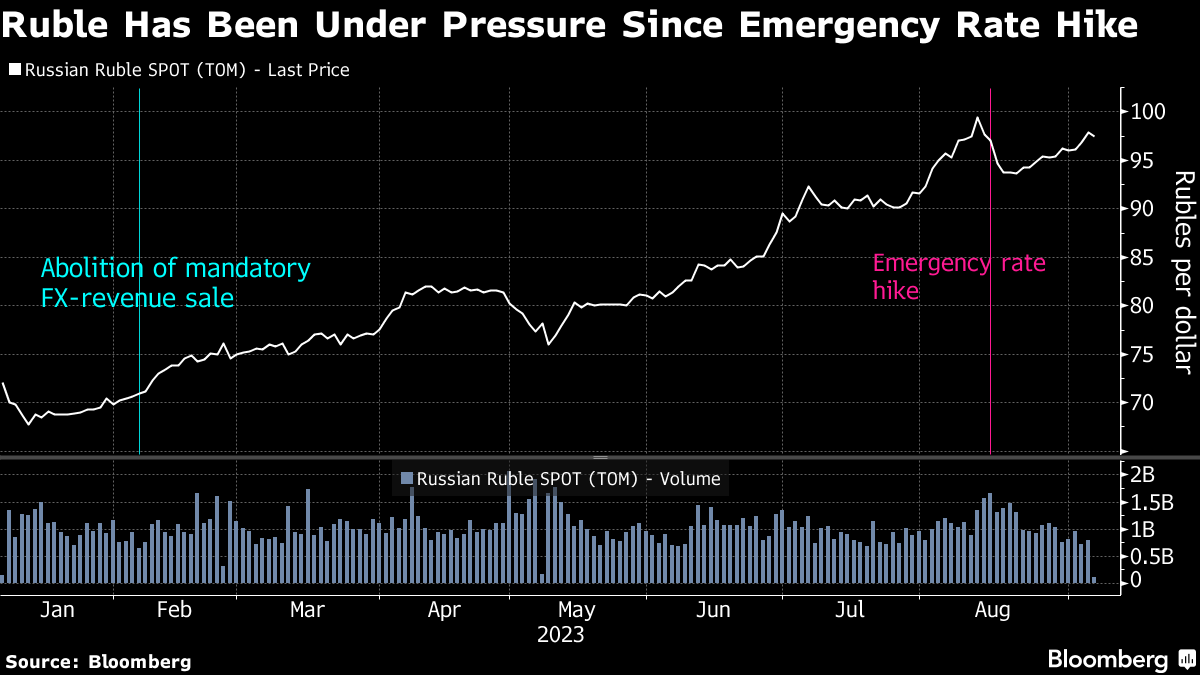
The announcement briefly helped the ruble, which has been depreciating since an emergency meeting on interest rates in August, extend gains versus the dollar. The Russian currency was down 0.2% versus the greenback as of 2:57 p.m. in Moscow.
Russia's $3 billion Eurobond is coming due on Sept. 16, according to the central bank. Although most holders will receive a payment in rubles, it said some of them may then seek out hard currency.
“Under these conditions, the decision to redistribute foreign currency sales as part of mirroring transactions related to investing” from the National Wellbeing Fund “will help meet possible additional demand for foreign currency and reduce volatility in the foreign-exchange market during this period,” the Bank of Russia said.
As the ruble came under intense selling pressure last month, the central bank announced it would refrain from foreign-exchange purchases for the rest of this year and then delivered a steep rate hike.
What Bloomberg Economics Says...
“The Bank of Russia's decision does not address the root causes of the ruble rout: excessive policy rate cuts and outsized budget spending, which drive capital outflow and expansion of imports. The decision to sell yuan by the central bank may reduce volatility in the coming weeks, but is unlikely to break the depreciation trend.”
—Alexander Isakov, Russia economist.
The Russian currency's brief plunge past 100 per dollar in August also revived a debate in Moscow about capital controls, with officials opting for informal measures to ensure enough foreign exchange is available in the domestic market.
The bulk of Russia's international reserves are frozen by US and European sanctions, leaving the yuan as the main asset the central bank can still use to conduct operations in the currency market.
The ruble is among the worst performers in emerging markets in 2023 after losing about a quarter of its value against the dollar. It's suffered from a deterioration in foreign trade amid a raft of international sanctions over the Kremlin's war in Ukraine.
The central bank's decision is unlikely to be part of an effort to keep the ruble from weakening past 100 versus the greenback, according to Olga Belenkaya, economist at Finam in Moscow. Since it's now conducting operations in the Chinese currency, any impact on the ruble's exchange rate against the dollar will be indirect, she said.
“This is a very short-term measure, and by itself it cannot affect the ruble exchange rate for a long time,” Belenkaya said.
(Updates with ruble performance, central bank comments starting in third paragraph.)
More stories like this are available on bloomberg.com
©2023 Bloomberg L.P.

-
Navigating Energy Crossroads: S Jaishankar's Call For Diversified Supply Chains At G20 Ministerial Meeting

As geopolitical fault lines continue to test maritime trade routes and commodity flows, Jaishankar's message remains pertinent: true economic resilience requires open markets, protected transit lines, and a genuine commitment to multilateral cooperation rather than coercion.
-
Indians Are Travelling, But Not Every Journey Is A Holiday | The Week In Whys
Pilgrims, patients and working women are the real travellers, and the system hasn't quite caught up with them.
-
Getting To Work Costs Women More | The Reason Why
It is not just about women paying more than men. It is about women paying much more in cities than in villages.
-
AI Bias In Investing Cannot Be Eliminated, But It Can Be Governed
Framing is a particularly important example as identical financial information presented in terms of gains rather than losses can lead an LLM to reach a different assessment.
-
Joining The Dots | Dark Skies, Steady Diya: Why Hope Holds This Diwali
With war, a weak rupee and foreign outflows weighing on sentiment, policymakers at the NDTV World Summit and market veterans at NDTV Profit Ignite: Diwali Edition offered the same advice: stay invested and filter out the noise.
-
The Curious Case of Equitas Small Finance Bank And A CEO Who Quit For Stock
PN Vasudevan believes persistent investor concerns over a perceived conflict of interest had become a governance overhang on Equitas Small Finance Bank's stock, even as the lender improved profitability and asset quality.
-
Talking Points This Week: AI Cash Burn, A Tiger Comeback And An India That Still Finds Its Own Path
India is not immune to higher oil or tighter global liquidity, yet its earnings base is broader, its domestic policy levers are still available.
-
Foreign Investors Own Half Of HDFC Bank and ICICI Bank. An LTCG Cut Could Matter Most Here
Foreign portfolio investors have US$115 billion parked in HDFC Bank, ICICI Bank. If the government cuts long-term capital gains tax, Jefferies says returning foreign money could land here first.
-
'Never Seen This Level Of Negativity': Sandeep Tandon Says The Next Rally May Be Closer Than You Think
Veteran investor Sandeep Tandon says foreign selling is easing, large-caps are due a comeback and mid-caps are crowded, while he turns positive on gold, power and pharma this Diwali.
-
Indians Stay With Family, Not In Hotels | The Reason Why
India still lacks enough clean, reliable and affordable hotels for budget-conscious travellers.










