Australia Raises Key Rate, Signals More Hikes To Come
(Bloomberg) -- Australia's central bank raised interest rates by a quarter-percentage point and signaled further tightening to come as it combats escalating inflation.
The Reserve Bank's board lifted the cash rate to 2.85% from 2.6%, the highest level since April 2013, in a result widely expected by economists. The decision underlined the RBA's pivot away from outsized hikes last month.
“The board has increased interest rates materially since May,” RBA Governor Philip Lowe said in his post-meeting statement. “The board expects to increase interest rates further over the period ahead. It is closely monitoring the global economy, household spending and wage and price-setting behavior.”
The central bank lowered its outlook for economic growth in response to higher rates. The Aussie dollar dropped briefly after the announcement before rebounding, while 3-year bond yields declined about 8 basis points to 3.30%. The benchmark stock index extended gains to as much as 1.3%.
“The tone of the statement was probably not as hawkish as I expected,” said David Plank, head of Australian economics at Australia & New Zealand Banking Group Ltd.
“The RBA is now prepared to tolerate inflation above target for a longer period. So there's really a key focus on keeping the economy on an even keel. Markets will be pondering the credibility of that.”
The RBA's consecutive quarter-point moves contrast with the Federal Reserve and Bank of England, which are forecast to unleash 75 basis-point hikes this week.
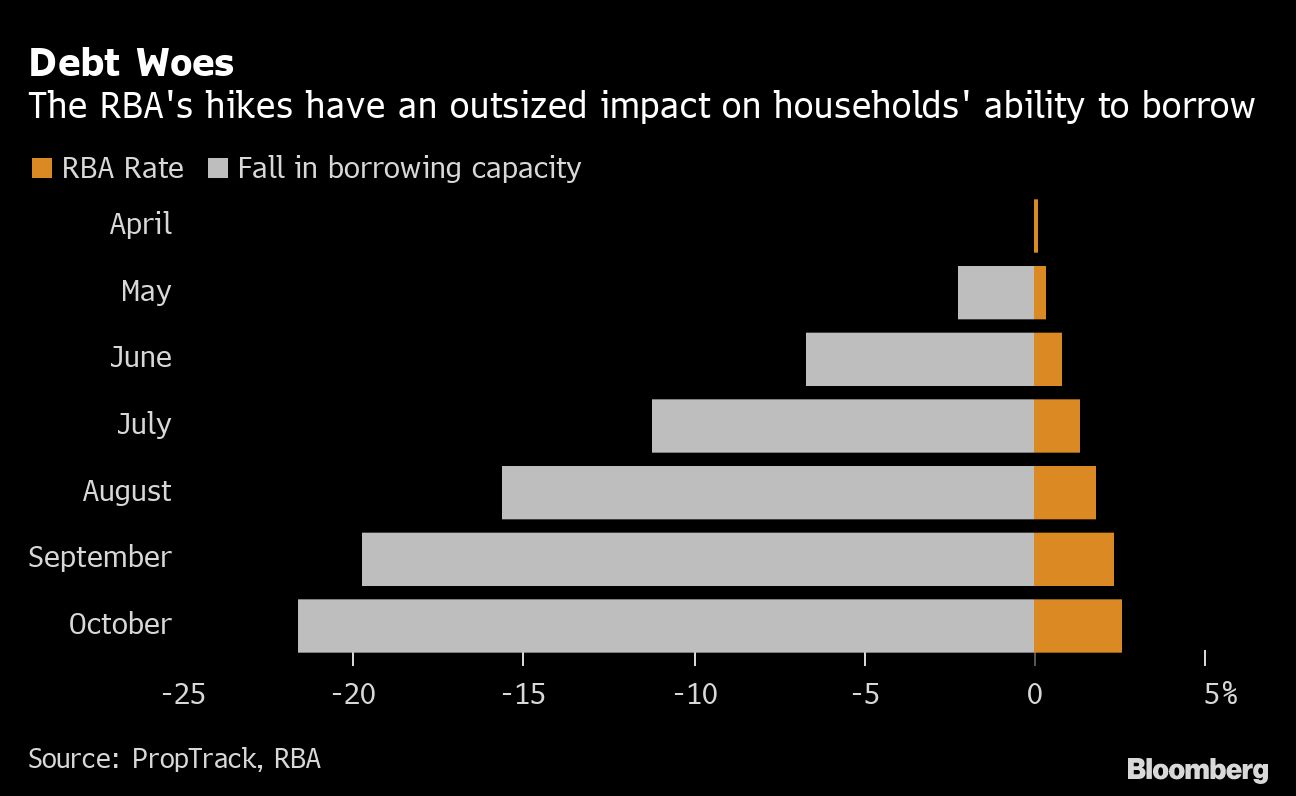
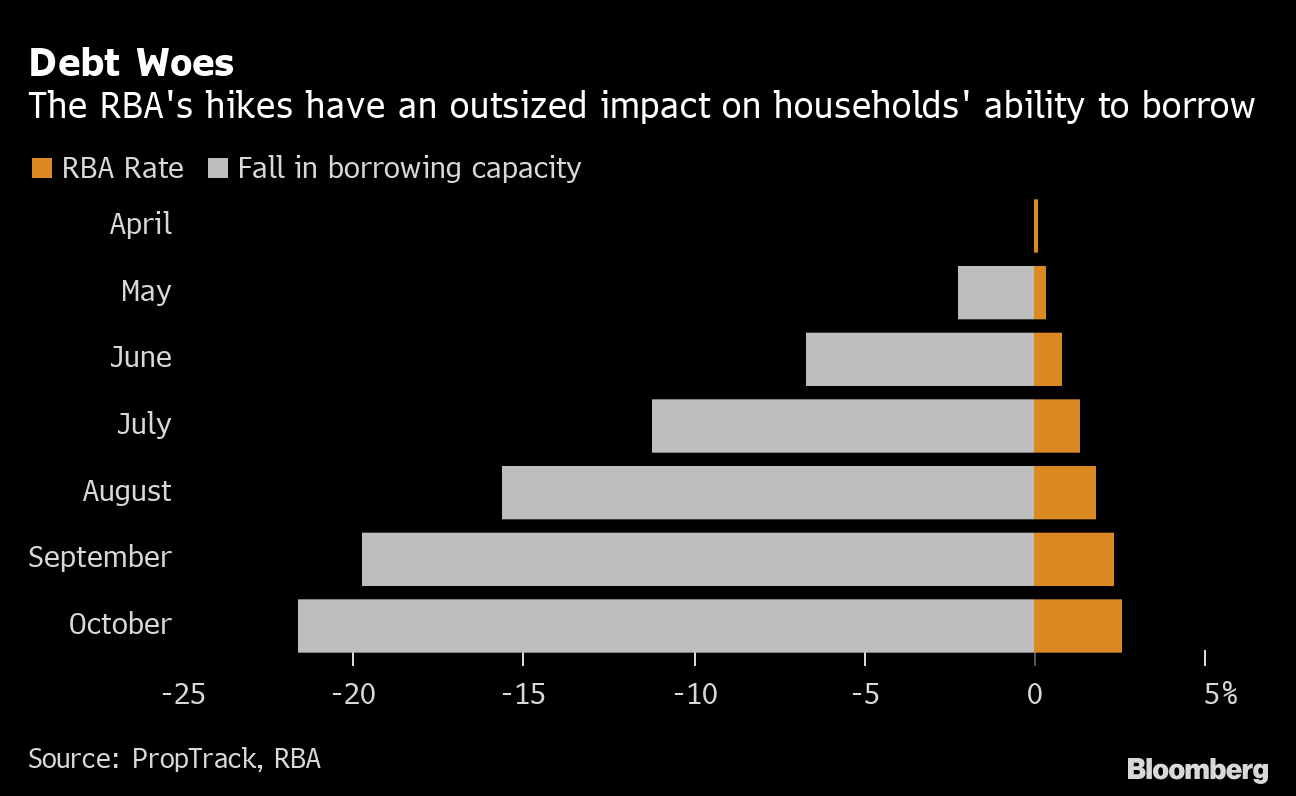
One reason for the RBA's difference is it meets more frequently -- every month bar January -- allowing it to move in smaller increments. Lowe is also mindful of the impact of higher borrowing costs on a household sector that's struggling under a debt-to-income ratio of 187%.
About 60% of Australian mortgages are also on variable rates, while fixed rates are typically for only two- to three years, unlike the US where 90% of home loans are fixed for 30 years.
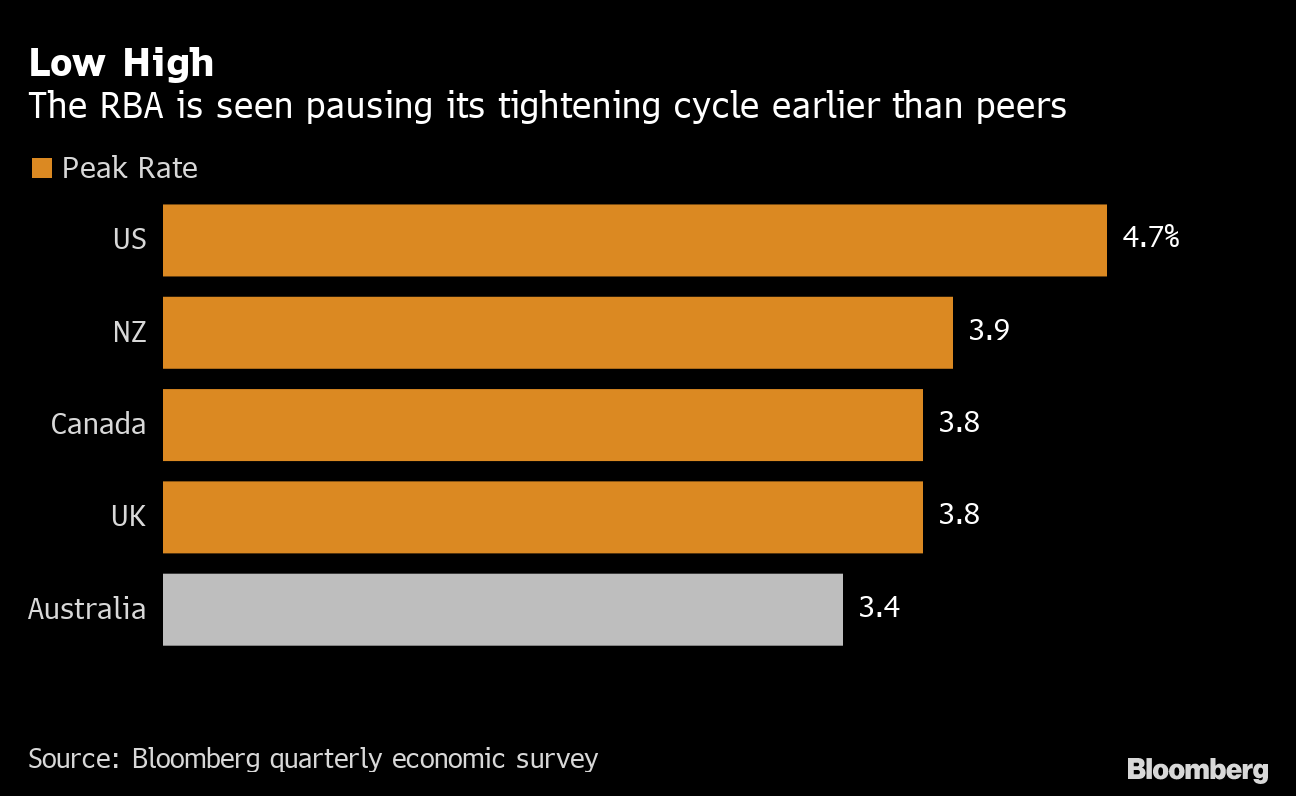
Money market pricing implies a peak in the cash rate of just under 4% by mid-2023, while economists expect a more cautious RBA will halt at around 3.5%.
So far, Australia's heavily indebted households have proved resilient to higher borrowing costs and a spike in living costs. Data Monday showed retail sales rose more than expected in September. Job ads also remain high, indicating further falls in unemployment that's already hovering near a 50-year low.
The RBA provided some headline numbers from its quarterly update of economic forecasts that will be released in full on Friday. The central bank now expects inflation to peak at around 8% later this year, slightly up from a previous 7.75%. That comes after much-hotter than expected third-quarter CPI last week of 7.3%.
It also lowered its economic growth forecast to around 3% this year and 1.5% in 2023 and 2024. As a result, unemployment is expected to rise gradually to “a little above” 4% in 2024.
Economists predict a sharp slowdown in Australia's A$2.2 trillion ($1.4 trillion) economy in the year ahead. Lowe has acknowledged that policy makers face a narrow path as they navigate a complex set of headwinds.
A key risk is an accelerating downturn in the housing market. Data Tuesday showed prices declined in every major city last month in response to rising rates and expectations of further policy tightening ahead.
Still, Treasurer Jim Chalmers played his part for the central bank last week by showing spending restraint in his first budget.
The RBA has highlighted an additional reason for drawing out its tightening cycle with smaller increases, saying last month this would “help to keep public attention focused for a longer period on the board's resolve to return inflation to target.”
The bank targets inflation of 2-3% over time.
--With assistance from , , and .
(Adds economic forecasts, market reaction, comment from economist.)
More stories like this are available on bloomberg.com
©2022 Bloomberg L.P.

-
It's Time To Take The GST Council's Bet On Trust Global

Payment records can prove India's services exports, and clear, proportionate rules can bring foreign digital sellers into the tax net.
-
Opinion | India at 38: From Innovation Overperformer to Innovation Powerhouse
India now has 453 VC-backed deep science startups, 18 of them late-stage, after 117 percent growth since 2020. Laurus Labs, at USD 9.3 billion, is the most valuable deep science company in any middle-income economy outside China.
-
Navigating Energy Crossroads: S Jaishankar's Call For Diversified Supply Chains At G20 Ministerial Meeting
As geopolitical fault lines continue to test maritime trade routes and commodity flows, Jaishankar's message remains pertinent: true economic resilience requires open markets, protected transit lines, and a genuine commitment to multilateral cooperation rather than coercion.
-
Indians Are Travelling, But Not Every Journey Is A Holiday | The Week In Whys
Pilgrims, patients and working women are the real travellers, and the system hasn't quite caught up with them.
-
Getting To Work Costs Women More | The Reason Why
It is not just about women paying more than men. It is about women paying much more in cities than in villages.
-
AI Bias In Investing Cannot Be Eliminated, But It Can Be Governed
Framing is a particularly important example as identical financial information presented in terms of gains rather than losses can lead an LLM to reach a different assessment.
-
Joining The Dots | Dark Skies, Steady Diya: Why Hope Holds This Diwali
With war, a weak rupee and foreign outflows weighing on sentiment, policymakers at the NDTV World Summit and market veterans at NDTV Profit Ignite: Diwali Edition offered the same advice: stay invested and filter out the noise.
-
The Curious Case of Equitas Small Finance Bank And A CEO Who Quit For Stock
PN Vasudevan believes persistent investor concerns over a perceived conflict of interest had become a governance overhang on Equitas Small Finance Bank's stock, even as the lender improved profitability and asset quality.
-
Talking Points This Week: AI Cash Burn, A Tiger Comeback And An India That Still Finds Its Own Path
India is not immune to higher oil or tighter global liquidity, yet its earnings base is broader, its domestic policy levers are still available.










