Arctic Sea Ice Shrinks To Record Winter Low As Earth Heats Up
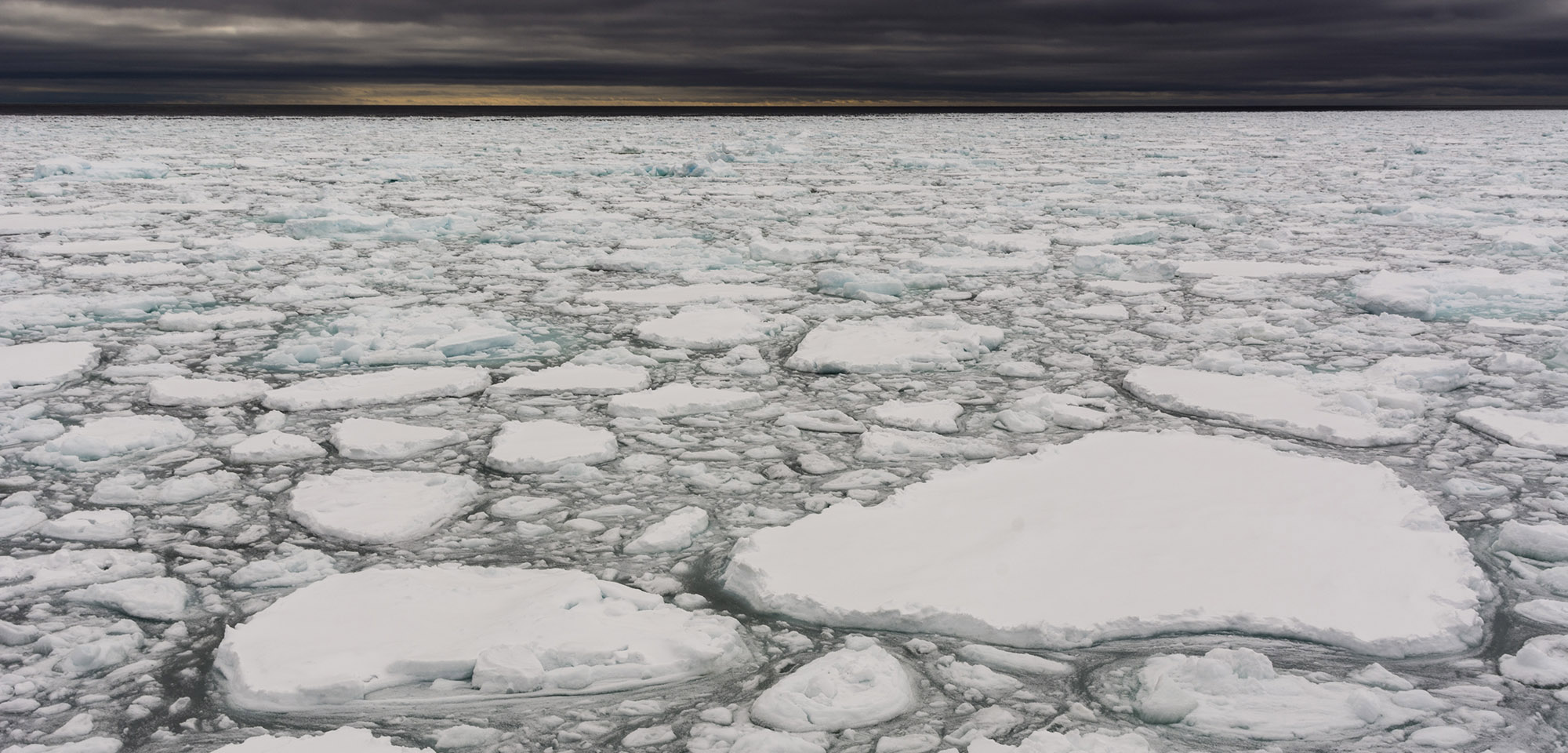
The Arctic Ocean likely had the smallest winter ice cover in 47 years of satellite records this season, with just 5.53 million square miles of sea ice covering the region at its peak on March 22.
That's 510,000 square miles less than the median coverage at other March peaks between 1981 and 2010, according to the National Snow & Ice Data Center at the University of Colorado at Boulder — a reduction equivalent to an area larger than Peru.

Arctic winter ice typically reaches its broadest expanse in March, after which it begins a slow melt over the spring and summer months, shrinking to its smallest area, or minimum extent, in September.
The previous record winter low occurred in 2017. The new record is still a preliminary finding but is unlikely to change, Mark Serreze, the center's director, said.
Last year was the hottest year on record and the loss of Arctic ice threatens to accelerate feedback loops involved in climate change. Warmer, darker, more open ocean waters absorb solar energy that would otherwise be reflected by ice, trapping more heat.
“Every year we're increasing the amount of heat that is stored in the Arctic Ocean,” said Penny Vlahos, a climate scientist at the University of Connecticut.
Since global weather patterns are driven by temperature differences between the planet's higher and lower latitudes, a faster-warming Arctic could lead to more unpredictable weather, Vlahos said.
“The analogy I use is that the Arctic is the ice in our cooler,” she said. “When the ice is gone in your cooler, you no longer have refrigeration and that's exactly what's happening to us. That ice in the Arctic and the Antarctic is the buffer in our system, and when you lose that, you are subject to much more extreme weather.”
The dwindling of sea ice also has geopolitical and security ramifications as it opens up the Arctic to more shipping and potential military uses. Earlier today, Russian President Vladimir Putin said he expects cargo shipments via the Northern Sea Route to reach 70 million to 100 million tons by 2030, compared with almost 38 million tons last year.
Serreze said levels of winter ice this low could compound the decline of the region's summer sea ice, which is expected to disappear as early as the next decade.
“We used to think starting off on a bad footing” ahead of the Arctic summer “didn't necessarily mean a very low September sea ice extent,” said Serreze. More snowfall in the spring, for example, could help the resilience of the summer ice cover. But now, he said, “we're thinking maybe it does. That's because it's so much warmer and the ice is so much thinner than it used to be.”
Each year, as the Arctic winter sea ice builds to a peak, sea ice on the opposite pole shrinks during the Southern Hemisphere's summer.
Antarctic sea ice covered just 764,000 square miles at its lowest point for the year, according to data released by NSIDC earlier this month. That figure was the second lowest on record, tying with 2022 and 2024, and 30% lower than the amount of ice that was typical in the region before 2010.

-
The Economic Imperative: Analysing The Material Driving Force Behind India-Canada Strategic Reset

This economic complementarity is further reinforced by deep institutional investment ties and talent mobility, which form the bedrock of the bilateral framework.
-
Medicine Pricing: Where Must Profit Stop?
India must confront excessive margins, hidden incentives and regulatory gaps that threaten the integrity of medicine.
-
Why Amazon And Flipkart Are Struggling To Beat Meesho In India's Smaller Cities
With 274 million users and lowest-cost logistics, Meesho is defending its value commerce crown against giants like Amazon and Flipkart.
-
High US Salaries, No Green Card Certainty: The Financial Calculation Facing Indian H-1B Families
The suspension of PERM processing at eight technology employers does not cancel existing H-1B visas. What it does is force a question many Indian families have been avoiding: is the US salary worth tying your career and family plans to one employer?
-
Swiggy vs Eternal: Food Delivery's Two Rivals Are No Longer In The Same Race
Eternal is building a private AI assistant, dark.ai. Swiggy is still working out how to make Instamart pay, with an operating loss of Rs 895 crore in the July-September quarter while Blinkit stayed profitable.
-
Where You Live Shapes How You Get To Work | The Reason Why
Two-wheelers are the most popular way to get to work in India, accounting for nearly 43% of workplace commutes.
-
Unhedged Position: Can India See An Indonesia-Style Time Correction?
The Nifty is trading below levels it first clocked in 2024. Is there, then, as I have suggested in the headline, potential that the current time correction drags on painfully for the next three-five, even ten years?
-
Navigating Friction And Energy Realities: An Analysis Of Marco Rubio's October Visit To India
Occurring at a critical juncture marked by stalled trade negotiations and escalating geopolitical pressures over global energy supplies, the visit offers a profound window into modern US-India relations.
-
India Exports Capital. Why Not Export Trusteeship?
The big question, then, is whether India can build an institution that global borrowers, investors, banks, and lawyers can trust, even without an Indian connection.
-
France's Economy & Politics Are In Crisis | The Reason Why
Let's look at how the French economy and politics evolved under Nicolas Sarkozy, Franois Hollande and Emmanuel Macron.










