An Oil Tanker Ablaze In The South China Sea Is A Global Problem
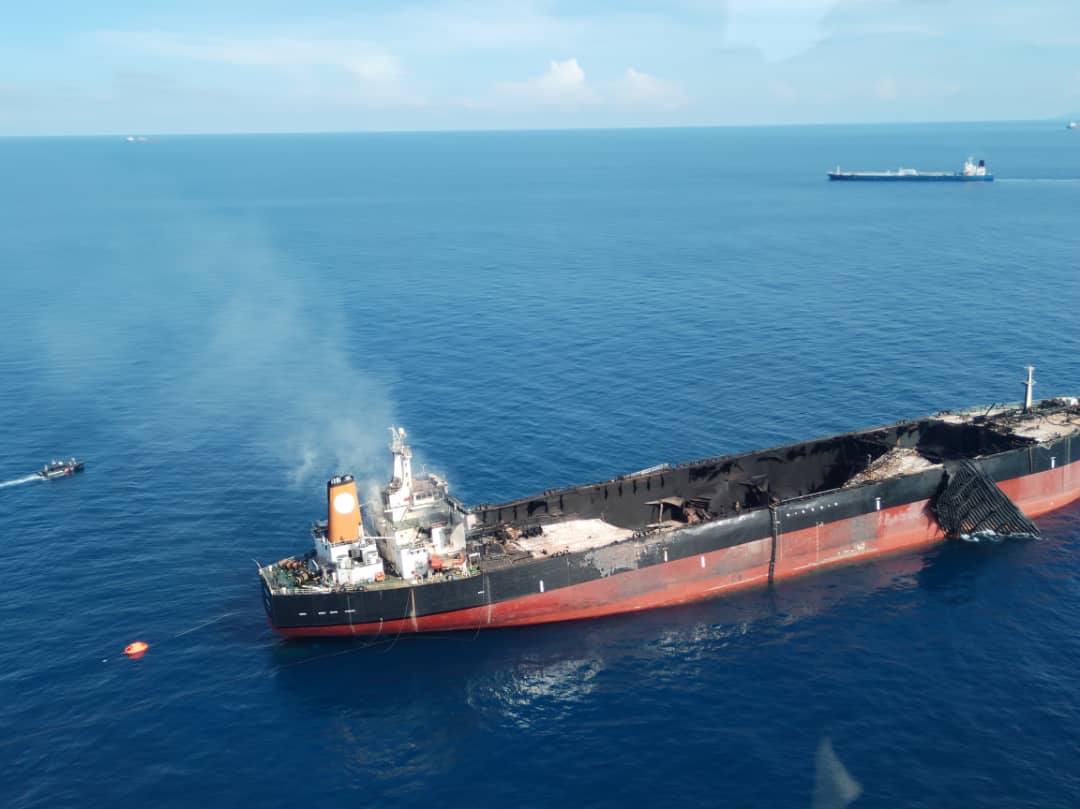
(Bloomberg) -- Off the coast of Malaysia, in one of the world's busiest shipping channels, an explosion on board the aging oil tanker Pablo ripped off its deck like a sardine can and began a fire that sent dark plumes of smoke into the sky.
It was a tragic accident that could have been a much larger catastrophe. The Gabon-registered ship, capable of carrying some 700,000 barrels of crude oil, was coming through the South China Sea after offloading a cargo in China — and so was nearly empty. Out of its international crew of 28, officials report that 25 were rescued by passing vessels. The blast happened just beyond Singapore's congested waters.
But for nearby maritime authorities, the headache has just begun. There is little evidence of the owner, a Marshall Islands-registered company whose fleet contains no other ships, and no trace of insurance. Both are vital for a clean-up to begin.
An Aframax-class crude oil tanker observed in Iranian waters last year, the Pablo underlines the risks that come with the expansion of a dark fleet of aging vessels moving sanctioned oil around the globe. Since the wave of sanctions that followed Russia's invasion of Ukraine — including the price caps imposed by the Group of Seven, intended to limit oil cash going back to the Kremlin — observers in the oil trading community have reported the purchase of hundreds of old tankers by undisclosed buyers.
With limited details on who is responsible for this vessel, there has been no one to hold to account as it burned just 40 nautical miles off Malaysia's Pulau Tinggi island. Oil, potentially from the wreck, has been reported washing up on Indonesia's coast.
“The Pablo casualty is tragic, and a stark reminder of what we have been saying all along: the shadow fleet poses a serious threat both to people's lives and to the marine environment,” said Rolf Thore Roppestad, chief executive officer of Gard AS, the largest of the protection and indemnity clubs that insure much of the world's fleet against risks such as oil spills.
“What worries me is that there are ships like these passing through high-traffic straits every day,” he added. “So the likelihood of more accidents like this happening is actually quite high.”
The cause of the fire is still unclear, though it's possible vapors from the remains of the oil cargo played a part. Regardless, when ships like the Pablo explode, the process of cleaning up the mess gets more difficult. Often, insurance companies, salvage businesses and various intermediaries begin dealing with the situation within a few hours of it happening.
But almost a week after this explosion, there is little sign of the insurer to get the process moving. The Pablo is not listed in an industry database of insured vessels, and the Malaysian Maritime Enforcement Agency did not answer questions on insurance.
In instances where shipowners are unknown, local authorities will often press the crew for more information as they are one of the few people who know where a vessel's orders are coming from. It is unclear whether that has been possible.
If the owner can't be contacted, local authorities can seize the ship and try to cover what costs they can, according to Oon Thian Seng, founding partner of Singapore law firm Oon & Bazul LLP and at its associated Malaysian office, TS Oon & Partners LLP. However, it's highly unlikely that selling what's left of the charred Pablo would cover the costs of removal.

The dangers the Pablo, and others like it, are clear from its history. The tanker was flying the flag of Gabon, which is a very small destination for vessel registration and falls outside of something called the Paris MoU, set up to promote safe shipping. It was built in 1997, meaning it's far beyond the age at which most tankers are sold as scrap.
Further, had the Pablo been laden with its most recent cargo, that would have been a major spill of oil sanctioned by the US.
The tanker spent two months at a shipyard near Shanghai, but before that its last two voyages were to deliver crude to Chinese ports in Shandong province, ship tracking data monitored by Bloomberg show. Data analytics firm Vortexa identifies both cargoes as Iranian heavy crude, which is sanctioned.
For authorities in Singapore, one of the world's busiest shipping hubs, the question is how to keep legitimate oil cargoes moving — while avoiding accidents like this one. The Maritime and Port Authority said it had requested the assistance of 20 vessels in the region to report any sighting of the Pablo's three missing crew, and reported no disruption to traffic. Officials did not comment further.
Malaysian authorities said they suspended search operations on Friday evening as efforts haven't turned up any sign of the crewmen. The explosion has made the ship unsafe to board, leaving it stuck off the country's coastline for the time being.
The longer it stays there, the longer it remains a visible reminder of the risks that come with an expanding shadow fleet.
“Sadly, it's the crew, their families, and the coastal communities that are paying the price,” Roppestad said.
--With assistance from Ann Koh, Ravil Shirodkar, Eko Listiyorini, Norman Harsono, Alaric Nightingale and Julian Lee.
More stories like this are available on bloomberg.com
©2023 Bloomberg L.P.

-
Ten Things I Learnt This Samvat

Patience can be a trap. Cheap stocks can stay cheap. Leverage can wipe you out. What did Samvat 2082 teach us? Niraj Shah writes on 10 lessons from the year gone by.
-
Talking Points This Week: Tech Nerves, FII Buying, And A Faraway Banking Shock
The global markets are not shining this Diwali. The exception in the large markets is, India.
-
Midterm Rally Lasted A Day. The Hard Reality Of A Divided US May Last Two Years | Opinion
Between a contested AI boom, a debt ceiling that arrives in 2027 and a president with every incentive to act alone, the next two years may prove more volatile than the first day's rally suggests.
-
Blue Wave Will Derail the AI Trade but Won't Dismantle the AI Era | Unhedged Position
The Democrats' sweep of the US Congress will see politics collide with economic forces both over the long and short term.
-
It's Time To Take The GST Council's Bet On Trust Global
Payment records can prove India's services exports, and clear, proportionate rules can bring foreign digital sellers into the tax net.
-
Opinion | India at 38: From Innovation Overperformer to Innovation Powerhouse
India now has 453 VC-backed deep science startups, 18 of them late-stage, after 117 percent growth since 2020. Laurus Labs, at USD 9.3 billion, is the most valuable deep science company in any middle-income economy outside China.
-
Navigating Energy Crossroads: S Jaishankar's Call For Diversified Supply Chains At G20 Ministerial Meeting
As geopolitical fault lines continue to test maritime trade routes and commodity flows, Jaishankar's message remains pertinent: true economic resilience requires open markets, protected transit lines, and a genuine commitment to multilateral cooperation rather than coercion.
-
Indians Are Travelling, But Not Every Journey Is A Holiday | The Week In Whys
Pilgrims, patients and working women are the real travellers, and the system hasn't quite caught up with them.
-
Getting To Work Costs Women More | The Reason Why
It is not just about women paying more than men. It is about women paying much more in cities than in villages.









