Americans Sour On Both Israel And Palestinian Authority In Poll

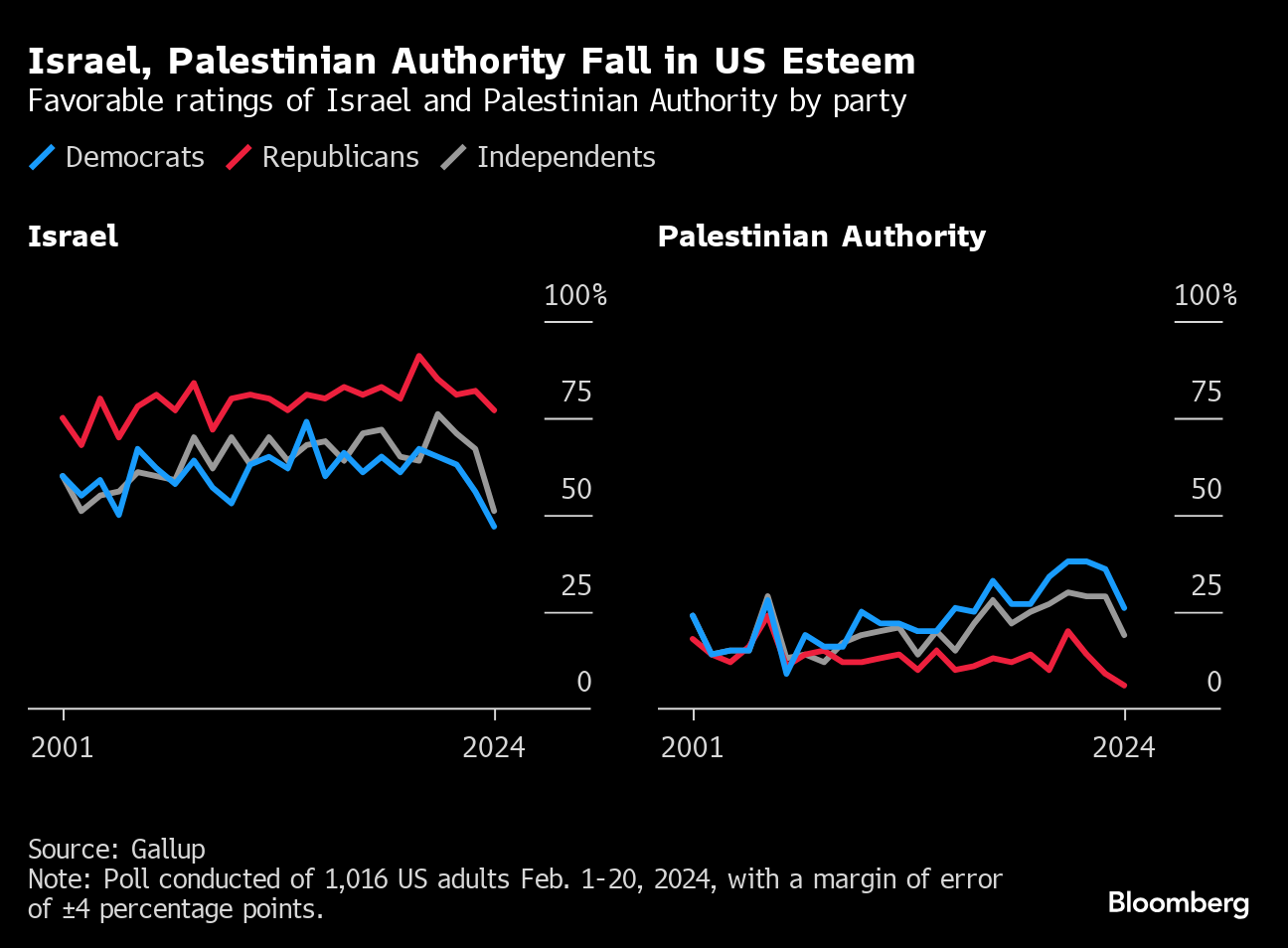
(Bloomberg) -- Americans across the political spectrum have less favorable opinions of both Israel and the Palestinian Authority after the onset of the Israeli-Hamas war last year, a Gallup survey found.
Overall, 58% of Americans have a positive view of Israel, down 10 percentage points since last year and the lowest favorable rating in more than two decades. Views of the Palestinian Authority declined 8 points to 18%, the lowest in nearly a decade.
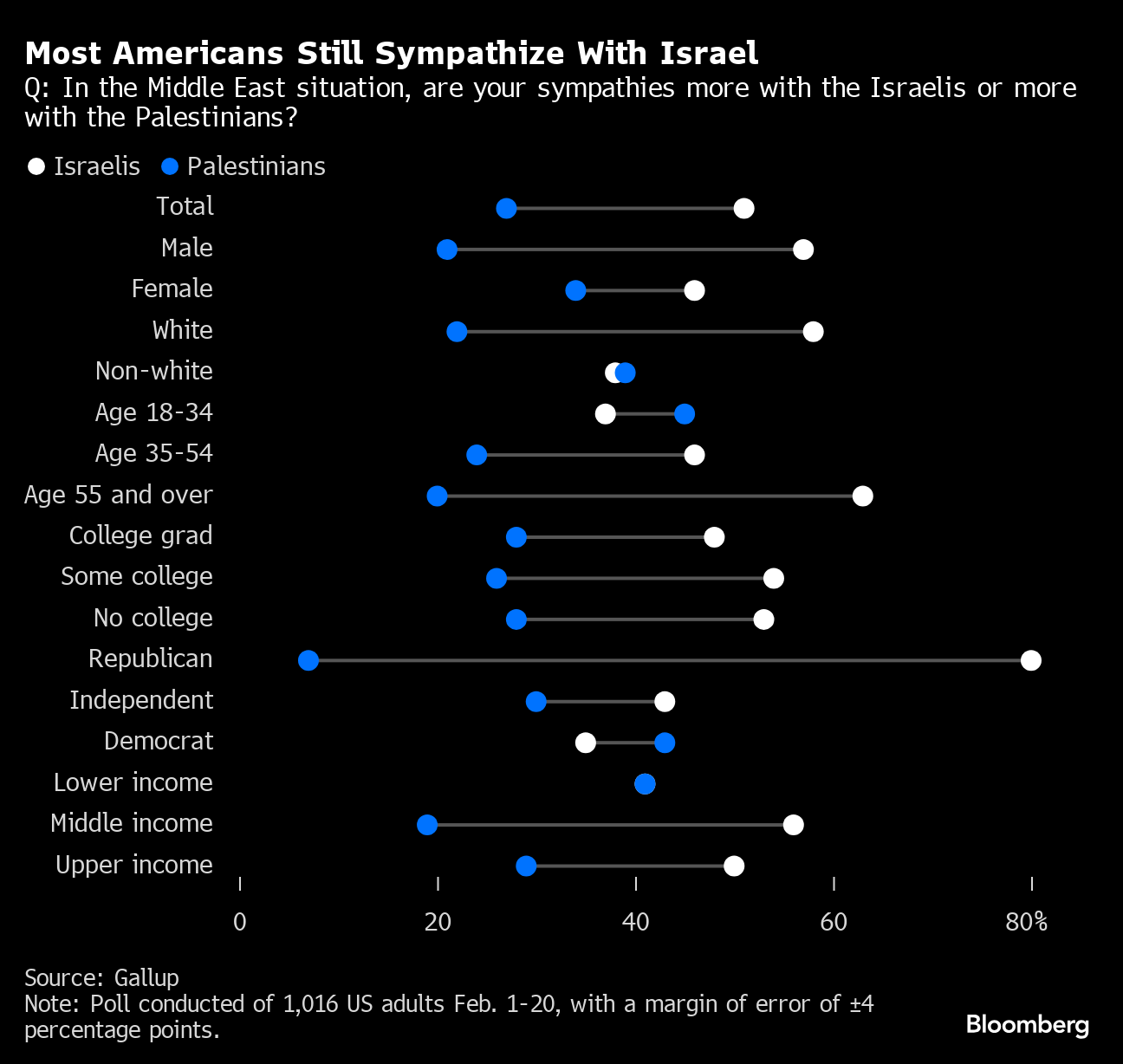
Still, US sympathies in the Middle East are largely unchanged, with Americans largely taking the side of Israel by a ratio of almost 2-to-1.
At least one demographic bucks that trend. For the first time, Americans under 35 were more likely to say they sympathized with Palestinian Arabs rather than Israelis.
That shift follows the outbreak of war last October, when Hamas — designated a terrorist group by US and European Union — launched a surprise attack on Israel from the Gaza Strip. Israel has retaliated with a five-month air and ground war in Gaza, with a one-week truce in November for a hostage-for-prisoner exchange.
The war has reverberated across western politics, fracturing key constituencies — including young voters and Muslims — in center-left parties.
It's been a particular problem for President Joe Biden, as 13% of Democrats in the crucial swing state of Michigan — home to a significant number of Arab-American voters — registered a protest vote for “uncommitted” in a primary election last week. Biden is also facing increasing pressure from within his party to broker a cease-fire in the war.
Read more: Democrats Step Up Calls for Biden to Rein In Israel-Hamas War
The poll showed 53% of Americans support the creation of an independent Palestinian state, though Republicans were more likely to oppose it.
The Gallup poll of 1,016 US adults was conducted Feb. 1-20 and has a margin of error of plus or minus 4 percentage points.
More stories like this are available on bloomberg.com
©2024 Bloomberg L.P.

-
Love, Sex Aur Dhokha: The Audacious Plot To Spy On Jensen Huang

A Taipei dinner, a Singapore chip buyer and a suspected Chinese asset: inside the alleged spy operation that got close to NVIDIA's Jensen Huang.
-
Ten Things I Learnt This Samvat
Patience can be a trap. Cheap stocks can stay cheap. Leverage can wipe you out. What did Samvat 2082 teach us? Niraj Shah writes on 10 lessons from the year gone by.
-
Talking Points This Week: Tech Nerves, FII Buying, And A Faraway Banking Shock
The global markets are not shining this Diwali. The exception in the large markets is, India.
-
Midterm Rally Lasted A Day. The Hard Reality Of A Divided US May Last Two Years | Opinion
Between a contested AI boom, a debt ceiling that arrives in 2027 and a president with every incentive to act alone, the next two years may prove more volatile than the first day's rally suggests.
-
Blue Wave Will Derail the AI Trade but Won't Dismantle the AI Era | Unhedged Position
The Democrats' sweep of the US Congress will see politics collide with economic forces both over the long and short term.
-
It's Time To Take The GST Council's Bet On Trust Global
Payment records can prove India's services exports, and clear, proportionate rules can bring foreign digital sellers into the tax net.
-
Opinion | India at 38: From Innovation Overperformer to Innovation Powerhouse
India now has 453 VC-backed deep science startups, 18 of them late-stage, after 117 percent growth since 2020. Laurus Labs, at USD 9.3 billion, is the most valuable deep science company in any middle-income economy outside China.
-
Navigating Energy Crossroads: S Jaishankar's Call For Diversified Supply Chains At G20 Ministerial Meeting
As geopolitical fault lines continue to test maritime trade routes and commodity flows, Jaishankar's message remains pertinent: true economic resilience requires open markets, protected transit lines, and a genuine commitment to multilateral cooperation rather than coercion.
-
Indians Are Travelling, But Not Every Journey Is A Holiday | The Week In Whys
Pilgrims, patients and working women are the real travellers, and the system hasn't quite caught up with them.









