World’s Richest People Led By Jensen Huang Lose $108 Billion After DeepSeek Selloff
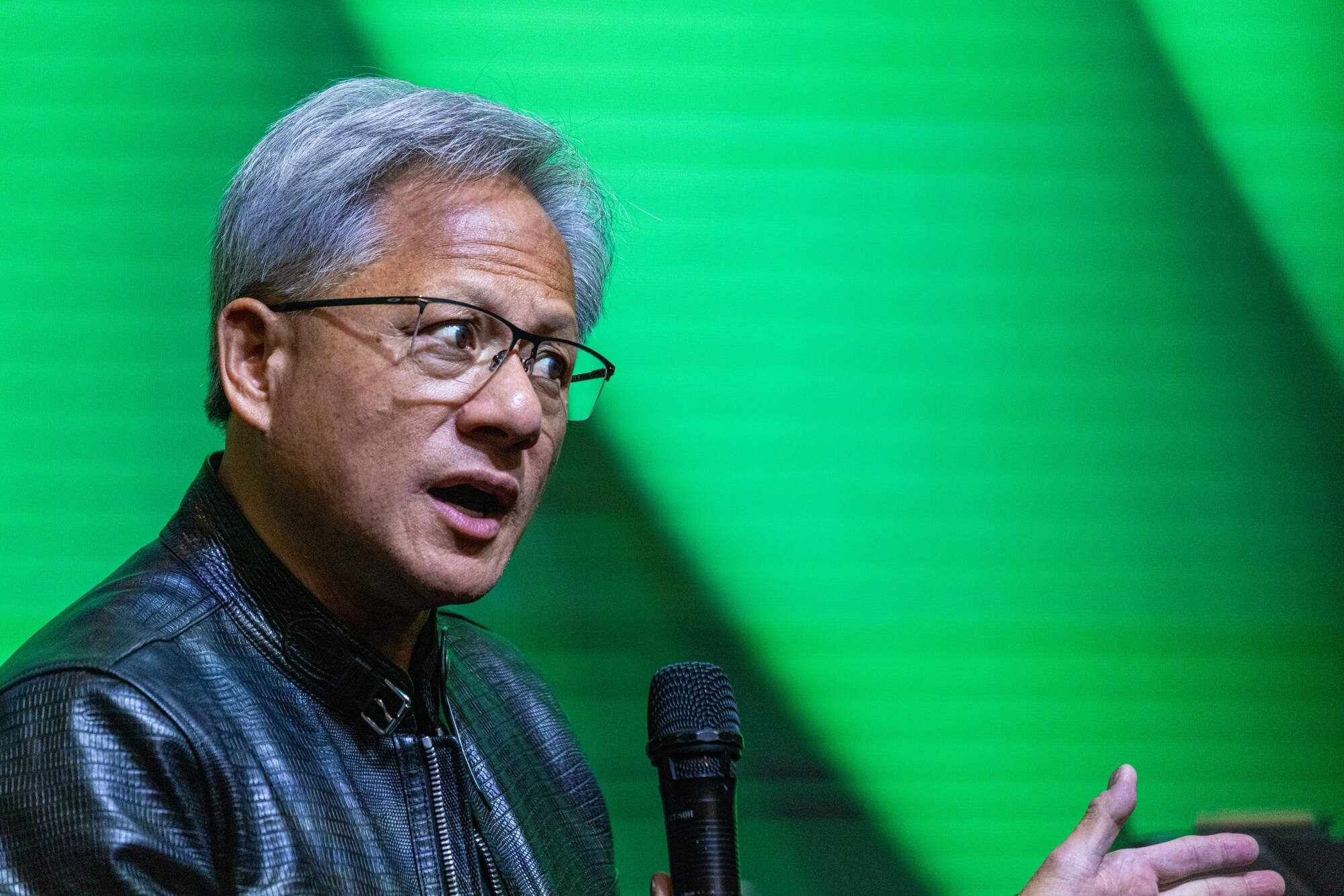
(Bloomberg) -- The world's 500 richest people, led by Nvidia Corp. co-founder Jensen Huang, lost a combined $108 billion on Monday as a tech-led selloff tied to Chinese AI developer DeepSeek sent major indices plunging.
Billionaires whose fortunes are linked to artificial intelligence were the biggest losers: Huang saw his fortune fall $20.1 billion, a 20% drop, while Oracle Corp. co-founder Larry Ellison's $22.6 billion loss was larger in absolute terms, but represented just 12% of his fortune, according to the Bloomberg Billionaires Index. Dell Inc.'s Michael Dell lost $13 billion, and Binance Holdings Ltd. co-founder Changpeng “CZ” Zhao shaved $12.1 billion.
Tech-sector titans as a group saw $94 billion of wealth evaporate — roughly 85% of the Bloomberg index's total decline. The Nasdaq Composite Index fell 3.1%, and the S&P 500 dropped 1.5%.
Hangzhou-based DeepSeek has been developing AI models since 2023, but the company first came onto the radar of many Western investors this weekend as its free DeepSeek R1 chatbot app topped download charts worldwide. So many new users piled in that DeepSeek struggled to keep the app online, suffering outages and forcing it to restrict signups to users with Chinese phone numbers.
DeepSeek's dark-horse entry into the AI race, which it says cost just $5.6 million to develop, is a challenge to Silicon Valley's narrative that massive capital spending is essential to developing the strongest models. That delivered a serious blow to billionaires whose fortunes are tied to the Western AI supply chain that's been the equities market's biggest driver over the past two years.
Similar Playbook
Soaring valuations for so-called AI hyperscalers — including Meta Platforms Inc., Alphabet Inc. and Microsoft Corp. — have generated billions in wealth for their owners since OpenAI unveiled ChatGPT in November 2022. These companies have for the most part operated on a similar playbook: Spend huge sums to develop and run AI systems by hoarding top-of-the-line semiconductors and the energy supplies needed to run them.
Meta Chief Executive Officer Mark Zuckerberg announced Friday that the company planned to spend $60 billion to $65 billion on projects related to AI this year, well above Wall Street estimates. Capital spending across all Big Tech firms is on pace to reach $200 billion in 2025, according to a Bloomberg Intelligence report.
Despite limited revenue to show for all their investment so far, markets have rewarded US tech stocks with record-high valuations, which have in turn generated historic wealth gains for their owners. Nvidia has stood out as the AI boom's biggest single winner so far, with Huang's net worth increasing almost eight-fold to $121 billion since the start of 2023 through Friday. Zuckerberg's fortune soared 385% to $229 billion over the same period and Amazon.com Inc.'s Jeff Bezos gained 133% to $254 billion.
While Huang and Ellison suffered losses, other major tech billionaires' fortunes escaped unscathed. Zuckerberg's net worth ended the day up, gaining $4.3 billion as Meta rebounded from an early-session decline. Bezos' wealth climbed by about $632 million.
Capital Spending
The fact that DeepSeek was able to develop a free model that potentially rivals or beats competitors including ChatGPT and Anthropic's Claude at a fraction of the development cost led investors to question the logic behind Silicon Valley's dependence on capital spending.
A key reason why DeepSeek didn't rely on big investment and top-of-the-line chips to develop its model is that Chinese firms have had limited access to the powerful GPUs, or graphics processing units, most Western companies rely on ever since the US government instituted strict export controls on the most advanced chips.
In an interview with CNBC last week, Alexandr Wang, CEO of training data provider Scale AI, said that despite the export controls, DeepSeek and other Chinese developers likely have more GPUs than Silicon Valley is aware of.
“The Chinese labs have more H100s than people think,” Wang said, referring to Nvidia's top-of-the-line AI chip. “My understanding is that DeepSeek has about 50,000 H100s, which they can't talk about, obviously, because it's against the export controls that the US has in place.”

-
Talking Points This Week: Tech Nerves, FII Buying, And A Faraway Banking Shock

The global markets are not shining this Diwali. The exception in the large markets is, India.
-
Midterm Rally Lasted A Day. The Hard Reality Of A Divided US May Last Two Years | Opinion
Between a contested AI boom, a debt ceiling that arrives in 2027 and a president with every incentive to act alone, the next two years may prove more volatile than the first day's rally suggests.
-
Blue Wave Will Derail the AI Trade but Won't Dismantle the AI Era | Unhedged Position
The Democrats' sweep of the US Congress will see politics collide with economic forces both over the long and short term.
-
It's Time To Take The GST Council's Bet On Trust Global
Payment records can prove India's services exports, and clear, proportionate rules can bring foreign digital sellers into the tax net.
-
Opinion | India at 38: From Innovation Overperformer to Innovation Powerhouse
India now has 453 VC-backed deep science startups, 18 of them late-stage, after 117 percent growth since 2020. Laurus Labs, at USD 9.3 billion, is the most valuable deep science company in any middle-income economy outside China.
-
Navigating Energy Crossroads: S Jaishankar's Call For Diversified Supply Chains At G20 Ministerial Meeting
As geopolitical fault lines continue to test maritime trade routes and commodity flows, Jaishankar's message remains pertinent: true economic resilience requires open markets, protected transit lines, and a genuine commitment to multilateral cooperation rather than coercion.
-
Indians Are Travelling, But Not Every Journey Is A Holiday | The Week In Whys
Pilgrims, patients and working women are the real travellers, and the system hasn't quite caught up with them.
-
Getting To Work Costs Women More | The Reason Why
It is not just about women paying more than men. It is about women paying much more in cities than in villages.
-
AI Bias In Investing Cannot Be Eliminated, But It Can Be Governed
Framing is a particularly important example as identical financial information presented in terms of gains rather than losses can lead an LLM to reach a different assessment.









