OpenAI Rival DeepSeek Shakes Up AI Universe: What Exactly Did It Do?
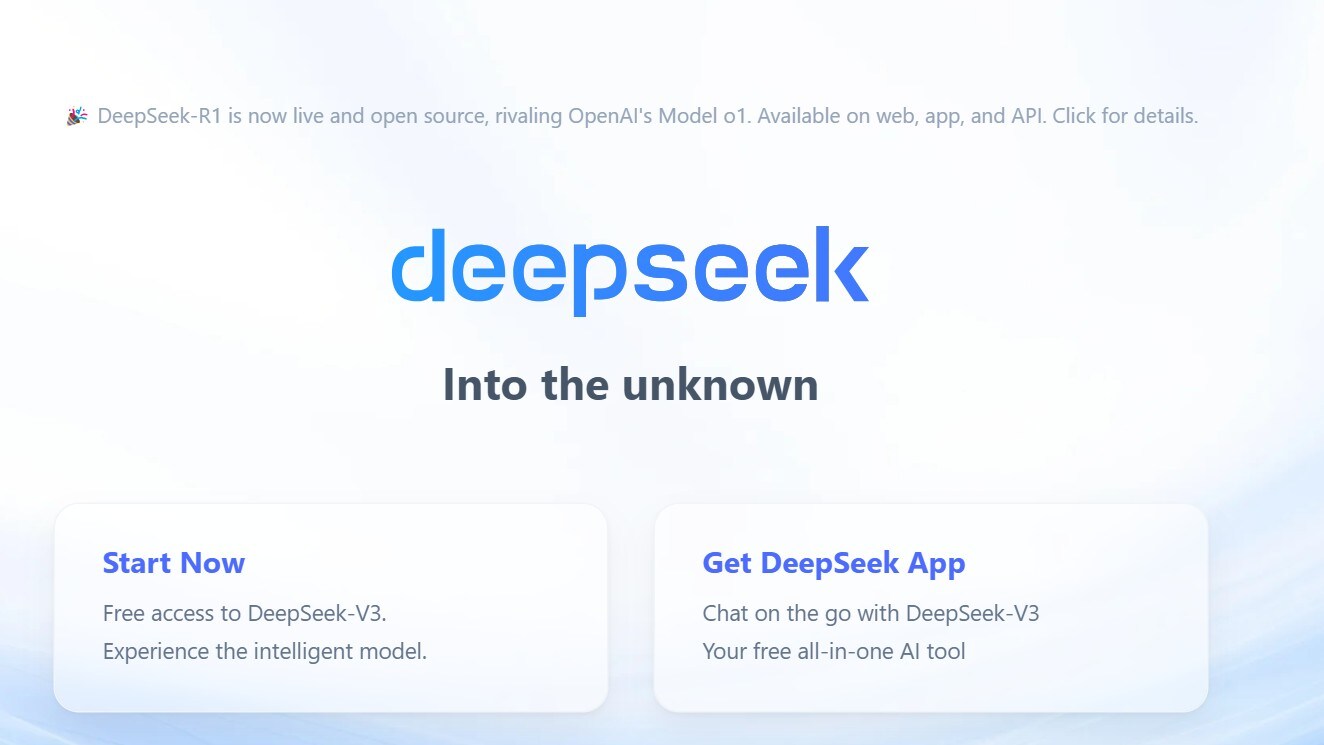
In a move reminiscent of a tech underdog stealing the show, DeepSeek—a Chinese AI startup founded by quant fund chief Liang Wenfeng—has flipped the global AI narrative. Its latest model, DeepSeek-R1, offers comparable performance to Western AI giants at a fraction of the cost, raising questions about America's technological dominance.
Released last week, DeepSeek-R1 is an open-source AI model that emphasises efficiency and transparency. The model, widely seen as competitive with those of OpenAI and Meta Platforms Inc., is designed to run on less-advanced chips, bypassing the US-imposed restrictions on cutting-edge semiconductor exports to China. Its app has surged to the top of Apple's App Store rankings.
The launch of DeepSeek-R1 sent shockwaves through global markets. Investors panicked over the startup's ability to deliver high-quality AI at a fraction of the cost. The launch triggered a selloff in global tech stocks, with shares of major US AI-related companies, including Nvidia, Meta, and Microsoft, dropping in response to DeepSeek's success.
Nvidia Corp., synonymous with AI chip innovation, saw its shares close nearly 17% lower, while ASML Holding NV ended 7% down. The tech-heavy Nasdaq 100 dipped nearly 3%, while the S&P 500 dropped 1.5%. Markets across New York, London, and Tokyo stock exchanges felt the shocks.
Nvidia has called the Chinese model and "excellent AI advancement", compliant with US technology export controls around high-end AI hardware. Notably, running the AI model needs a lot of high-performance GPUs and networking, which made the US-based company's worth trillions of dollars.
DeepSeek's Recipe To Success?
But the bigger question is — what is the secret sauce behind DeepSeek's success? DeepSeek-R1 delivers impressive performance compared to OpenAI's and Meta's models but runs on less-advanced chips. Its efficiency stems from innovative multi-stage training and large-scale reinforcement learning, bypassing the need for expensive high-tech infrastructure. The breakthrough makes AI accessible to users and companies on a tighter budget.
Its rise highlights how Chinese engineers are navigating US sanctions, proving that innovation does not always require cutting-edge technology. By developing models that rely on fewer resources, DeepSeek challenges the notion that China's AI lags behind its Western counterparts.
Despite US bans on advanced semiconductor exports, DeepSeek has sidestepped these restrictions by optimising efficiency with accessible open-source technology.
DeepSeek's strategy of offering free and unrestricted AI access poses a direct challenge to the costly infrastructure investments of giants like Nvidia, Microsoft, and Meta. While Meta plans to increase AI spending to $65 billion, OpenAI, SoftBank, and Oracle recently announced a $100 billion venture to expand AI infrastructure in the US.
As global investors monitor DeepSeek's next moves, its market disruption highlights a shifting balance in technological power.

-
Why Amazon And Flipkart Are Struggling To Beat Meesho In India's Smaller Cities

With 274 million users and lowest-cost logistics, Meesho is defending its value commerce crown against giants like Amazon and Flipkart.
-
High US Salaries, No Green Card Certainty: The Financial Calculation Facing Indian H-1B Families
The suspension of PERM processing at eight technology employers does not cancel existing H-1B visas. What it does is force a question many Indian families have been avoiding: is the US salary worth tying your career and family plans to one employer?
-
Swiggy vs Eternal: Food Delivery's Two Rivals Are No Longer In The Same Race
Eternal is building a private AI assistant, dark.ai. Swiggy is still working out how to make Instamart pay, with an operating loss of Rs 895 crore in the July-September quarter while Blinkit stayed profitable.
-
Where You Live Shapes How You Get To Work | The Reason Why
Two-wheelers are the most popular way to get to work in India, accounting for nearly 43% of workplace commutes.
-
Unhedged Position: Can India See An Indonesia-Style Time Correction?
The Nifty is trading below levels it first clocked in 2024. Is there, then, as I have suggested in the headline, potential that the current time correction drags on painfully for the next three-five, even ten years?
-
Navigating Friction And Energy Realities: An Analysis Of Marco Rubio's October Visit To India
Occurring at a critical juncture marked by stalled trade negotiations and escalating geopolitical pressures over global energy supplies, the visit offers a profound window into modern US-India relations.
-
India Exports Capital. Why Not Export Trusteeship?
The big question, then, is whether India can build an institution that global borrowers, investors, banks, and lawyers can trust, even without an Indian connection.
-
France's Economy & Politics Are In Crisis | The Reason Why
Let's look at how the French economy and politics evolved under Nicolas Sarkozy, Franois Hollande and Emmanuel Macron.
-
You May Inherit The Business. You Must Earn Its Credibility.
Succession tests the founder's ability to share authority as much as it tests the next generation's readiness to assume it.
-
Signing Deals Is One Thing; Making Them Work Is Another | The Week In Whys
Sometimes, things don't turn out as planned. Indian companies have lost some bids to rivals, some projects won't produce until 2030.










