Nvidia Chart Watchers Brace for More Pain With Dip Buyers at Bay
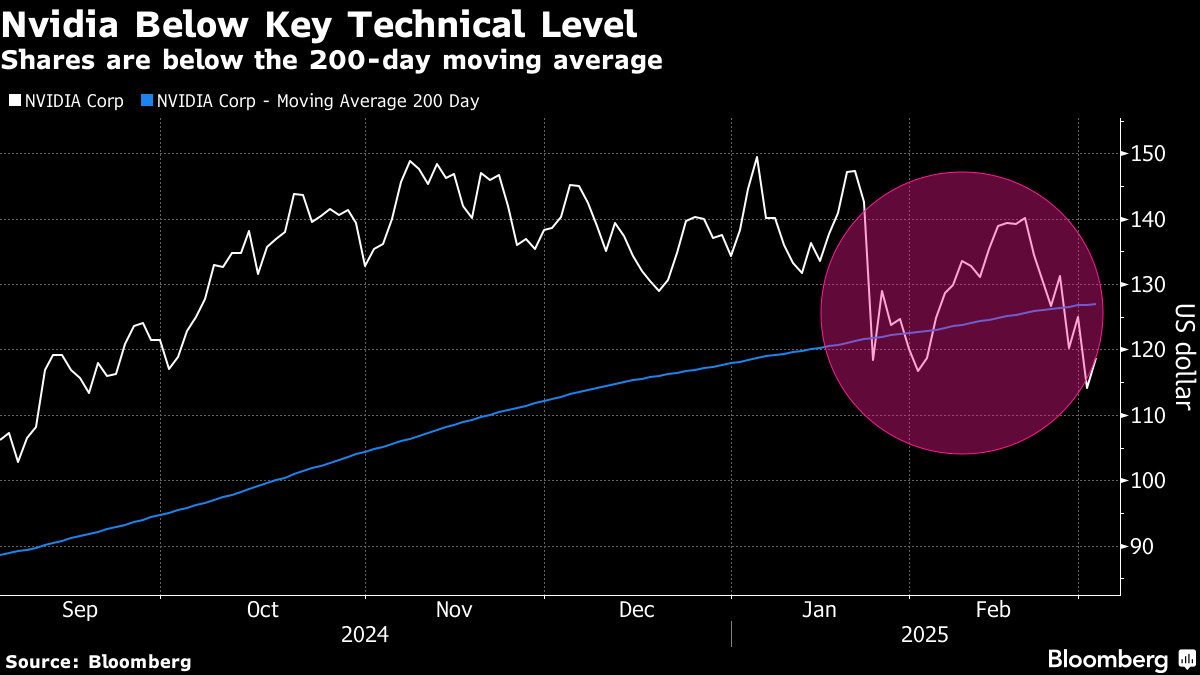
(Bloomberg) --The selloff that's hammered Nvidia Corp. shares over the past month has market technicians tracking a key momentum indicator for signs of more trouble ahead.
Chart watchers are fixated on the 200-day moving average, a measure of long term-momentum that was breached in January for the first time in more than two years. While Nvidia rose modestly on Tuesday, with the stock now trading well below the gauge, market professionals are fixated on the trajectory of the moving average.
“It's definitely a change of character compared to the last two years,” said Todd Sohn, senior ETF and technical strategist at Strategas Securities LLC. “On a tactical basis, it's hard to remain super bullish on a name once the 200-day starts to crest and slope downward.”
Sohn says the next level he's watching is $113 per share for Nvidia, the intraday low it hit in an early February trough. Rick Bensignor, chief executive officer of Bensignor Investment Strategies and a former Morgan Stanley strategist, has a similar area in focus.
“I'm inclined to think there's more to go on the downside,” Bensignor said. “We could see support anywhere from here to $110, but below that my minimum downside target is in the $107-$103 range.” The next support is at about $90, he added.
The Nvidia downturn has come amid broader market uncertainty that's shaken most of the biggest technology stocks. The so-called Magnificent Seven group of tech megacaps recently fell into correction territory — down more than 10% from its peak. The Nasdaq 100 Index is flirting with the same level.
Beyond the specific fears that have weighed on Nvidia since the emergence of DeepSeek, there are also broader questions around President Donald Trump's tariffs and exactly how much technology companies — especially those with exposure to China — would be impacted.
Nvidia is responsible for more than 30% of the Nasdaq's decline this year. Tesla Inc. and Broadcom Inc. are the second and third biggest contributors to the slide, and both are also near their 200-day moving average.
“It is possible we've seen a long-term peak in the stock. Nvidia remains the way to play AI, and people continue to debate AI,” said Buff Dormeier, chief technical analyst at Kingsview Partners. “The stock looks tired on a longer-term basis. The flattening of the 200-day trendline is a sign that momentum has been weakening and things are turning.”
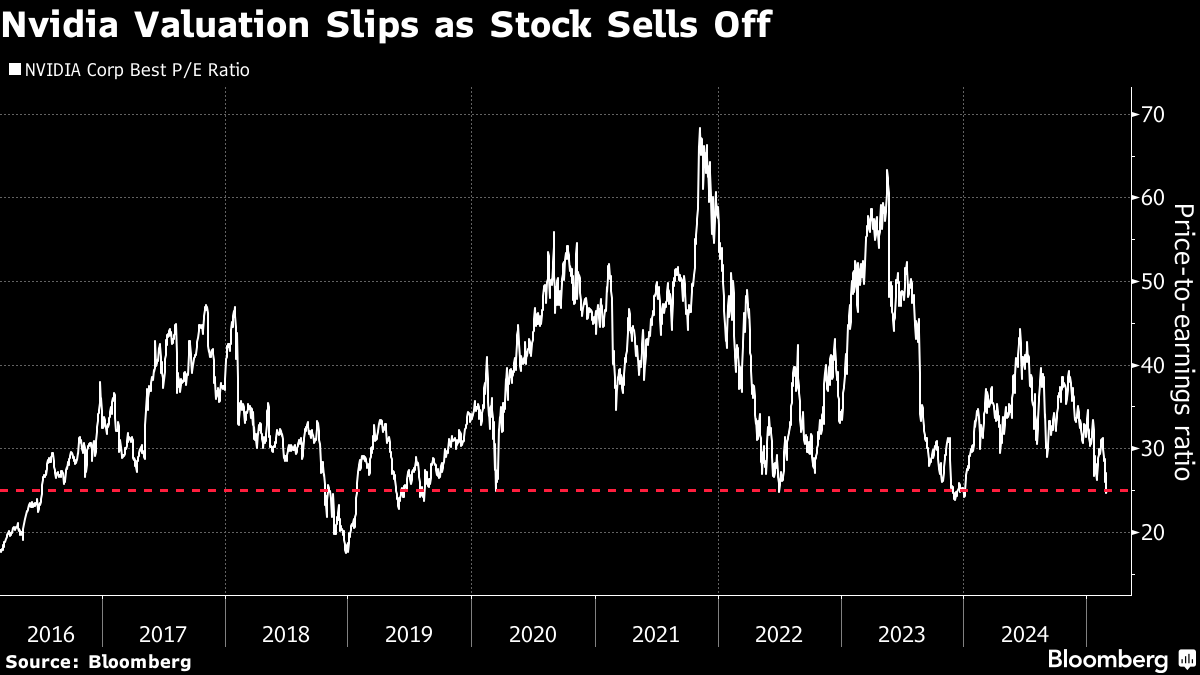
The rout has brought Nvidia's valuation based on forward earnings down to about 25, the lowest multiple the technology giant has seen in more than a year. The Nasdaq trades at about 22 times forward earnings, and the S&P 500 Index has a multiple around 20.
Nvidia's falling valuation and the recent pessimism on the shares have puzzled bulls, especially given that the biggest technology companies have made it clear that they're going to continue to spend billions of dollars on artificial intelligence in the coming years.
“The de-rating feels a little stunning especially right at the start of a product cycle,” Bernstein analysts led by Stacy Rasgon wrote in a March 4 note, referring to Nvidia's new Blackwell line of chips. “Worries that the AI trade is 'over' feel a little premature to us, and valuation is getting increasingly attractive.”
Still, caution might be warranted until some of the broader market pressures are alleviated.
“While risk-reward looks attractive on the stock with stock trading below historical troughs, we believe investors are looking for the clearance event on the overhang from the AI restrictions and tariff impact to gross margins,” Citigroup analysts led by Atif Malik wrote in a note.
Tech Chart of the Day

-
Talking Points This Week: Tech Nerves, FII Buying, And A Faraway Banking Shock

The global markets are not shining this Diwali. The exception in the large markets is, India.
-
Midterm Rally Lasted A Day. The Hard Reality Of A Divided US May Last Two Years | Opinion
Between a contested AI boom, a debt ceiling that arrives in 2027 and a president with every incentive to act alone, the next two years may prove more volatile than the first day's rally suggests.
-
Blue Wave Will Derail the AI Trade but Won't Dismantle the AI Era | Unhedged Position
The Democrats' sweep of the US Congress will see politics collide with economic forces both over the long and short term.
-
It's Time To Take The GST Council's Bet On Trust Global
Payment records can prove India's services exports, and clear, proportionate rules can bring foreign digital sellers into the tax net.
-
Opinion | India at 38: From Innovation Overperformer to Innovation Powerhouse
India now has 453 VC-backed deep science startups, 18 of them late-stage, after 117 percent growth since 2020. Laurus Labs, at USD 9.3 billion, is the most valuable deep science company in any middle-income economy outside China.
-
Navigating Energy Crossroads: S Jaishankar's Call For Diversified Supply Chains At G20 Ministerial Meeting
As geopolitical fault lines continue to test maritime trade routes and commodity flows, Jaishankar's message remains pertinent: true economic resilience requires open markets, protected transit lines, and a genuine commitment to multilateral cooperation rather than coercion.
-
Indians Are Travelling, But Not Every Journey Is A Holiday | The Week In Whys
Pilgrims, patients and working women are the real travellers, and the system hasn't quite caught up with them.
-
Getting To Work Costs Women More | The Reason Why
It is not just about women paying more than men. It is about women paying much more in cities than in villages.
-
AI Bias In Investing Cannot Be Eliminated, But It Can Be Governed
Framing is a particularly important example as identical financial information presented in terms of gains rather than losses can lead an LLM to reach a different assessment.









