NASA Wants to Send the Fastest Spacecraft Ever Into the Sun
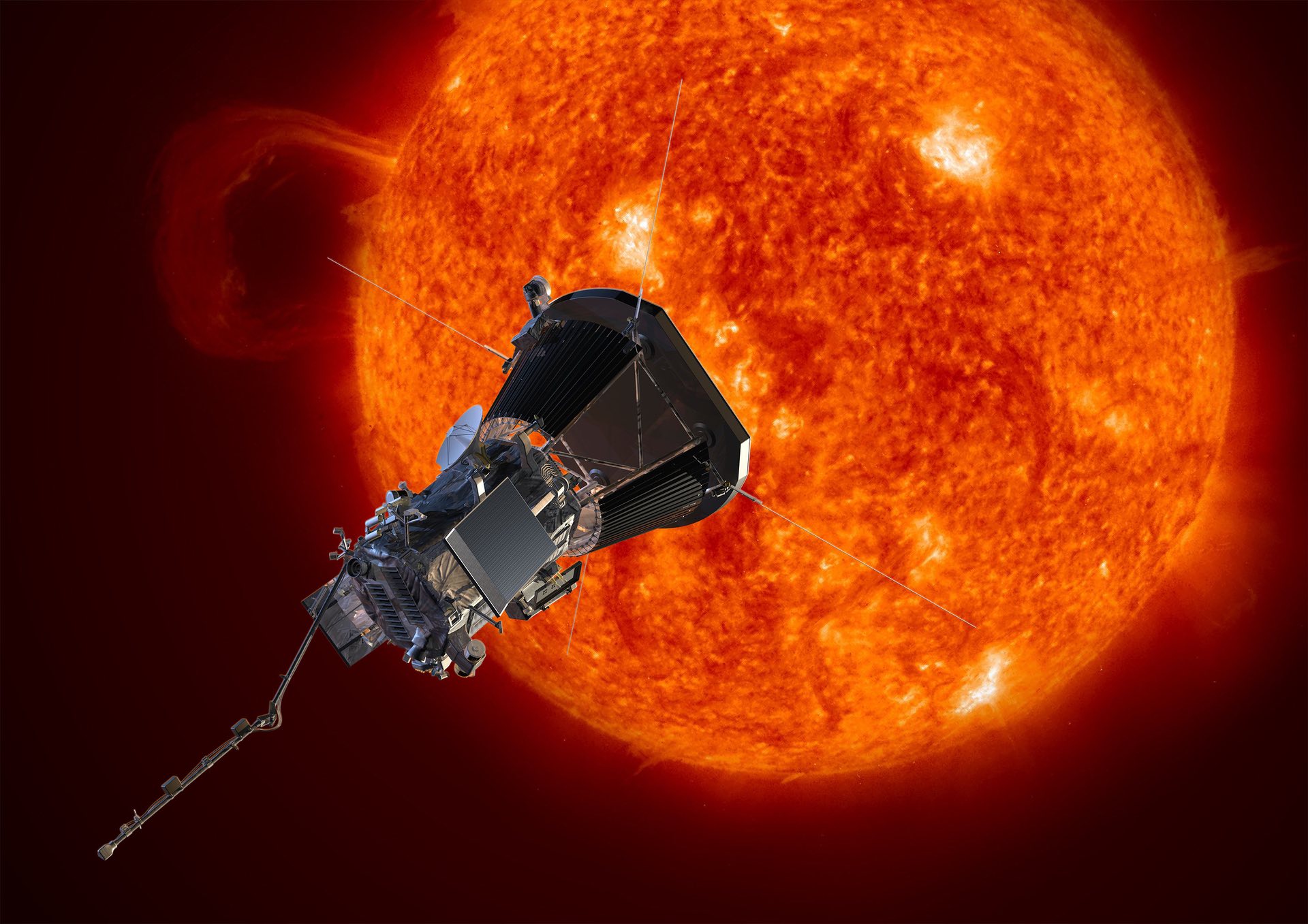
(Bloomberg) -- NASA will launch a probe next year into the Sun's outer atmosphere that's expected to improve dramatically our understanding of “space weather” and its risk to satellites, electrical grids, and telecommunications.
Mission leaders gathered at the University of Chicago on Wednesday both to introduce the Space Probe Plus and to rechristen it the Parker Space Probe, in honor of Eugene Parker, the University of Chicago scientist who in 1958 hypothesized the existence of solar wind—an idea his contemporaries ridiculed until the Mariner 2 probe confirmed it a few years later.
Despite decades of research, critical knowledge gaps remain that prevent scientists from being able to predict and track solar storms with the precision necessary to avoid low-probability, high-cost damage to technology. The probe will investigate two key questions about solar physics: How does the solar wind start? And why is the sun's surface, at 10,000 degrees Fahrenheit, just a tiny fraction of the million-plus degree corona? “It's like water flowing uphill,” said Nicola Fox, a professor at the Johns Hopkins University Applied Physics Laboratory where the probe is being assembled and tested. “It shouldn't happen.”
The announcement is the first time NASA has ever named a mission after a living scientist—not a bad birthday present for Parker, who turns 90 on June 10. “Hooray for Solar Probe!” he said, at the conclusions of his remarks at the University of Chicago.
The $1.5 billion mission was first proposed as the nation's nascent space program was drawing up a to-do the list in the shadow of Russia's successful launch of Sputnik in 1957. It has taken six decades of technical improvement to pull it off, in part because it's an extreme project even by space exploration standards. The closest of Parker‘s planned seven approaches to the Sun, expected in mid-2025, will bring it within 4 million miles of the surface, or seven times closer than the 1974 Helios mission. At a top speed of 125 miles per second, it'll be the fastest spacecraft in history.
Four suites of instruments will measure the Sun's magnetic field, the solar wind's speed, and the density and temperature of the particles that make it up. The instruments are protected from 2,500-degree heat by an engineering feat worthy of science fiction—a 4.5-inch carbon-composite shield that will keep the equipment near room temperature.
Answering questions as fundamental as these will have the practical effect of improving space-weather prediction, an increasingly critical component of managing, and protecting, the increasing traffic jam
Space-weather monitoring in the U.S. is the responsibility of the National Oceanic and Atmospheric Administration. The Space Weather Prediction Center, based in Boulder, Colo., monitors solar activity from instruments both terrestrial and in orbit, including the Deep Space Climate Observatory, which circles the Sun a million miles from Earth and can give Earthlings an hour heads-up on how serious a solar eruption might be. It's not much, but it's better than nothing.
Shooting the new probe into orbit and accelerating it to ludicrous speeds will require the most powerful rocket currently at NASA's disposal, United Launch Alliance's Delta IV Heavy. The vehicle will have a rare third-stage, “just so we can achieve the incredible speed we need to be able to ‘surf' around the Sun to take the critical data without getting pulled into the sun itself,” Nicola Fox, the Johns Hopkins professor, said in a statement.
The launch window for the Parker Space Probe opens July 31, 2018, and closes 20 days later. In the seven years between launch and its 24th pass of the sun, the spacecraft will flip past Venus seven times, each time slowing a little bit, allowing a closer approach to the Sun.
“Solar Probe is going to be the hottest fastest mission,” Fox said. “I like to call it the coolest hottest mission under the sun.”
To contact the author of this story: Eric Roston in New York at eroston@bloomberg.net.
To contact the editor responsible for this story: David Rovella at drovella@bloomberg.net.

-
Navigating Energy Crossroads: S Jaishankar's Call For Diversified Supply Chains At G20 Ministerial Meeting

As geopolitical fault lines continue to test maritime trade routes and commodity flows, Jaishankar's message remains pertinent: true economic resilience requires open markets, protected transit lines, and a genuine commitment to multilateral cooperation rather than coercion.
-
Indians Are Travelling, But Not Every Journey Is A Holiday | The Week In Whys
Pilgrims, patients and working women are the real travellers, and the system hasn't quite caught up with them.
-
Getting To Work Costs Women More | The Reason Why
It is not just about women paying more than men. It is about women paying much more in cities than in villages.
-
AI Bias In Investing Cannot Be Eliminated, But It Can Be Governed
Framing is a particularly important example as identical financial information presented in terms of gains rather than losses can lead an LLM to reach a different assessment.
-
Joining The Dots | Dark Skies, Steady Diya: Why Hope Holds This Diwali
With war, a weak rupee and foreign outflows weighing on sentiment, policymakers at the NDTV World Summit and market veterans at NDTV Profit Ignite: Diwali Edition offered the same advice: stay invested and filter out the noise.
-
The Curious Case of Equitas Small Finance Bank And A CEO Who Quit For Stock
PN Vasudevan believes persistent investor concerns over a perceived conflict of interest had become a governance overhang on Equitas Small Finance Bank's stock, even as the lender improved profitability and asset quality.
-
Talking Points This Week: AI Cash Burn, A Tiger Comeback And An India That Still Finds Its Own Path
India is not immune to higher oil or tighter global liquidity, yet its earnings base is broader, its domestic policy levers are still available.
-
Foreign Investors Own Half Of HDFC Bank and ICICI Bank. An LTCG Cut Could Matter Most Here
Foreign portfolio investors have US$115 billion parked in HDFC Bank, ICICI Bank. If the government cuts long-term capital gains tax, Jefferies says returning foreign money could land here first.
-
'Never Seen This Level Of Negativity': Sandeep Tandon Says The Next Rally May Be Closer Than You Think
Veteran investor Sandeep Tandon says foreign selling is easing, large-caps are due a comeback and mid-caps are crowded, while he turns positive on gold, power and pharma this Diwali.










