Is This The Beginning Of The End For Facebook?
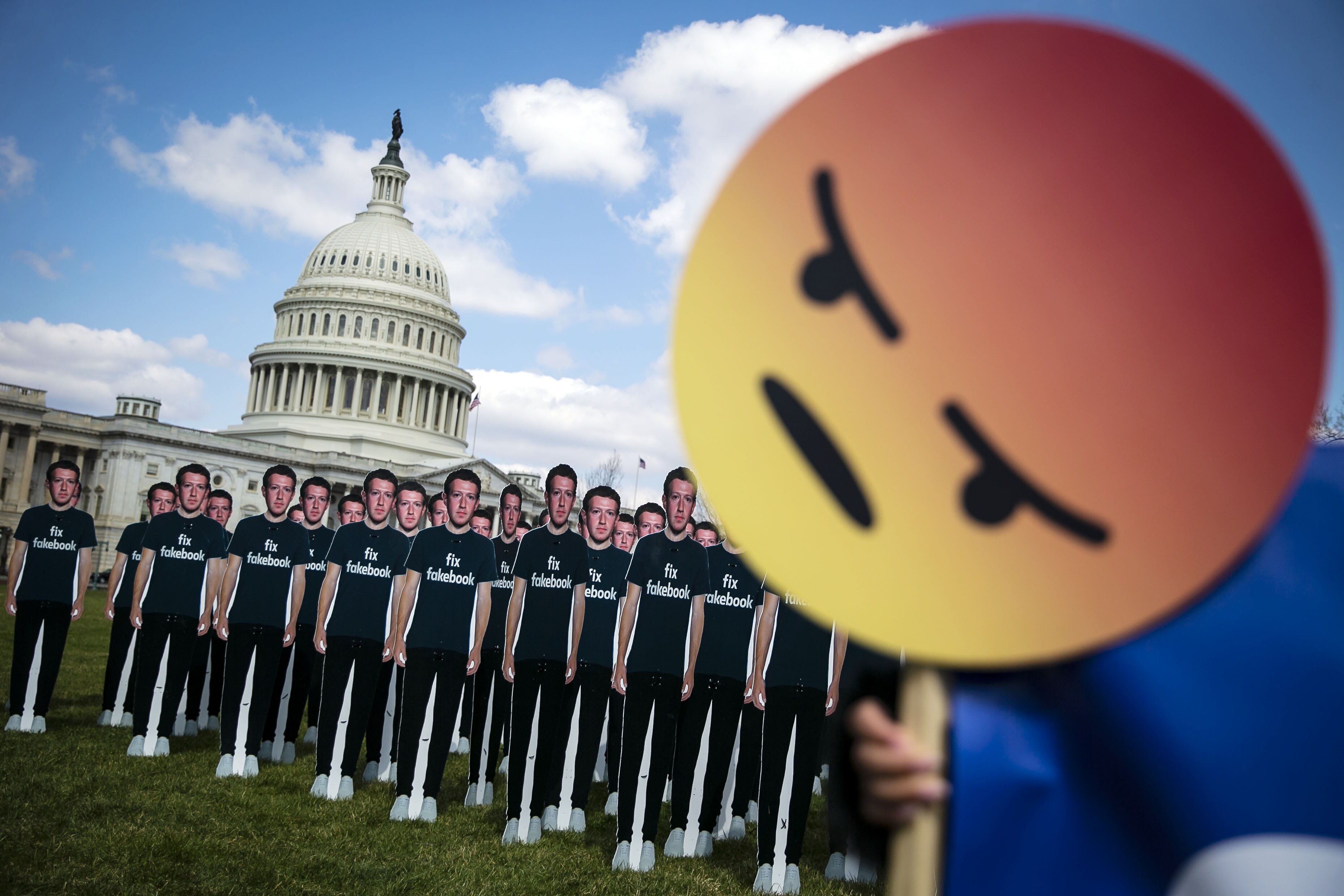
After two days of congressional hearings that collectively lasted over ten hours, there are many questions about Facebook, its policies and its future that experts are debating.
Do Facebook's privacy policies confuse more than they inform? Is the platform a near monopoly that may need to be broken? And how do you ensure that the vast wealth of data that Facebook has is not misused, particularly in elections?
BloombergQuint has collected views on some of these issues.
Privacy Policy Or Legalese?
Since the Cambrdge Analytica scandal came to light, Facebook has been receiving a lot of flak for its ambiguous and verbose privacy and data policy. Lawmakers quizzed founder Mark Zuckerberg about how an ordinary user was expected to decipher the terms of the user agreement, something even some of the lawmakers grilling him couldn't comprehend.
Jitendra Waral of Bloomberg Intelligence says, “It's so complicated that nobody reads it. Essentially the data sharing beyond the Facebook ecosystem came into question here. Is it just necessary to have data sharing for the service to work? Is it restricted to you sharing your content with your friends in your network or do the restrictions go beyond that? So basically they have a lot of work to do in terms of transparency, in terms how the data is used and shared.”
During the conversations, it also came to light that Facebook collects data even on those who don't use the platform.
“In general we collect data on people who are not signed up for Facebook for security purposes," Zuckerberg said Wednesday in a hearing about the social network's privacy practices in Washington before the House Energy and Commerce Committee.
While privacy experts and tech geeks have been crying foul for years about the data collection and storage practices adopted by tech behemoths like Facebook, this revelation by the Facebook founder was the first public acknowledgement of the fact.
Is Facebook A Monopoly?
It's not just data concerns that were brought up at the hearings.
Sen. Lindsey Graham asked Zuckerberg if Facebook enjoys a monopoly on the type of service it provides to its users. He asked, “If I buy a Ford and it doesn't work well and I don't like it, I can buy a Chevy, if I'm upset with Facebook, what's the equivalent product that I can go sign up for?”
Zuckerberg responded to say that there are other tech companies which operate in the same sphere as Facebook does. He offered statistics of how many Americans use different social apps nowadays, in support of his argument that Facebook does not enjoy a monopoly in the tech world.
Jeff Hauser, executive director of the Revolving Door Project at the non-partisan Center for Economic and Policy Research says, “ Zuckerberg's answer to who his competitor was kind of comically unsatisfying because there is no competition for Facebook and they do have monopoly power in the United States and in many other countries across the world. ”
So one idea is to take Facebook and break it into many other parts that it acquired through previous acquisitions. Instagram would be a powerful competitor to Facebook if it was independent of Facebook. WhatsApp would be a powerful competitor to Facebook if it was an independent competitor to Facebook.Jeff Hauser, Center for Economic and Policy Research
Time To Regulate The Internet?
Another big moment during the testimony was when Zuckerberg conceded that it was only a matter of time before the internet would be regulated.
He said, “The internet is growing in importance around the world in people's lives and I think that it is inevitable that there will need to be some regulation.”
Waral agrees that light touch regulation is the way to prevent a Cambridge Analytica like scandal from occurring again in the future. But, he believes that regulation will only raise costs for a company like Facebook. He explains, “What it does is raise compliance costs through out the ecosystem. So, the impact on Facebook from this is that the company is going to increase expenses due to compliance costs.”
The Big Election(s) Year
During his testimony, Zuckerberg did acknowledge that a lot needs to be done to ensure data does not get misused, particularly in elections. Concerns about misuse of user data have emerged in countries like the U.S., but also in India.
Last month, the Union Minister for Law and Information Technology, Ravi Shankar Prasad warned Zuckerberg that if there was any data theft of Indian users due to Facebook's data collection practices, he would stop at nothing short of summoning the Facebook founder to India.
While Pranesh Prakash, policy director at the Centre For Internet and Society, doesn't believe the government would actually summon Zuckerberg to India, he says, “One new concern that's valid across the world, where there are limitations put on freedom of expression during times of campaigning and elections, how do they translate online? There is no typical answer to this.”
Most of the speech regulations apply to candidates and apply to media platforms, which are largely mass media platforms. Now, social media platforms where individuals express themselves might not be regulated the same way or currently at least aren't regulated the same way.Pranesh Prakash, Policy Director, Centre For Internet and Society
Pranesh thinks it is time to re-look at the existing election laws which might not prove to be as useful now as they were some time ago.

Hauser thinks Facebook should help users discern between fakes news and a legitimate source of news.
In the 2016 elections cycle, for fake news, a lot of bots and trolls liked them and they started appearing in the lot of users' feeds. So the algorithm of Facebook encouraged manipulation. Facebook needs to address these concerns. I don't think we can trust Facebook if it doesn't make hard decisions about its algorithms. Right now, Facebook needs to say this is what the algorithm does.Jeff Hauser, Center for Economic and Policy Research

-
Opinion | India at 38: From Innovation Overperformer to Innovation Powerhouse

India now has 453 VC-backed deep science startups, 18 of them late-stage, after 117 percent growth since 2020. Laurus Labs, at USD 9.3 billion, is the most valuable deep science company in any middle-income economy outside China.
-
Navigating Energy Crossroads: S Jaishankar's Call For Diversified Supply Chains At G20 Ministerial Meeting
As geopolitical fault lines continue to test maritime trade routes and commodity flows, Jaishankar's message remains pertinent: true economic resilience requires open markets, protected transit lines, and a genuine commitment to multilateral cooperation rather than coercion.
-
Indians Are Travelling, But Not Every Journey Is A Holiday | The Week In Whys
Pilgrims, patients and working women are the real travellers, and the system hasn't quite caught up with them.
-
Getting To Work Costs Women More | The Reason Why
It is not just about women paying more than men. It is about women paying much more in cities than in villages.
-
AI Bias In Investing Cannot Be Eliminated, But It Can Be Governed
Framing is a particularly important example as identical financial information presented in terms of gains rather than losses can lead an LLM to reach a different assessment.
-
Joining The Dots | Dark Skies, Steady Diya: Why Hope Holds This Diwali
With war, a weak rupee and foreign outflows weighing on sentiment, policymakers at the NDTV World Summit and market veterans at NDTV Profit Ignite: Diwali Edition offered the same advice: stay invested and filter out the noise.
-
The Curious Case of Equitas Small Finance Bank And A CEO Who Quit For Stock
PN Vasudevan believes persistent investor concerns over a perceived conflict of interest had become a governance overhang on Equitas Small Finance Bank's stock, even as the lender improved profitability and asset quality.
-
Talking Points This Week: AI Cash Burn, A Tiger Comeback And An India That Still Finds Its Own Path
India is not immune to higher oil or tighter global liquidity, yet its earnings base is broader, its domestic policy levers are still available.
-
Foreign Investors Own Half Of HDFC Bank and ICICI Bank. An LTCG Cut Could Matter Most Here
Foreign portfolio investors have US$115 billion parked in HDFC Bank, ICICI Bank. If the government cuts long-term capital gains tax, Jefferies says returning foreign money could land here first.










