Google's Willow Quantum Chip Impresses Elon Musk, Chat With Sundar Pichai Goes Viral
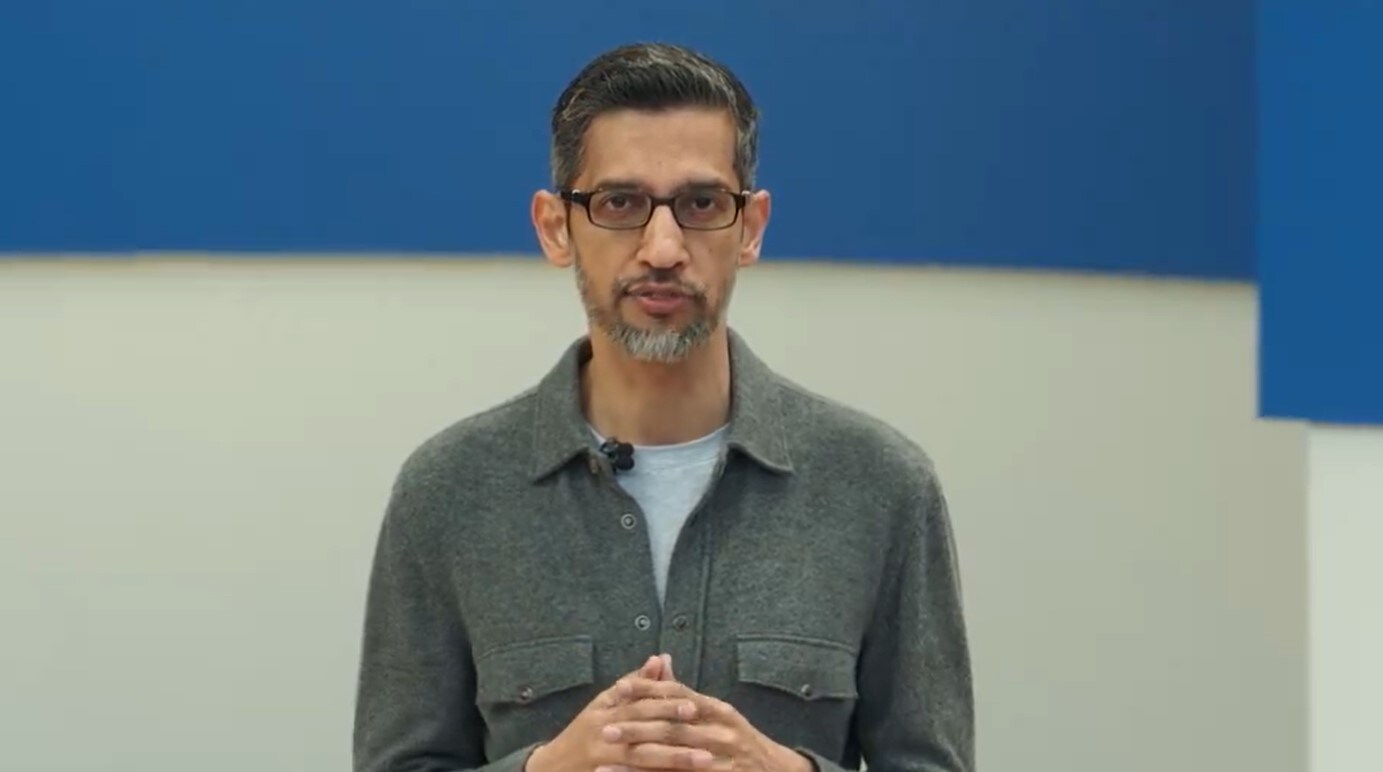
The conversation between Elon Musk and Sundar Pichai on Alphabet Inc.'s Willow quantum chip has taken social media by storm on the chance that the partnership for a quantum cluster in space via the new "breakthrough chip" will "probably happen."
Google's new "state-of-the-art quantum computing chip"—Willow—made a breakthrough that can reduce errors exponentially if scaled up using more qubits, cracking a 30-year challenge in the field, Sundar Pichai said in a post on X.
"In benchmark tests, Willow solved a standard computation in <5 mins that would take a leading supercomputer over 10^25 years, far beyond the age of the universe(!)."
Taking interest in the new breakthrough, SpaceX CEO Musk replied, "Wow", after with Pichai suggested, "We should do a quantum cluster in space with Starship one day."
Musk replied: “That will probably happen,” and discussed a cosmic philosophy, referencing Kardashev scale. "Any self-respecting civilization should at least reach Kardashev Type II. In my opinion, we are currently only at <5% of Type I. To get to ~30%, we would need to place solar panels in all desert or highly arid regions."
indeed. We should scale solar so much more, amazing that we keep looking at alternatives when the most obvious path is staring at our eyes, literally!
December 9, 2024"Indeed. We should scale solar so much more, amazing that we keep looking at alternatives when the most obvious path is staring at our eyes, literally!," Pichai responded.
In 2019, IBM disputed Google's claims that its quantum chip solved a problem that would have taken a classical computer 10,000 years, arguing that, with different technical assumptions about a classical system, the problem might be resolved in two and a half days.
Google stated in a blog post that it considered some of those worries when making its most recent projections. Google said that even in the best-case scenario, a traditional computer would still require a billion years to achieve the same outcomes as its most recent chip.

-
Where You Live Shapes How You Get To Work | The Reason Why

Two-wheelers are the most popular way to get to work in India, accounting for nearly 43% of workplace commutes.
-
High US Salaries, No Green Card Certainty: The Financial Calculation Facing Indian H-1B Families
The suspension of PERM processing at eight technology employers does not cancel existing H-1B visas. What it does is force a question many Indian families have been avoiding: is the US salary worth tying your career and family plans to one employer?
-
Unhedged Position: Can India See An Indonesia-Style Time Correction?
The Nifty is trading below levels it first clocked in 2024. Is there, then, as I have suggested in the headline, potential that the current time correction drags on painfully for the next three-five, even ten years?
-
Navigating Friction And Energy Realities: An Analysis Of Marco Rubio's October Visit To India
Occurring at a critical juncture marked by stalled trade negotiations and escalating geopolitical pressures over global energy supplies, the visit offers a profound window into modern US-India relations.
-
India Exports Capital. Why Not Export Trusteeship?
The big question, then, is whether India can build an institution that global borrowers, investors, banks, and lawyers can trust, even without an Indian connection.
-
France's Economy & Politics Are In Crisis | The Reason Why
Let's look at how the French economy and politics evolved under Nicolas Sarkozy, Franois Hollande and Emmanuel Macron.
-
You May Inherit The Business. You Must Earn Its Credibility.
Succession tests the founder's ability to share authority as much as it tests the next generation's readiness to assume it.
-
Signing Deals Is One Thing; Making Them Work Is Another | The Week In Whys
Sometimes, things don't turn out as planned. Indian companies have lost some bids to rivals, some projects won't produce until 2030.
-
FOMC Wall, PERM Suspension, Hospital Stocks | Talking Points This Week
A PERM suspension would directly affect green-card sponsorship rather than H-1B visas, so the near-term earnings impact could remain relatively limited. The key question is whether this marks a new phase in US scrutiny of Indian IT.
-
Everything, Everywhere, All At Once: Dalal Street's Week To Forget | Joining The Dots
Visa curbs, a Starlink spat and cancer drug caps: what connects this week's shocks for Indian markets









