Google Unveils New Phones And Watch That Undercut Apple On Price
(Bloomberg) -- Alphabet Inc.'s Google on Thursday said its new Pixel phones will deliver improved voice and camera features while bringing back facial recognition for unlocking the device as it seeks to better compete with Apple Inc. and Samsung Electronics Co.
The company's Pixel 7 and 7 Pro devices offer more affordable prices than the dominant duo of the mobile market, coming in at $599 and $899, respectively, and introduce the second generation of Google's in-house Tensor chip. The 6.7-inch Pro version has an additional zoom camera, better display and more memory than the 6.3-inch Pixel 7.
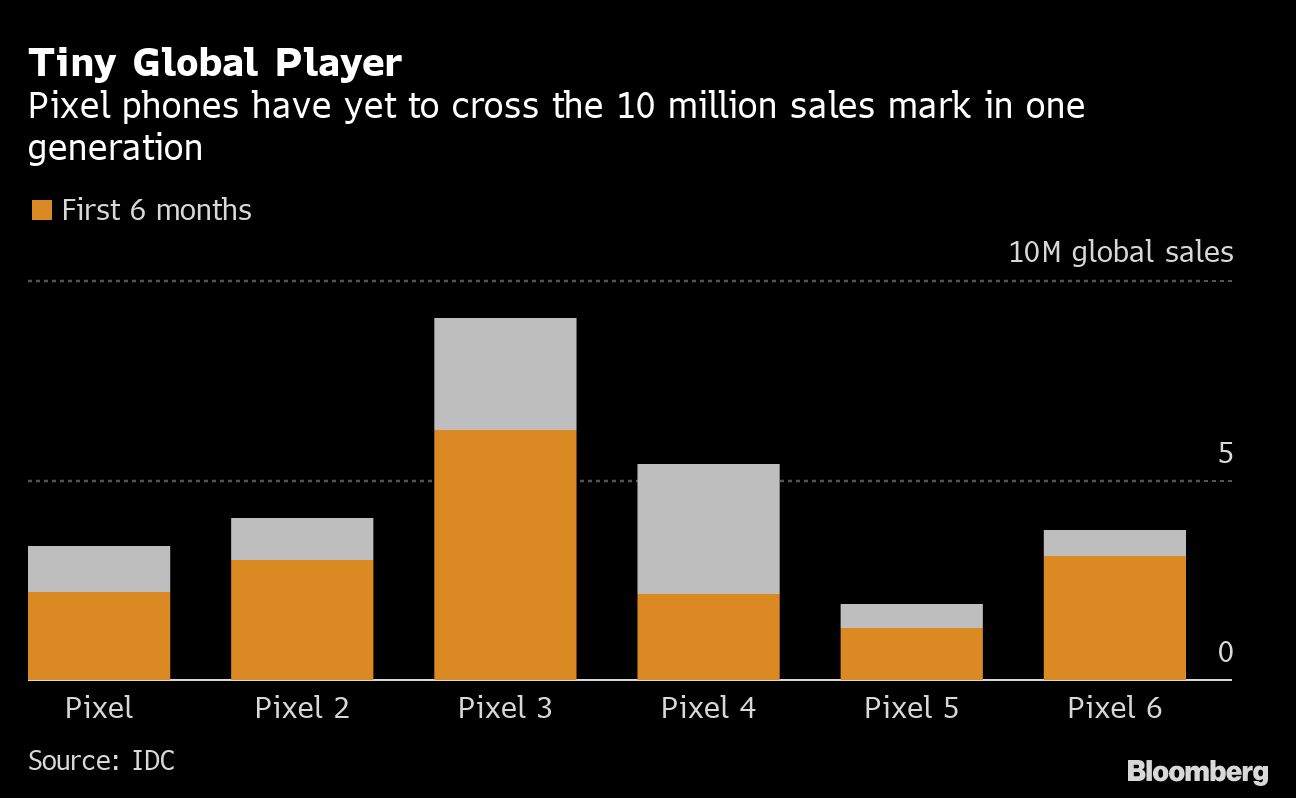
Google's Pixel phones every year serve as the showcase for the company's latest Android software and artificial intelligence-based services, such as the Google Assistant. They demonstrate how Google hopes device-making partners will best use its operating system. Google continues developing its own hardware, which has only ever sold in small numbers, in part as insurance against missteps by Samsung, the only credible Apple rival in the US.
“Google cannot afford to bet its future on Samsung not just for the US market but for the higher-end market across the board,” said Atlanta-based mobile industry analyst Carolina Milanesi. “It also needs a clean experience to show off its AI.”
Google AI shows up in the upgraded language-processing capabilities of its latest software. The Recorder app for voice memos can now automatically label different speakers in transcriptions, and transcriptions are also being added to audio messages in the new Pixels' messaging app.

The Pixel lineup had only 2% of the North American market in the second quarter, whereas Apple's iPhone commanded 52%, according to Canalys data. Still, Google said it's now the fastest-growing smartphone developer, in comments ahead of its launch event in New York Thursday.
Also introduced at the event was the $349 Pixel Watch. It's the first smartwatch from the company to bear the Pixel name and undercuts the latest-generation Apple Watch, which starts at $399. Google will equip its smartwatch with an on-board app store, Google Wallet for mobile payments and Fitbit health sensors and workout services, the company said. There'll be models with and without cellular connectivity and Google promises up to 24 hours of battery life for the round-faced device. It will be available Oct. 13, alongside the new phones.
What Bloomberg Intelligence Says
Google could aggressively diversify its supply chain as it has expanded into various categories including wearables, security systems and smart speakers. Hardware makes up about $10 billion, or 4% of Alphabet's sales, and could grow much faster if the company expands into AR/VR and robots.
-- Mandeep Singh and Ashley Kim, BI analysts
Click here for the full research
Among Google's other smartphone upgrades this year is a promised 72-hour battery life on low-power mode, up from last year's 48 hours. The higher-tier Pixel 7 Pro has three rear cameras, including a 50-megapixel wide-angle lens with the ability to take macro shots and a 48-megapixel telephoto lens with 5X optical zoom. It can record 4K video at 60 frames per second. The standard model benefits from the same macro camera but misses out on the zoom; it also has a slower 90Hz screen rather than the 120Hz display of the Pro.
Both phones see the return of face unlock, matching most of the high-end handsets on the market, after that biometric authentication option was removed from the Pixel line with the fifth-generation model in 2020. Google also matches a feature introduced with much fanfare on the iPhone 13 last year: a Cinematic Blur mode that can synthesize depth of field and background blur in videos.
Questions about the long-term viability of the Pixel line have circulated for years and may intensify now that all tech companies, Google included, are looking at ways to control costs and streamline operations. Success in the smartphone business requires significant upfront and marketing investment.
“If Google does not become serious about the hardware business, I'm afraid this product will be another lost opportunity to expand its phone business in critical markets, such as North America and Europe,” IDC's Francisco Jeronimo said ahead of the launch event.
More stories like this are available on bloomberg.com
©2022 Bloomberg L.P.

-
Love, Sex Aur Dhokha: The Audacious Plot To Spy On Jensen Huang

A Taipei dinner, a Singapore chip buyer and a suspected Chinese asset: inside the alleged spy operation that got close to NVIDIA's Jensen Huang.
-
Ten Things I Learnt This Samvat
Patience can be a trap. Cheap stocks can stay cheap. Leverage can wipe you out. What did Samvat 2082 teach us? Niraj Shah writes on 10 lessons from the year gone by.
-
Talking Points This Week: Tech Nerves, FII Buying, And A Faraway Banking Shock
The global markets are not shining this Diwali. The exception in the large markets is, India.
-
Midterm Rally Lasted A Day. The Hard Reality Of A Divided US May Last Two Years | Opinion
Between a contested AI boom, a debt ceiling that arrives in 2027 and a president with every incentive to act alone, the next two years may prove more volatile than the first day's rally suggests.
-
Blue Wave Will Derail the AI Trade but Won't Dismantle the AI Era | Unhedged Position
The Democrats' sweep of the US Congress will see politics collide with economic forces both over the long and short term.
-
It's Time To Take The GST Council's Bet On Trust Global
Payment records can prove India's services exports, and clear, proportionate rules can bring foreign digital sellers into the tax net.
-
Opinion | India at 38: From Innovation Overperformer to Innovation Powerhouse
India now has 453 VC-backed deep science startups, 18 of them late-stage, after 117 percent growth since 2020. Laurus Labs, at USD 9.3 billion, is the most valuable deep science company in any middle-income economy outside China.
-
Navigating Energy Crossroads: S Jaishankar's Call For Diversified Supply Chains At G20 Ministerial Meeting
As geopolitical fault lines continue to test maritime trade routes and commodity flows, Jaishankar's message remains pertinent: true economic resilience requires open markets, protected transit lines, and a genuine commitment to multilateral cooperation rather than coercion.
-
Indians Are Travelling, But Not Every Journey Is A Holiday | The Week In Whys
Pilgrims, patients and working women are the real travellers, and the system hasn't quite caught up with them.









