Hyundai India Unveils Biggest Product Cycle After Tepid Q4 Results
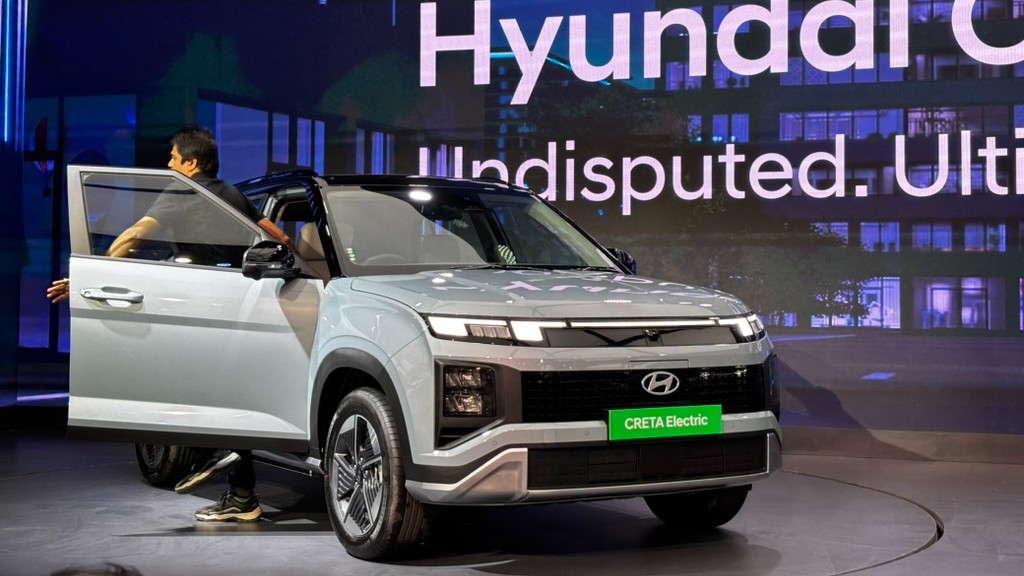
Hyundai Motor India Ltd. has grown for the first time since listing but at the cost of profitability. That didn't stop the company from unveiling its biggest product cycle.
Standalone net profit of the Creta maker fell 4% year-on-year to Rs 1,583 crore in the three months ended March 31, 2025, even as revenue rose 2.5% at Rs 17,562 crore, according to an exchange filing on Friday. Analysts polled by Bloomberg had estimated the bottomline at Rs 1,332 crore and the topline at Rs 17,351 crore.
Hyundai Q4 FY25 Results (Standalone, YoY)
Revenue up 2.5% at Rs 17,562 crore (Estimate: Rs 17,351 crore)
Ebitda up 0.6% at Rs 2,489 crore (Estimate: Rs 2,102 crore)
Margin down 20 basis points at 14.2% (Estimate: 12.1%)
Net profit down 4% at Rs 1,583 crore (Estimate: Rs 1,332 crore)
Final dividend of Rs 21/share declared
One basis point is one-hundredth of a percentage point.
For the full year, net profit fell 6.92% year-on-year to Rs 5,640.2 crore on the back of revenue that declined 1% to Rs 69,193 crore. Ebitda fell 1.95% to Rs 8,954 crore at a margin that shrunk 20 bps to 12.9%.
Hyundai India's quarterly results came against the backdrop of slowing sales and growing competition in the SUV space. Even discounts couldn't prop up sales.
In fiscal 2025, Hyundai India's sales fell 0.66% year-on-year even as the wider industry grew 4.86%, according to VAHAN data. Its longstanding No.2 position is now under threat from historically smaller peers Tata Motors Ltd. and Mahindra & Mahindra Ltd. At 14%, its market share was the lowest in 12 years.
Even exports aren't working. They too were largely stagnant last year, even as largest peer Maruti Suzuki India Ltd. ramped up shipments to Japan.
“Hyundai is at a pivotal stage of its presence in India,” Tarun Garg, chief operating officer at the Indian unit of the South Korean carmaker, said during a virtual media scrum following the earnings announcement. “We are cautiously optimistic of the demand outlook in the near-term.”
In fiscal 2026, the company expects to grow in low single digits, in line with industry estimates, but is confident of growing exports by 7-8%.
Towards that end, Hyundai India has set aside Rs 7,000 crore for capital expenditure in the ongoing fiscal. About 40% of that amount will be deployed to onstream the Talegaon plant by October-December, while a further 25% has been earmarked for product development. Additionally, the company aims to increase localisation beyond 82% across models.
The expansion coincides with Hyundai's biggest product onslaught till date.
The company, which debuted in India with the Santro hatchback nearly three decades ago, plans to launch 26 new and refreshed cars by 2029-30. Of these, 20 will be ICE and six will be EVs. Additionally, Hyundai will debut a hybrid car in India for the first time.
Still, Hyundai India is confident of maintaining double-digit margins in fiscal 2026, despite the Talegaon plant initially being a drag on profitability. The ongoing rollout of the Creta Electric SUV is yet another overhang, as is the packed product cycle.
“The year gone by signifies our resilience in the face of global headwinds…,” Hyundai India Managing Director Unsoo Kim said in a company statement. Going ahead, “we believe that this aggressive launch pipeline, coupled with our upcoming Pune plant capacity, will give us great impetus to continue our growth story in India.”
On Friday, Hyundai India shares fell 0.61% to Rs 1,825 apiece on the BSE even as the benchmark S&P BSE Sensex ended the day 0.22% lower at 82,348.96 points.

-
High US Salaries, No Green Card Certainty: The Financial Calculation Facing Indian H-1B Families

The suspension of PERM processing at eight technology employers does not cancel existing H-1B visas. What it does is force a question many Indian families have been avoiding: is the US salary worth tying your career and family plans to one employer?
-
Swiggy vs Eternal: Food Delivery's Two Rivals Are No Longer In The Same Race
Eternal is building a private AI assistant, dark.ai. Swiggy is still working out how to make Instamart pay, with an operating loss of Rs 895 crore in the July-September quarter while Blinkit stayed profitable.
-
Where You Live Shapes How You Get To Work | The Reason Why
Two-wheelers are the most popular way to get to work in India, accounting for nearly 43% of workplace commutes.
-
Unhedged Position: Can India See An Indonesia-Style Time Correction?
The Nifty is trading below levels it first clocked in 2024. Is there, then, as I have suggested in the headline, potential that the current time correction drags on painfully for the next three-five, even ten years?
-
Navigating Friction And Energy Realities: An Analysis Of Marco Rubio's October Visit To India
Occurring at a critical juncture marked by stalled trade negotiations and escalating geopolitical pressures over global energy supplies, the visit offers a profound window into modern US-India relations.
-
India Exports Capital. Why Not Export Trusteeship?
The big question, then, is whether India can build an institution that global borrowers, investors, banks, and lawyers can trust, even without an Indian connection.
-
France's Economy & Politics Are In Crisis | The Reason Why
Let's look at how the French economy and politics evolved under Nicolas Sarkozy, Franois Hollande and Emmanuel Macron.
-
You May Inherit The Business. You Must Earn Its Credibility.
Succession tests the founder's ability to share authority as much as it tests the next generation's readiness to assume it.
-
Signing Deals Is One Thing; Making Them Work Is Another | The Week In Whys
Sometimes, things don't turn out as planned. Indian companies have lost some bids to rivals, some projects won't produce until 2030.
-
FOMC Wall, PERM Suspension, Hospital Stocks | Talking Points This Week
A PERM suspension would directly affect green-card sponsorship rather than H-1B visas, so the near-term earnings impact could remain relatively limited. The key question is whether this marks a new phase in US scrutiny of Indian IT.









