Canara Bank Q1 Results: Profit Up 10.5% On Lower Provisions
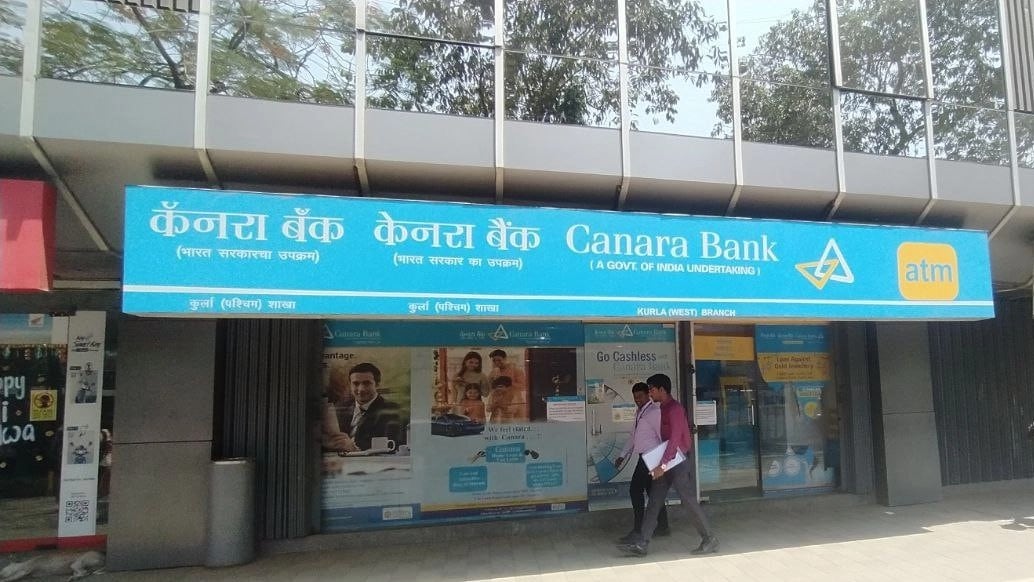
Canara Bank's net profit rose in the first quarter of fiscal 2025, meeting analysts' estimates.
The lender's standalone net profit increased 10.5% year-on-year to Rs 3,905 crore in the quarter-ended June, according to an exchange filing on Thursday. Analysts polled by Bloomberg estimated a net profit of Rs 3,944 crore.
Canara Bank Q1 FY25 Highlights (Standalone)
Net interest income up 6% to Rs 9,166 crore (YoY).
Net profit up 10.5% to Rs 3,905 crore (YoY).
GNPA at 4.14% versus 4.23% (QoQ).
NNPA at 1.24% versus 1.27% (QoQ).
Net interest income, or core income, for the lender was up 5.7% year-on-year to Rs 9,166 crore. Other income was up 10.3% year-on-year to Rs 5,318.8 crore.
In a post-results media briefing, K Satyanarayana Raju, managing director and chief executive officer of Canara Bank, said the bank used to calculate penal interest in interest income. But as per RBI's revised guidelines, it is now being accounted under other charges and this has had an impact on NII.
Asset quality for the lender improved with gross non-performing asset ratio falling 9 basis points quarter-on-quarter to 4.14%. Net NPA ratio, too, improved to 1.24% from 1.27% in the previous quarter.
Provisions for the quarter fell 16% year-on-year to Rs 2,282.34 crore. Of these, provisions for NPAs stood at Rs 2,170.86 crore.
Its provision coverage ratio stood at 89.22% for the quarter. "We want to complete 90% PCR by the end of FY25," Raju said.
He told reporters that the bank has a central government PSU account from Andhra Pradesh, which is showing some sickness. Hence, it has provided Rs 560 crore worth of provisions.
Operating expenses for the lender were up 16.8% to Rs 6,869 crore. Here, employee costs increased 15.8% to Rs 4,229.5 crore and other opex increased 18.3% to Rs 2,639.4 crore.
Canara Bank's domestic gross advances increased 9.17% year-on-year to Rs 9.20 lakh crore. Here, retail advances grew 23.5% year-on-year to Rs 1.75 lakh crore, MSME advances rose 6.84% year-on-year to Rs 1.35 lakh crore, and corporate and others grew 6.87% to Rs 4.23 lakh crore.
Responding to a question on advances, Raju said that the bank withdrew Rs 22,500 crore from low-yielding advances in Q1 and almost completed the exercise of replacing low-cost, low-yielding advances with better ones.
"...have taken a business call that RAM (retail, agriculture and MSME) sector growth would outpace the corporate sector as there are more returns and less risk in RAM, " he said.
It deposits, however, increased 11.47% year-on-year to Rs 12.3 lakh crore. On this front, Raju said that in March, the bank received Rs 15,000 crore from a central government department, which was converted to term deposits after April 1.
"...in gold portfolio, we stopped lending to agriculture," he said.
Net interest margin, another profitability indicator, narrowed 17 basis points quarter-on-quarter to 2.90% in Q1. Cost of funds inched up to 5.25%, as compared to 5% in the previous quarter.
In addition, Raju said that the bank was working towards divestment of two subsidiaries—Canara HSBC Life Insurance and Canara Robeco Mutual Fund. The former is expected to come in the market by Q1 of FY26 and the latter in Q4 of this fiscal.

-
Why Amazon And Flipkart Are Struggling To Beat Meesho In India's Smaller Cities

With 274 million users and lowest-cost logistics, Meesho is defending its value commerce crown against giants like Amazon and Flipkart.
-
High US Salaries, No Green Card Certainty: The Financial Calculation Facing Indian H-1B Families
The suspension of PERM processing at eight technology employers does not cancel existing H-1B visas. What it does is force a question many Indian families have been avoiding: is the US salary worth tying your career and family plans to one employer?
-
Swiggy vs Eternal: Food Delivery's Two Rivals Are No Longer In The Same Race
Eternal is building a private AI assistant, dark.ai. Swiggy is still working out how to make Instamart pay, with an operating loss of Rs 895 crore in the July-September quarter while Blinkit stayed profitable.
-
Where You Live Shapes How You Get To Work | The Reason Why
Two-wheelers are the most popular way to get to work in India, accounting for nearly 43% of workplace commutes.
-
Unhedged Position: Can India See An Indonesia-Style Time Correction?
The Nifty is trading below levels it first clocked in 2024. Is there, then, as I have suggested in the headline, potential that the current time correction drags on painfully for the next three-five, even ten years?
-
Navigating Friction And Energy Realities: An Analysis Of Marco Rubio's October Visit To India
Occurring at a critical juncture marked by stalled trade negotiations and escalating geopolitical pressures over global energy supplies, the visit offers a profound window into modern US-India relations.
-
India Exports Capital. Why Not Export Trusteeship?
The big question, then, is whether India can build an institution that global borrowers, investors, banks, and lawyers can trust, even without an Indian connection.
-
France's Economy & Politics Are In Crisis | The Reason Why
Let's look at how the French economy and politics evolved under Nicolas Sarkozy, Franois Hollande and Emmanuel Macron.
-
You May Inherit The Business. You Must Earn Its Credibility.
Succession tests the founder's ability to share authority as much as it tests the next generation's readiness to assume it.
-
Signing Deals Is One Thing; Making Them Work Is Another | The Week In Whys
Sometimes, things don't turn out as planned. Indian companies have lost some bids to rivals, some projects won't produce until 2030.










