These Are the Best — and Worst — Cities for Work-Life Balance
(Bloomberg) -- The best city for work-life balance: Oslo. The most overworked? Dubai.
That's according to a study released on Wednesday by mobile access technology company Kisi, which looked at factors including work intensity and city livability as well as quality health care, affordable cost-of-living, and ample time off. While a typical worker in Helsinki — number three for work- life balance on the list — takes a full month of paid vacation every year, for example, the norm in Los Angeles is just one week.

For many, the pandemic has been a time to rethink priorities and make big leaps — like moving to a new city. And as the labor market continues to run hot, return-to-office plans across industries have faltered. Employees have resisted – savoring the flexibility afforded by remote work – and many are prepared to job hop if their company mandates in-person work. Companies like Airbnb Inc. are promising permanent work-from-home policies to entice candidates in an increasingly intense competition for talent. City leaders looking to capitalize on workers' newfound mobility and seize the opportunity to expand their tax base and boost their economies will need to compete across many dimensions.
Against this backdrop, some financial and corporate hubs, which have long been economic powerhouses, ranked poorly. New York City plunged in the rankings, coming in at 59 out of 100 cities, down from 38 the year before and 21 in 2019 before the pandemic took hold. London, while ranked significantly higher, also fell — to 27 in 2022 from 20 the year before and 12 in 2019.

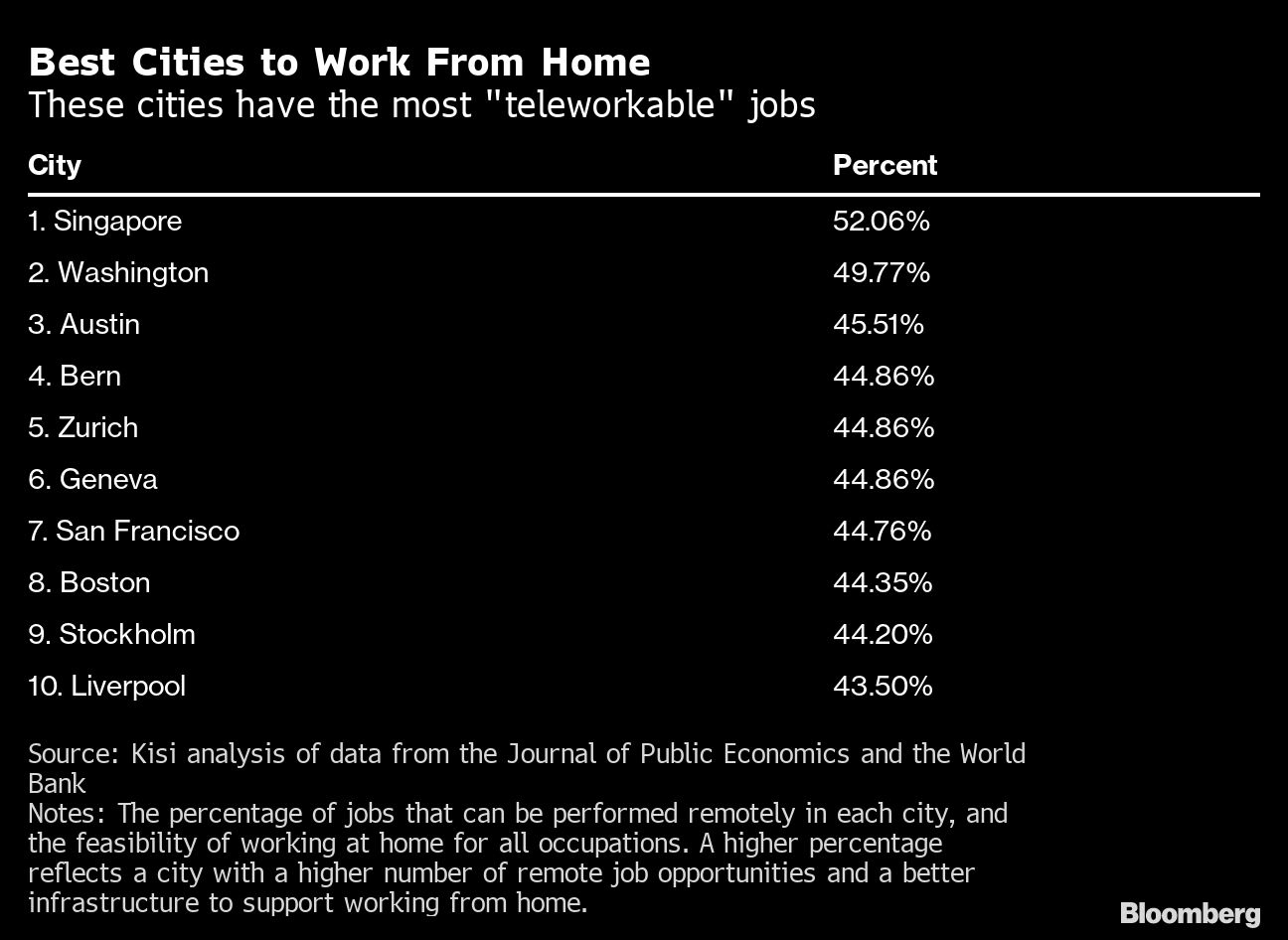
Burned-out workers may instead want to consider Amsterdam, Buenos Aires, or Sydney, where less than 10% of the population is overworked, according to the study. Those who cherish their five-minute morning commute from bed to living room may want to ponder Singapore, Washington D.C. or Austin, where the highest percentage of jobs can be performed remotely at in and around 50%.
Kisi studied 51 U.S. metro areas and 49 major global cities across more than 130 data points — such as rates of overwork, access to health care, and safety metrics to gauge the work intensity, rights and the well-being of inhabitants.
“Recent years have tested the support structures in place for employees around the world,” said Bernhard Mehl, chief executive officer of Kisi. “The ongoing stress and disruption brought about by the pandemic has been followed by war in Ukraine, contributing to global instability that will be felt for years to come.”

More stories like this are available on bloomberg.com
©2022 Bloomberg L.P.

-
Navigating Energy Crossroads: S Jaishankar's Call For Diversified Supply Chains At G20 Ministerial Meeting

As geopolitical fault lines continue to test maritime trade routes and commodity flows, Jaishankar's message remains pertinent: true economic resilience requires open markets, protected transit lines, and a genuine commitment to multilateral cooperation rather than coercion.
-
Indians Are Travelling, But Not Every Journey Is A Holiday | The Week In Whys
Pilgrims, patients and working women are the real travellers, and the system hasn't quite caught up with them.
-
Getting To Work Costs Women More | The Reason Why
It is not just about women paying more than men. It is about women paying much more in cities than in villages.
-
AI Bias In Investing Cannot Be Eliminated, But It Can Be Governed
Framing is a particularly important example as identical financial information presented in terms of gains rather than losses can lead an LLM to reach a different assessment.
-
Joining The Dots | Dark Skies, Steady Diya: Why Hope Holds This Diwali
With war, a weak rupee and foreign outflows weighing on sentiment, policymakers at the NDTV World Summit and market veterans at NDTV Profit Ignite: Diwali Edition offered the same advice: stay invested and filter out the noise.
-
The Curious Case of Equitas Small Finance Bank And A CEO Who Quit For Stock
PN Vasudevan believes persistent investor concerns over a perceived conflict of interest had become a governance overhang on Equitas Small Finance Bank's stock, even as the lender improved profitability and asset quality.
-
Talking Points This Week: AI Cash Burn, A Tiger Comeback And An India That Still Finds Its Own Path
India is not immune to higher oil or tighter global liquidity, yet its earnings base is broader, its domestic policy levers are still available.
-
Foreign Investors Own Half Of HDFC Bank and ICICI Bank. An LTCG Cut Could Matter Most Here
Foreign portfolio investors have US$115 billion parked in HDFC Bank, ICICI Bank. If the government cuts long-term capital gains tax, Jefferies says returning foreign money could land here first.
-
'Never Seen This Level Of Negativity': Sandeep Tandon Says The Next Rally May Be Closer Than You Think
Veteran investor Sandeep Tandon says foreign selling is easing, large-caps are due a comeback and mid-caps are crowded, while he turns positive on gold, power and pharma this Diwali.
-
Indians Stay With Family, Not In Hotels | The Reason Why
India still lacks enough clean, reliable and affordable hotels for budget-conscious travellers.










