India's $21 Billion Telecom War Comes Down to $2

India's great telecom melee was bad enough as a brawl between service providers and the state, with operators complaining about the government's outlandish claims on their past revenue. Now, consumers have jumped into the fray. A confusing three-cornered fight could lead to ugly outcomes: The country's broken financial system would take a fresh hit; new 5G networks could be delayed; and the government's annual revenue from the sector might get squeezed.
This week, New Delhi wants nearly Rs 1.5 lakh crore ($21 billion) in back license fees and spectrum usage charges, including penalties, interest and interest on unpaid interest. Before they lost the case in Supreme Court, the telcos maintained the government's interpretation of what it was owed under the 1999 revenue-sharing agreement to be too broad and unfair because it included even their non-telecom revenue, such as interest and dividend income.
It's a Pyrrhic victory for the government because not all the money it wants is coming. Of the 15 firms facing these long-contested demands, most have shut down, sold out or ended up insolvent. All eyes are now on Vodafone Idea Ltd., one of the three private-sector mobile services companies still standing. It has to pay Rs 53,000 crore by January 23, by government estimates. Even taking Vodafone Idea's own calculation of the liability at Rs 44,200 crore, the loss-making carrier's net debt soars to a life-threatening Rs 1.6 lakh crore. It may not be able to meet all its obligations.
The threat of a bankruptcy was real when I wrote about Vodafone Idea's grim prospects in November. With the two large shareholders - Britain's Vodafone Group Plc and billionaire Kumar Mangalam Birla - reluctant to throw more good money after bad, the equity value of the business is hurtling toward zero.
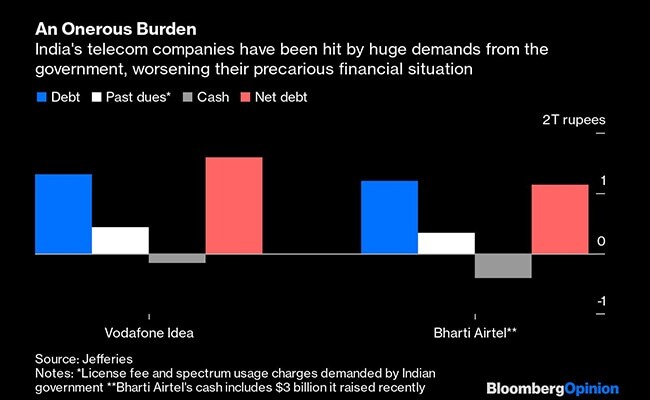
Telcos have requested the country's top court to extend the payment terms. Even if Vodafone Idea stays afloat thanks to a last-minute compromise, customers have read the writing on the wall. The mobile carrier lost 3.6 crore subscribers in November. And that was before all three players raised prices in December. As the churn gets busier, the hypercompetitive Indian market will effectively turn into a duopoly. Bharti Airtel Ltd. and Reliance Jio Infocomm Ltd. will see their market shares settle at around 35 per cent and 45 per cent, respectively, by March 2021, according to Jefferies Financial Group Inc.
Where will this leave Vodafone, or the $1.7 billion that the government earns from the current No. 2 player as annual spectrum revenue? Of the many creditors that have exposure to the telco, Yes Bank Ltd. is particularly vulnerable. Saddled with bad loans, the Indian bank is struggling to raise funds as its capital buffers wear dangerously thin. If potential white knights get cold feet because of the lender's outsize telecom exposure (as much as 29 per cent of shareholders' funds, including 18 per cent for Vodafone Idea), then the country's financial system may be looking at a big confidence shock.
Worryingly, future profitability of the telecom industry also remains unclear. Blame it on the cost-conscious Indian consumer. With telcos raising prices, using one SIM card for calls and another for data isn't cost effective any more. Demand will consolidate, and some of it may vanish altogether. Bharti Airtel recently introduced a Rs 179 plan, valid for 28 days, which offers 2 gigabytes of data, unlimited calls, and comes packaged with Rs 200,000 of life insurance. This is a way to lessen the sticker-price shock for entry-level subscribers, especially in semi-urban and rural areas, who are being nudged to trade up from the current Rs 149 basic plan. Expect more such bundled offerings as both Bharti and Jio try to raise their average revenue per user to around Rs 300, where the economics starts to make more sense.
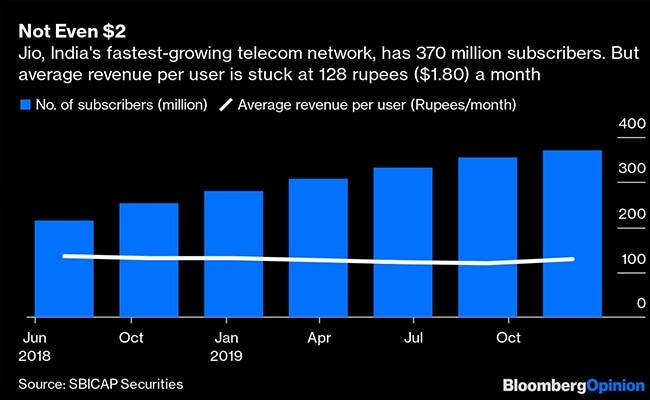
That's still a ways off, though. Jio, whose aggressive entry three years ago with free voice calls and cheap data triggered cutthroat competition, garnered revenue per user of just Rs 128- not even $2 - in the December quarter, practically flat from a year earlier. Being a new entrant, Jio isn't saddled by the government's revenue demands that have come to haunt Vodafone Idea and, to a smaller extent, Bharti. Until Mukesh Ambani, the deep-pocketed tycoon behind Jio, turns his attention from chasing market share to maximizing returns on his $50 billion foray, pricing will stay irrational and new investment will remain constrained.
Although Bharti has raised new equity and convertible debt, at more than Rs 1 lakh crore, its net debt is onerous. It's hard to see strong demand at the government's auction of 5G airwaves in April. Vodafone's long-standing tax dispute with New Delhi has been a cautionary tale. The business imploding because of another instance of government heavy-handedness will send a fresh bad signal about India's business climate, though for the country's telecom industry, the outlook will remain somber regardless of whether Vodafone Idea survives or not.
(Andy Mukherjee is a Bloomberg Opinion columnist covering industrial companies and financial services. He previously was a columnist for Reuters Breakingviews. He has also worked for the Straits Times, ET NOW and Bloomberg News.)
Disclaimer: The opinions expressed within this article are the personal opinions of the author. The facts and opinions appearing in the article do not reflect the views of NDTV and NDTV does not assume any responsibility or liability for the same.

-
High US Salaries, No Green Card Certainty: The Financial Calculation Facing Indian H-1B Families

The suspension of PERM processing at eight technology employers does not cancel existing H-1B visas. What it does is force a question many Indian families have been avoiding: is the US salary worth tying your career and family plans to one employer?
-
Swiggy vs Eternal: Food Delivery's Two Rivals Are No Longer In The Same Race
Eternal is building a private AI assistant, dark.ai. Swiggy is still working out how to make Instamart pay, with an operating loss of Rs 895 crore in the July-September quarter while Blinkit stayed profitable.
-
Where You Live Shapes How You Get To Work | The Reason Why
Two-wheelers are the most popular way to get to work in India, accounting for nearly 43% of workplace commutes.
-
Unhedged Position: Can India See An Indonesia-Style Time Correction?
The Nifty is trading below levels it first clocked in 2024. Is there, then, as I have suggested in the headline, potential that the current time correction drags on painfully for the next three-five, even ten years?
-
Navigating Friction And Energy Realities: An Analysis Of Marco Rubio's October Visit To India
Occurring at a critical juncture marked by stalled trade negotiations and escalating geopolitical pressures over global energy supplies, the visit offers a profound window into modern US-India relations.
-
India Exports Capital. Why Not Export Trusteeship?
The big question, then, is whether India can build an institution that global borrowers, investors, banks, and lawyers can trust, even without an Indian connection.
-
France's Economy & Politics Are In Crisis | The Reason Why
Let's look at how the French economy and politics evolved under Nicolas Sarkozy, Franois Hollande and Emmanuel Macron.
-
You May Inherit The Business. You Must Earn Its Credibility.
Succession tests the founder's ability to share authority as much as it tests the next generation's readiness to assume it.
-
Signing Deals Is One Thing; Making Them Work Is Another | The Week In Whys
Sometimes, things don't turn out as planned. Indian companies have lost some bids to rivals, some projects won't produce until 2030.
-
FOMC Wall, PERM Suspension, Hospital Stocks | Talking Points This Week
A PERM suspension would directly affect green-card sponsorship rather than H-1B visas, so the near-term earnings impact could remain relatively limited. The key question is whether this marks a new phase in US scrutiny of Indian IT.









