Is It Time to Break Up Luxury Behemoth LVMH?
(Bloomberg Opinion) -- When Bernard Arnault presents LVMH's annual earnings on Thursday, investors and analysts will be hanging on to his every word as they try to decipher the direction of top-end demand.
Yet LVMH is being penalized by shareholders for its disparate collection of businesses. Breaking up the behemoth could release significant value for investors. It might, incidentally, help solve the looming succession issue as founder and Chief Executive Officer Arnault comes closer to handing over the reins to the next generation.
LVMH suffers from a conglomerate discount, because not only does it include its two biggest brands, Louis Vuitton and Dior, but it also has watches and jewelry, cosmetics, wines and spirits, duty-free retailing and hospitality. Shares in LVMH trade on about 16 times this year's estimated earnings before interest and tax, less than half of Hermes International SCA's 34 times.
Some discount to Hermes is warranted. The Birkin bag maker can, in effect, control demand for its iconic products. Meanwhile, LVMH's valuation could also reflect concerns that its scale means there's less room to grow and that Dior is decelerating after a remarkable run.
Nevertheless, the markdown looks harsh. After all, Louis Vuitton is expected to generate €12.3 billion ($13.4 billion) of operating profit this year, an impressive 51.8% of sales, according to HSBC Holdings Plc estimates.
Even on the simplest breakup valuation, the rationale for a split is compelling. For example, by putting Louis Vuitton and Dior on a multiple closer to that of Hermes than the rest of the fashion and leather-goods sector, these brands could be worth as much as the whole group, which currently has an enterprise value of about €360 billion.
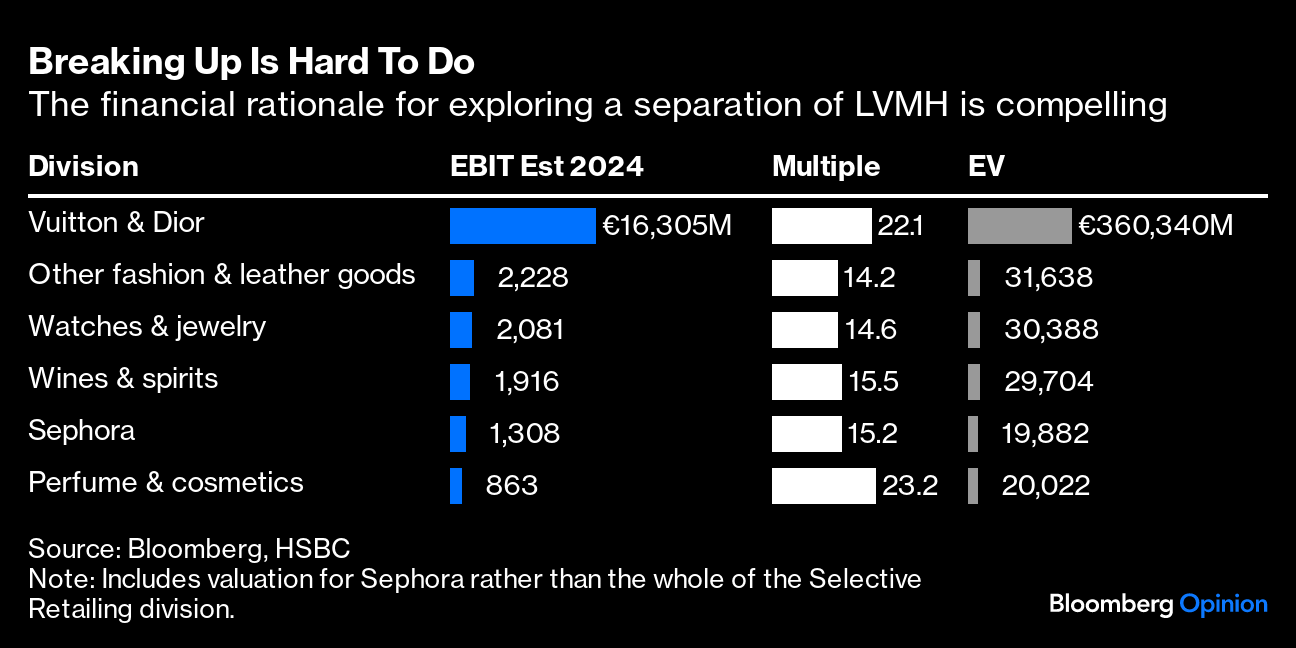
Luxury goods groups don't do “buy one, get one free” deals. But in effect that's what LVMH investors are getting. The other fashion and leather-goods houses within the LVMH stable, such as Loewe, Fendi and Celine, are being thrown in for nothing, as well as beauty retailer Sephora, jewelers Tiffany and Bulgari, and wines and spirits. That looks like a good reason to explore a separation.
Questions around LVMH's structure need to be driven primarily by valuation. But dismantling the group might also help avoid potential pitfalls on succession. Arnault turns 75 in March, and all of his five children have senior roles within the business. Eventually, he will have to decide whether to pick one to be CEO or divide the responsibilities between them. Handing the reins over to an outsider looks unlikely, though he could appoint a non-family member as CEO until one of the next generation is ready to take over, emulating the arrangement at Prada SpA.
Of course, no way of cleaving apart LVMH would be perfect. It could be split into four or five separate businesses, depending on whether Sephora continues to sit within a retail division or this unit is combined into an enlarged cosmetics and fragrance company, including brands such as Parfums Christian Dior, Guerlain and Fenty Beauty.
There would also be some additional costs from each arm having to support its own central functions and head office. The individual businesses might have less clout than the behemoth when it comes to buying advertising, securing the best store locations, digital marketing and recruiting top talent. But synergies between luxury brands are relatively few. And an independent fashion and leather-goods business would still dwarf rivals.
The biggest question is whether Arnault senior would really take an ax to the empire he has spent 40 years building. In fact, he has been taking steps to keep it together. In 2022, he orchestrated raising the age limit for his roles by five years to 80. He has also tightened the family's grip, restructuring its holding company, Agache SE, into a limited partnership, with the patriarch as managing partner and the share capital held equally between the five children.
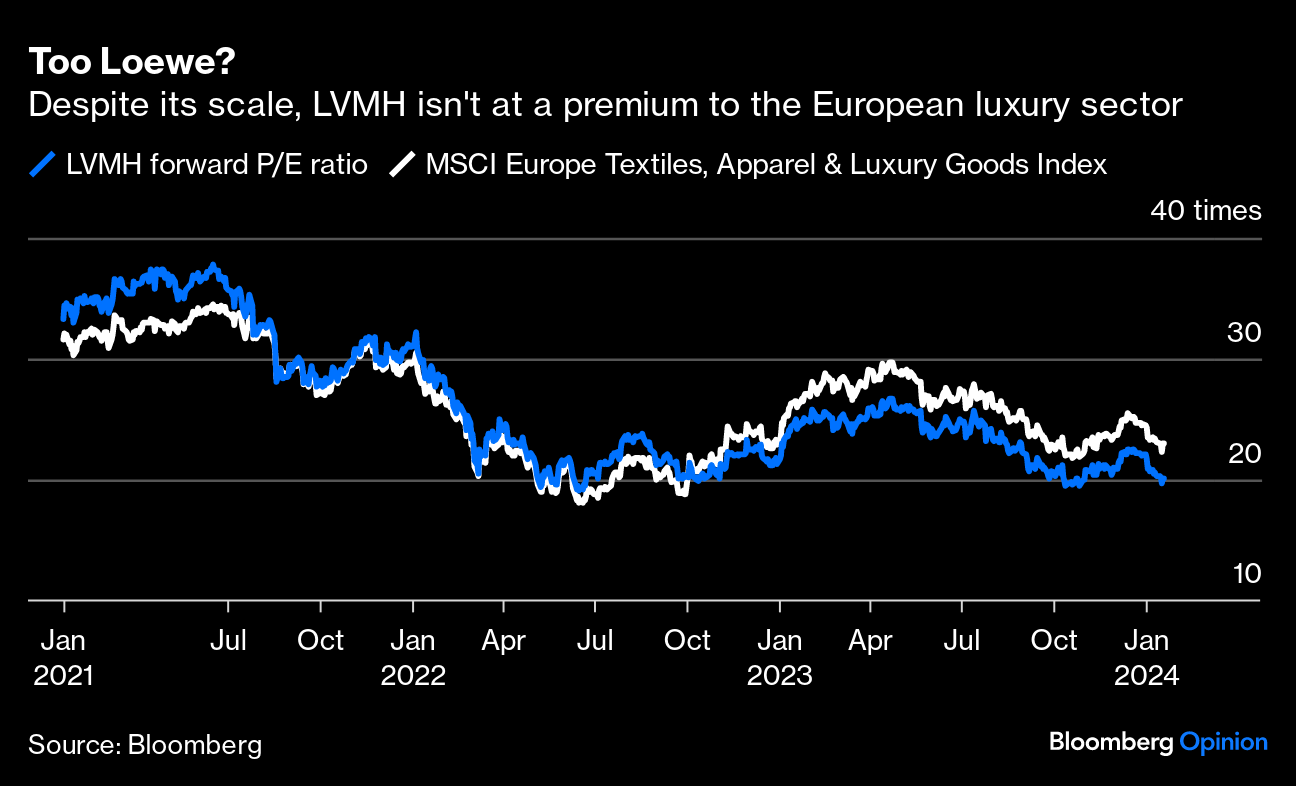
But the debate will only intensify if the conglomerate discount remains — right now, luxury valuations are also depressed by slowing demand after the extraordinary boom of the past three years — and as we move closer to a decision on succession.
Alternatively, a strategic shift could force it onto the agenda. A merger with Chanel might necessitate the separation of the enlarged fashion and leather-goods unit. Meanwhile, Diageo Plc owns 34% of LVMH's wines and spirts division. The British company acquiring the remainder has long been seen as a possibility.
Whether LVMH is more valuable together or split into its constituent parts is more of a PowerPoint idea for now. The company's scale and the family's control make an activist intervention unlikely. But for investors, it's a conversation that needs to be had.
- The Luxury Slump Is Keeping Burberry in Check: Andrea Felsted
- You're All Paying Attention to the Wrong Davos: Adrian Wooldridge
- Everyone Seems to Want Uranium Right Now: Merryn Somerset Webb
This column does not necessarily reflect the opinion of the editorial board or Bloomberg LP and its owners.
Andrea Felsted is a Bloomberg Opinion columnist covering consumer goods and the retail industry. Previously, she was a reporter for the Financial Times.
More stories like this are available on bloomberg.com/opinion
©2024 Bloomberg L.P.

-
Navigating Friction And Energy Realities: An Analysis Of Marco Rubio's October Visit To India

Occurring at a critical juncture marked by stalled trade negotiations and escalating geopolitical pressures over global energy supplies, the visit offers a profound window into modern US-India relations.
-
India Exports Capital. Why Not Export Trusteeship?
The big question, then, is whether India can build an institution that global borrowers, investors, banks, and lawyers can trust, even without an Indian connection.
-
France's Economy & Politics Are In Crisis | The Reason Why
Let's look at how the French economy and politics evolved under Nicolas Sarkozy, Franois Hollande and Emmanuel Macron.
-
You May Inherit The Business. You Must Earn Its Credibility.
Succession tests the founder's ability to share authority as much as it tests the next generation's readiness to assume it.
-
Signing Deals Is One Thing; Making Them Work Is Another | The Week In Whys
Sometimes, things don't turn out as planned. Indian companies have lost some bids to rivals, some projects won't produce until 2030.
-
FOMC Wall, PERM Suspension, Hospital Stocks | Talking Points This Week
A PERM suspension would directly affect green-card sponsorship rather than H-1B visas, so the near-term earnings impact could remain relatively limited. The key question is whether this marks a new phase in US scrutiny of Indian IT.
-
Everything, Everywhere, All At Once: Dalal Street's Week To Forget | Joining The Dots
Visa curbs, a Starlink spat and cancer drug caps: what connects this week's shocks for Indian markets
-
India Is Going Abroad For Critical Minerals. But It May Take Years To Pay Off | The Reason Why
Although India's steps are in the right direction, they remain modest compared with India's growing dependence.
-
When Everyone Has AI, What Gives You An Edge?
India's young workforce is entering an uncertain world of work where powerful AI tools are becoming widely accessible. The advantage will belong to those who combine deep expertise with digital fluency, and the distinctly human capabilities that technology cannot manufacture.
-
Wrong Labels, High Pesticide Residues Holding Back Agri Exports | The Reason Why
India needs stronger domestic food-safety and labelling standards, with best practices becoming part of everyday business for farmers, traders and food companies.










