Unprecedented Monsoon Fury In Himachal Pradesh
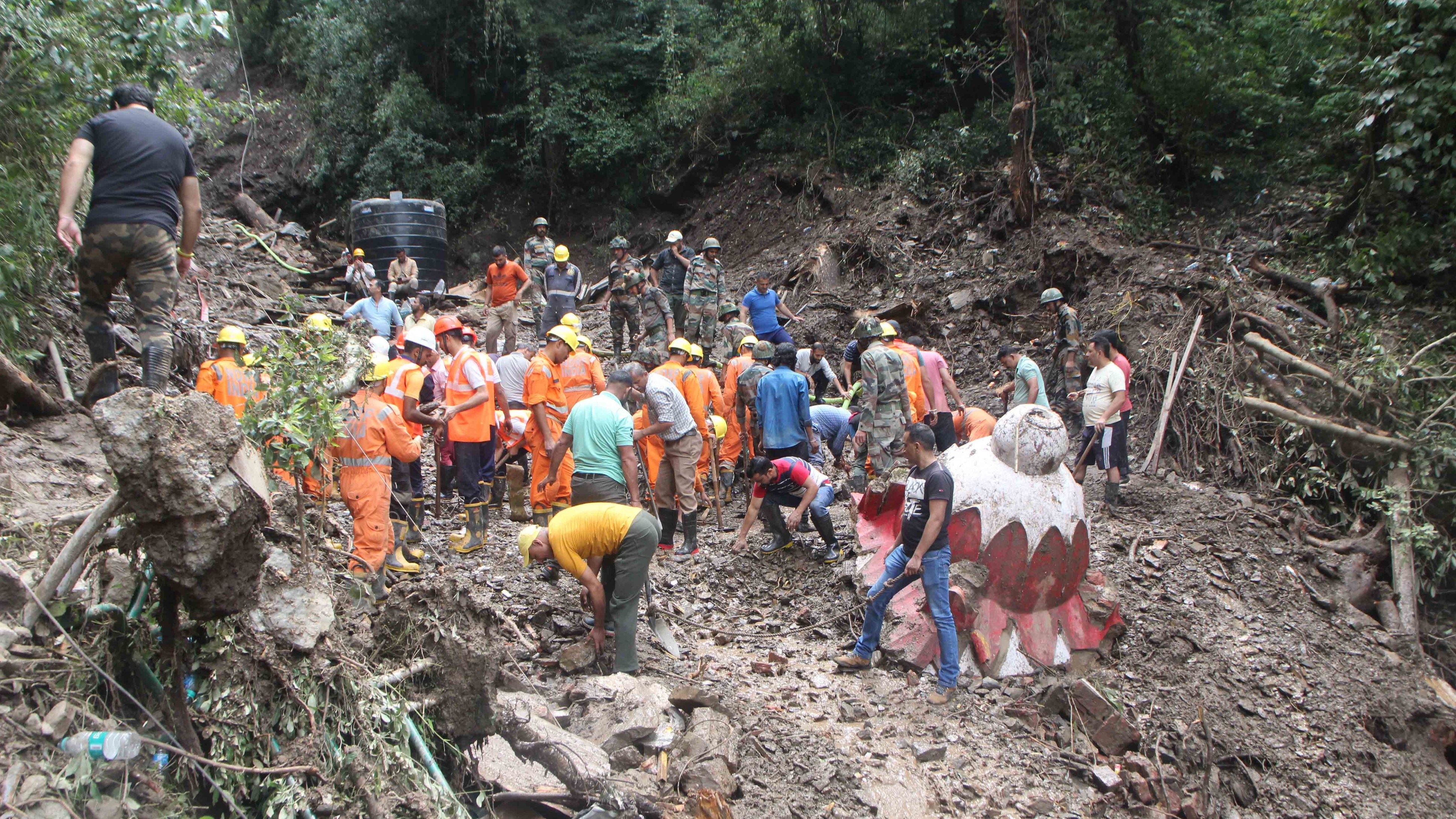
Unprecedented rains and flash floods over the last two months have thrown life out of gear in the tiny hill state of Himachal Pradesh in North India, moving the state government to declare Himachal a ‘Natural Calamity Affected Area.'
The gushing water in rivers, sliding hills and falling trees in the midst of downpour have claimed over 330 lives in Monsoons in Himachal Pradesh this year ( 77 of them since Sunday last) and have caused massive damage to National Highways, state roads, homes, hotels, agriculture and horticulture fields and just any other infrastructure coming in their way.
“The state has suffered financial losses amounting to over Rs 8000 crore since the onset of Monsoons this year, which includes Rs 2700 crore in Public Works Department (PWD) due to massive damage to state roads followed by Rs 1850 crore in Irrigation and Public Health (IPH) department. The Agriculture department has suffered losses of Rs 257 crore, said Principal Secretary (Revenue) to Government of Himachal Pradesh, Onkar Sharma, who is also the Member Secretary of Himachal Pradesh State Disaster Management Authority (HP SDMA).
Sharma said in view of the colossal damage, the Himachal Pradesh government has gone for ‘Post Disaster Need Assessment' for the first time so as to ascertain the focus and priority in restoration works and timeline is being given for that.
The funds are also being requisitioned from different agencies, including NDMA, for rehabilitation works, he said, adding that the government has associated the experts of National Institute of Technology (NIT) and Indian Institute of Technology (IIT) in the state to study the landslides in Shimla and other parts of Himachal to ascertain the cause.
Although most of the districts in the state have suffered devastation with road links snapped in many areas bringing life to standstill, the scenario in the two main international tourist destinations in the state- Manali and the Shimla- has turned scary. Manali saw major devastation due to furious Beas waters on 8-9 July and Shimla was witness to the worst landslides on 14 and 15 August.
The landslide originating from the side of Indian Institute of Advanced Study (IIAS) on the morning of 14 August, which reportedly buried around 20 people persons alive in a temple, has left the people in the state capital in shock especially as 16 bodies have been retrieved so far from the debris after frantic search by Police, National Disaster Response Force (NDRF), State Disaster Response Force (SDRF) and the army jawans over last six days. The search is still on.
The second landslide in Shimla was so frightening (as caught in videos) that it reduced some houses, built one over another on the fragile hill, and a state of art slaughter house manned by Shimla Municipal Corporation Krishna Nagar locality to rubble in a few seconds. Two people were killed in this incident.
The continuous rains earlier this week uprooted and shook several Deodar trees in Shimla and its surrounding that has loosened the strata and has left houses in some localities unsafe to live and pass by.
The road connectivity to Shimla and Manali too has suffered badly for the past one month. A stretch of National Highway between Kalka and Shimla was swept away near Dharampur in Solan with swirling rain waters bringing down debris, shooting stones and boulders from the hill alongside. The highway between Mandi and Manali has also been washed away at several places due to the raging Beas river changing its course in heavy rains last month.
Apple Growers Worried
While within the state connectivity is snapped at many places, causing much inconvenience to the commuters the broken road link within Himachal Pradesh has worried apple growers too, with the fruit ready for marketing and the buyers, who used to come to their doorstep in local mandis, staying away this time for scary weather.
The production of apple is lesser this year due to adverse weather conditions since flowering in April, the small and big growers incurred major losses on account of incessant rains and landslides over last two months that uprooted apple trees in large numbers in many orchards in Shimla, Kullu, Mandi and other apple growing areas of the state.
“The production on my apple orchard on 13 bighas is just half this time. A portion of my orchard, with many full grown apple trees on it, was swept away by a landslide in the rain some days back. The fruit is not good and buyers from outside are not interested this time due to bad roads, weather. They are asking us to drop the produce at Chandigarh if we want to sell, which is difficult for us also,” said Rinku Sagaik from Sapral village in Kalbog area in Shimla district.
The apple growers said the wholesale price of normal apple is higher, Rs 150-200 per kilogram this time, because of lesser supply, which is discouraging the buyers to come over in inclement weather as the retail price of the fruit would then go out of the reach of consumers.
The apple economy of Himachal Pradesh runs to over Rs 4000 crore annually.
Need To Revisit Development Model
On the whole, the state government is struggling to take immediate measures on restoration, given the tough situation.
Congress Chief Minister, Sukhvinder Singh Sukhu is personally reaching out to the people in distress in affected areas to monitor the rescue and relief measures across the state and has assured all help apple growers.
Even though the political leadership, the ruling and the opposition, in the state is hesitant to accept the man-made factors in aggravating disaster at the moment for obvious reasons, the Chief Minister did indicate that the government will have to go stricter with the construction norms and pointed to the faulty cutting of hills to widen roads.
The locals strongly feel that nature's fury this time is nothing less than a wakeup call for policy makers to revisit the ‘development model' being followed in the fragile hill state.
“I have never seen such a huge damage to life and property due to excessive rains in my lifetime. In 1945, there was heavy snowfall, 9-10 feet, in one spell in Shimla. Many people were buried under the snow that time also, but the British officers did not reveal the statistics,” recalled 87 year old retired IAS officer and a litterateur in Shimla, Shriniwas Joshi.
Joshi said the pressure on Shimla has increased manifold over time with a burgeoning population of over 2 lakh, which has led to massive construction just everywhere.
He said the state must reconsider whether it needs huge infrastructure or not.
“The straight cutting of hills for four lanes is bringing down the whole strata. The cutting was earlier done at 45 degrees and above that we were supposed to have orchards. But now it's going ruthless and the hills are cut straight to carve out bigger roads,” he added.
On ground, the tourist hill state's unmindful quest to catch up with development on the lines of plain areas over the last few decades is seemingly paying back in terms of nature's extremity.
Whether it is about four-lanes piercing through the fragile mountains, hydro project tunnels shaking rocks and hills, haphazard and unsafe construction just everywhere on the mountains or the debris of construction work finding way to the rivers or their tributaries- Everything has added up to the devastation caused by rains.
The alleged unscientific mining on river beds in Himachal Pradesh too has been a cause of concern that increases the risk in such a disaster.
The environmentalists feel that while the digging of hills for infrastructure is loosening the strata, the construction activity near the river beds across the state has increased the extent of damage in floods. The devastation that occurred in Kullu, Manali and Mandi, which are located on the banks of Beas river, is a live example.
17,120 Landslide Sites In HP
According to SDMA, the total number of landslide sites in the state is 17,120 with maximum of them in Sirmaur district (2559) followed by Chamba district (2389). As many as 675 landslide sites are near the critical infrastructure/habitations, according to HP SDMA.
A case study by National Institute of Disaster Management on major Kotrupi landslide in Mandi district of Himachal Pradesh in 2017, where 46 passengers travelling in two buses were buried alive, revealed that the five perennial rivers of Himachal Pradesh house 118 mini, small, large and mega hydro power stations, out of which 67 hydro power stations are built in landslide hazard risk zones. Among these, 10 mega hydro power stations are in medium to high risk landslide areas.
The study also pointed out that landslides are the second most recurring hazards in the mountainous state, after earthquakes.
A noted environment activist from Chamba district of Himachal Pradesh, Kulbhushan Upmanyu, 74, who participated in the Chipko movement spearheaded by Sunderlal Bahuguna in 70s and is heading the Himalaya Niti Abhiyaan in Himachal Pradesh, is critical about the state's vision on development so far. “The hill state chose execution of hydro power projects for income generation in the last three decades without conducting specific studies on carrying capacity of various river basins. The state is also going for construction of four-lanes in a massive way now, which is another disastrous step in the fragile mountains,” he said.
Stressing the need for a mountain specific policy and technology for the hill state, Upmanyu said, “Himachal is a green state and should be preserved for tourism, without interfering with the mountains. This will boost the local economy and protect the environment and beauty of the state.”
Archana Phull, currently a freelance journalist based in Shimla, has spent more than three decades reporting on the political, socio-cultural and environment issues in Himachal Pradesh.

-
High US Salaries, No Green Card Certainty: The Financial Calculation Facing Indian H-1B Families

The suspension of PERM processing at eight technology employers does not cancel existing H-1B visas. What it does is force a question many Indian families have been avoiding: is the US salary worth tying your career and family plans to one employer?
-
Swiggy vs Eternal: Food Delivery's Two Rivals Are No Longer In The Same Race
Eternal is building a private AI assistant, dark.ai. Swiggy is still working out how to make Instamart pay, with an operating loss of Rs 895 crore in the July-September quarter while Blinkit stayed profitable.
-
Where You Live Shapes How You Get To Work | The Reason Why
Two-wheelers are the most popular way to get to work in India, accounting for nearly 43% of workplace commutes.
-
Unhedged Position: Can India See An Indonesia-Style Time Correction?
The Nifty is trading below levels it first clocked in 2024. Is there, then, as I have suggested in the headline, potential that the current time correction drags on painfully for the next three-five, even ten years?
-
Navigating Friction And Energy Realities: An Analysis Of Marco Rubio's October Visit To India
Occurring at a critical juncture marked by stalled trade negotiations and escalating geopolitical pressures over global energy supplies, the visit offers a profound window into modern US-India relations.
-
India Exports Capital. Why Not Export Trusteeship?
The big question, then, is whether India can build an institution that global borrowers, investors, banks, and lawyers can trust, even without an Indian connection.
-
France's Economy & Politics Are In Crisis | The Reason Why
Let's look at how the French economy and politics evolved under Nicolas Sarkozy, Franois Hollande and Emmanuel Macron.
-
You May Inherit The Business. You Must Earn Its Credibility.
Succession tests the founder's ability to share authority as much as it tests the next generation's readiness to assume it.
-
Signing Deals Is One Thing; Making Them Work Is Another | The Week In Whys
Sometimes, things don't turn out as planned. Indian companies have lost some bids to rivals, some projects won't produce until 2030.
-
FOMC Wall, PERM Suspension, Hospital Stocks | Talking Points This Week
A PERM suspension would directly affect green-card sponsorship rather than H-1B visas, so the near-term earnings impact could remain relatively limited. The key question is whether this marks a new phase in US scrutiny of Indian IT.









