Why The Rupee Markets Are Watching This Indicator

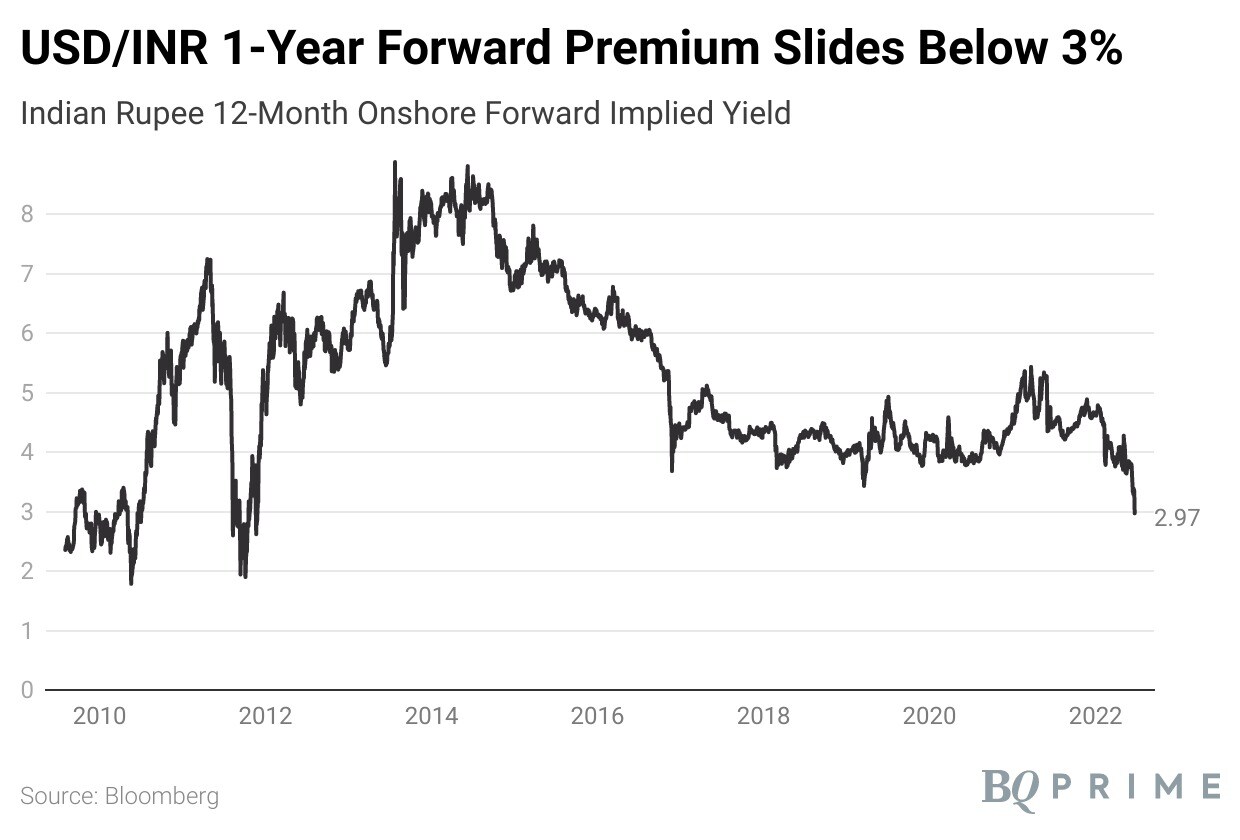
The Indian currency markets are keeping a close eye on an indicator that has fallen to its lowest since 2011—the forward premium. The drop in the forward premia, traders fear, could accelerate the weakness in the rupee which has fallen to one record low after the next. It closed at one such low of 78.39 against the U.S. dollar on Wednesday.
The forward premium reflects the expected future price of a currency, which in this case is the dollar-rupee pair. Broadly, it is measured as the difference between the current spot rate of a currency and the forward rate.
The one-year forward premium for the dollar-rupee, which has been sliding for some time now, fell to under 3% for the first time since 2011.
What Is Driving The Forward Premia Lower?
The last time the forward premia was this low was during the European debt crisis, when there was a fear of dollar shortages. This time, there is no such immediate concern, said Anindya Banerjee, vice president for currency derivatives and interest rate derivatives at Kotak Securities Ltd.
Instead what seems to be driving the forward premia lower is a combination of global and local factors. The narrowing of interest rate differentials, particularly on shorter-term securities, between the U.S. and emerging economies like India, is one such factor, he explained. Banerjee added that a drop in the forward premia across other emerging Asian currencies has also fallen.
A working paper by the RBI, published in April 2022, had cited interest rate differentials as a key driving factor behind forward premia.
"Based on a machine learning technique and monthly data spanning more than a decade, the interest rate differential turns out to be the dominant determinant of the forward premia across maturities," said the paper.
Another factor that influences this rate is the RBI intervention in forward markets, the paper said.
The RBI, which was intervening in the currency markets by buying forwards to prevent an excess build-up of liquidity, is no longer doing so, said the head of treasury for a foreign bank.
Earlier, when the liquidity surplus was larger and foreign currency inflows were strong, the RBI had chosen to prevent a quick appreciation in the rupee by buying in the forwards market rather than the spot market. This, as directly buying dollars in the spot market infuses further rupee liquidity.
Market conditions have now changed. The RBI is now selling dollars more as foreign portfolio flows have reversed. Also it is selling forwards, perhaps to limit the drawdown of forex reserves.
"RBI has been selling dollars forward," said IFA Global in a note on Thursday. This has resulted in a 1-year forward yield collapsing to 2.86% from 3.17% the day before, the lowest since 2011, the research advisory firm said.
The RBI's decision to open a non-collateralised liquidity absorption window via the standing deposit facility may also have had an indirect impact on the forward premia, the treasury official quoted above explained.
This is because the RBI no longer needs to worry about having adequate government bonds in its kitty to absorb liquidity. When the RBI used to absorb liquidity using the reverse repo window, it had to offer bonds to banks against the money they parked with the central bank. This always left a lingering concern that the central bank would run out of these securities if the liquidity surplus widened. With a new window opened, where the RBI does not need to offer securities to suck out liquidity, the RBI could be more comfortable intervening in the spot markets rather than the forward markets.
Since the SDF was introduced, the forward premia has been sliding, the treasury official said.
Why It Matters
A smaller forward premia makes carry trades less attractive for foreign investors, explained Banerjee. As such, if the drop in premia persists, you could see carry trade unwinding, which in turn could lead to rupee weakness.
"With forward yields quoting at the lowest levels since November 2011, the risk of carry trade unwind and low exporter hedging can worry rupee bulls," said Banerjee. This is one factor which could add to the weakness in the rupee and push it into a range of 78-78.60 against the dollar, he added.
Since the RBI is not selling dollars in the spot markets but in the forwards markets, there is a "massive cash dollar shortage," said IFA Global. A bit of dollar funding stress is evident globally as well, however, RBI forward intervention has made it more acute in India's case, the note added.

-
A New Samvat Wishlist: Inclusive Prosperity And Human Development

India has strengthened its economic foundations through infrastructure, digital access and enterprise. Its next growth chapter must deepen productivity, create better livelihoods and widen participation in prosperity.
-
Love, Sex Aur Dhokha: The Audacious Plot To Spy On Jensen Huang
A Taipei dinner, a Singapore chip buyer and a suspected Chinese asset: inside the alleged spy operation that got close to NVIDIA's Jensen Huang.
-
Ten Things I Learnt This Samvat
Patience can be a trap. Cheap stocks can stay cheap. Leverage can wipe you out. What did Samvat 2082 teach us? Niraj Shah writes on 10 lessons from the year gone by.
-
Talking Points This Week: Tech Nerves, FII Buying, And A Faraway Banking Shock
The global markets are not shining this Diwali. The exception in the large markets is, India.
-
Midterm Rally Lasted A Day. The Hard Reality Of A Divided US May Last Two Years | Opinion
Between a contested AI boom, a debt ceiling that arrives in 2027 and a president with every incentive to act alone, the next two years may prove more volatile than the first day's rally suggests.
-
Blue Wave Will Derail the AI Trade but Won't Dismantle the AI Era | Unhedged Position
The Democrats' sweep of the US Congress will see politics collide with economic forces both over the long and short term.
-
It's Time To Take The GST Council's Bet On Trust Global
Payment records can prove India's services exports, and clear, proportionate rules can bring foreign digital sellers into the tax net.
-
Opinion | India at 38: From Innovation Overperformer to Innovation Powerhouse
India now has 453 VC-backed deep science startups, 18 of them late-stage, after 117 percent growth since 2020. Laurus Labs, at USD 9.3 billion, is the most valuable deep science company in any middle-income economy outside China.
-
Navigating Energy Crossroads: S Jaishankar's Call For Diversified Supply Chains At G20 Ministerial Meeting
As geopolitical fault lines continue to test maritime trade routes and commodity flows, Jaishankar's message remains pertinent: true economic resilience requires open markets, protected transit lines, and a genuine commitment to multilateral cooperation rather than coercion.









