Why Rivals Will Line Up At RCom’s Spectrum Fire Sale

Reliance Communications Ltd.'s plan to sell spectrum to pare debt is expected to draw rivals as they look to beef up services in the world's second-largest mobile market.
The Anil Ambani-led telecom operator is looking to offload assets to repay lenders after its merger with Aircel Ltd. failed. The company recently defaulted on its bond payments and could be drawn into insolvency proceedings with the China Development Bank filing a petition in the National Company Law Tribunal. The spectrum sale may help the telecom company cut debt by Rs 19,000 crore — gross value of spectrum according to the company press release — about 40 percent of its total burden.
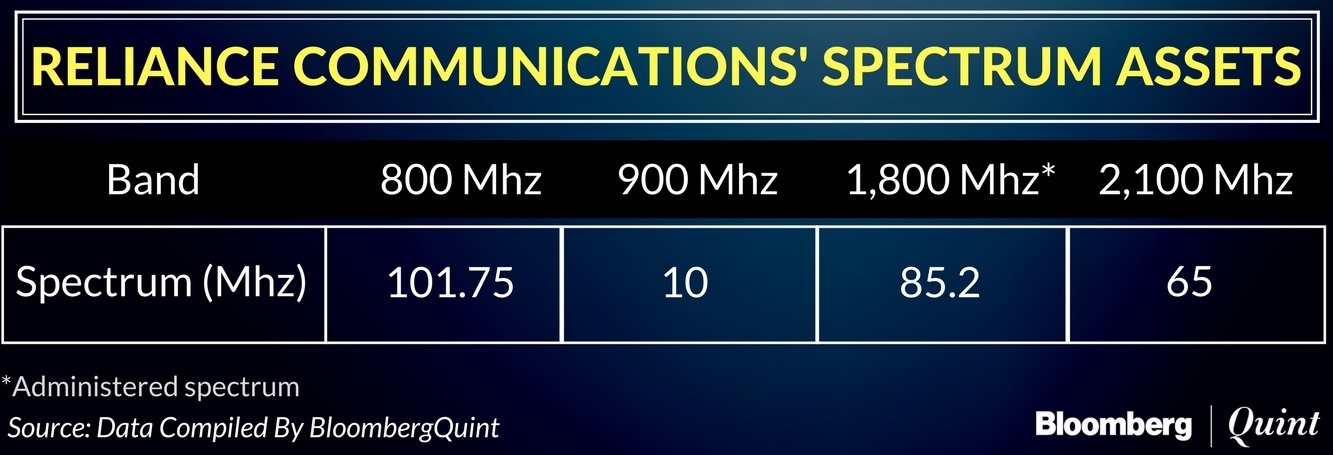
RCom owns 262 megahertz of airwaves across four bands, including the 800 MHz frequency that's in demand to offer 4G services. About a third of its holdings are administered - in the 1,800 MHz band - or allocated without bidding and can't be used for 3G and 4G services. The higher the frequency, the lower is the signal strength as the wavelength of the network is small.
India has 118 crore mobile users—second only to China but more than the U.S., Brazil, Russia and Indonesia put together. Services can be patchy as users lose connectivity frequently during travel. More so for data-heavy 3G and 4G services. RCom's spectrum could help operators strengthen their networks.
BloombergQuint explores who stands to gain the most from buying RCom's airwaves…
Reliance Jio
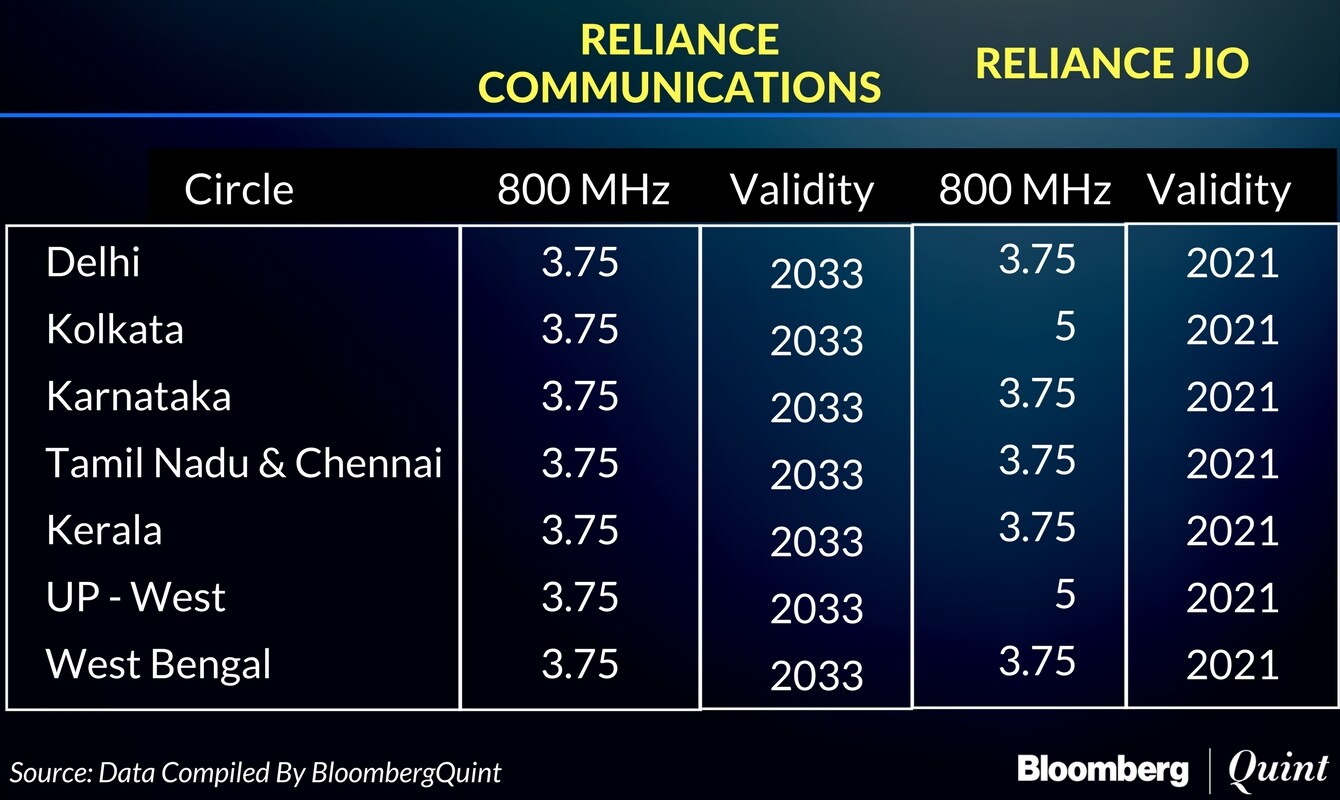
Mukesh Ambani's Reliance Jio Infocomm Ltd. currently has the rights to use the spectrum owned by his younger brother's company as per an earlier agreement. Now that it's on the block, Reliance Jio could be interested in the 800 MHz band which has a longer validity until 2033.
It would serve Reliance Jio better to acquire airwaves in the 800 MHz band because it's rolling out 4G services on that frequency, Nitin Soni, director at Fitch Ratings, said.
Bharti Airtel
Bharti Airtel has limited spectrum in the in-demand 800 MHz band that India's largest telecom operator can use to offer 4G LTE (long-term evolution) services.
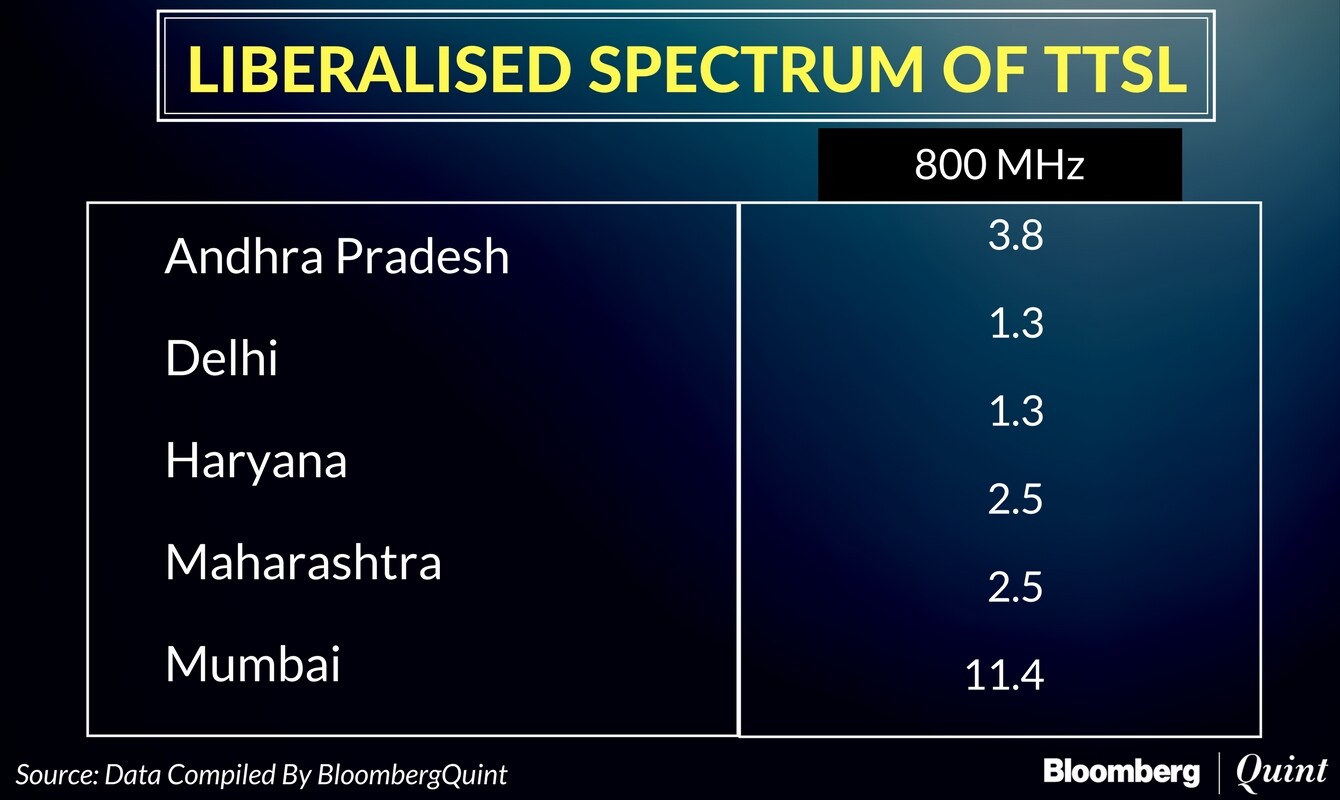
Bharti Airtel recently got airwaves in the 800 MHz band through its acquisition of Tata Teleservices' business. Most of it is administered and the Tata Group company had acquired spectrum through auction only in five circles.
Fitch's Soni said Bharti Airtel may not be interested given that it's rolling out 4G on 1,800 MHz and 2,300 MHz frequencies.
However, using 800 Mhz band spectrum could lead to lower infrastructure cost for India's largest telecom operator.
Moreover, lower frequency spectrum means greater coverage and lower cost of deploying infrastructure. Ideally, companies would prefer lower 800 MHz spectrum band for providing services, said Mahesh Uppal, telecom analyst and director of consultancy firm Com First India.
Vodafone India & Idea Cellular
The combined entity after the merger will hold close to 1,849 MHz across five different bands - the largest holding by an operator and sufficient to provide services. Yet, it may require airwaves in the 900 MHz frequency owned by RCom in Himachal Pradesh to improve its 4G services in that circle.
Vodafone India and Idea Cellular together hold only 0.6 MHz liberalised spectrum in the 1,800 MHz frequency to deliver 4G services in Himachal. In comparison, RCom has 5 MHz of liberalised spectrum in the 900 MHz with a validity till 2035.
Spectrum sale will make RCom a mobile virtual network operator—which leases wireless capacity from another carrier at wholesale prices and resells it to subscribers at lower retail prices under its own brand.
While Vodafone India declined to comment, Idea Cellular, Reliance Jio and Bharti Airtel have not yet responded to email queries.

-
Navigating Friction And Energy Realities: An Analysis Of Marco Rubio's October Visit To India

Occurring at a critical juncture marked by stalled trade negotiations and escalating geopolitical pressures over global energy supplies, the visit offers a profound window into modern US-India relations.
-
India Exports Capital. Why Not Export Trusteeship?
The big question, then, is whether India can build an institution that global borrowers, investors, banks, and lawyers can trust, even without an Indian connection.
-
France's Economy & Politics Are In Crisis | The Reason Why
Let's look at how the French economy and politics evolved under Nicolas Sarkozy, Franois Hollande and Emmanuel Macron.
-
You May Inherit The Business. You Must Earn Its Credibility.
Succession tests the founder's ability to share authority as much as it tests the next generation's readiness to assume it.
-
Signing Deals Is One Thing; Making Them Work Is Another | The Week In Whys
Sometimes, things don't turn out as planned. Indian companies have lost some bids to rivals, some projects won't produce until 2030.
-
FOMC Wall, PERM Suspension, Hospital Stocks | Talking Points This Week
A PERM suspension would directly affect green-card sponsorship rather than H-1B visas, so the near-term earnings impact could remain relatively limited. The key question is whether this marks a new phase in US scrutiny of Indian IT.
-
Everything, Everywhere, All At Once: Dalal Street's Week To Forget | Joining The Dots
Visa curbs, a Starlink spat and cancer drug caps: what connects this week's shocks for Indian markets
-
India Is Going Abroad For Critical Minerals. But It May Take Years To Pay Off | The Reason Why
Although India's steps are in the right direction, they remain modest compared with India's growing dependence.
-
When Everyone Has AI, What Gives You An Edge?
India's young workforce is entering an uncertain world of work where powerful AI tools are becoming widely accessible. The advantage will belong to those who combine deep expertise with digital fluency, and the distinctly human capabilities that technology cannot manufacture.
-
Wrong Labels, High Pesticide Residues Holding Back Agri Exports | The Reason Why
India needs stronger domestic food-safety and labelling standards, with best practices becoming part of everyday business for farmers, traders and food companies.










