Why Dr. Reddy’s Returned Best Gains Among Peers In Last One Year
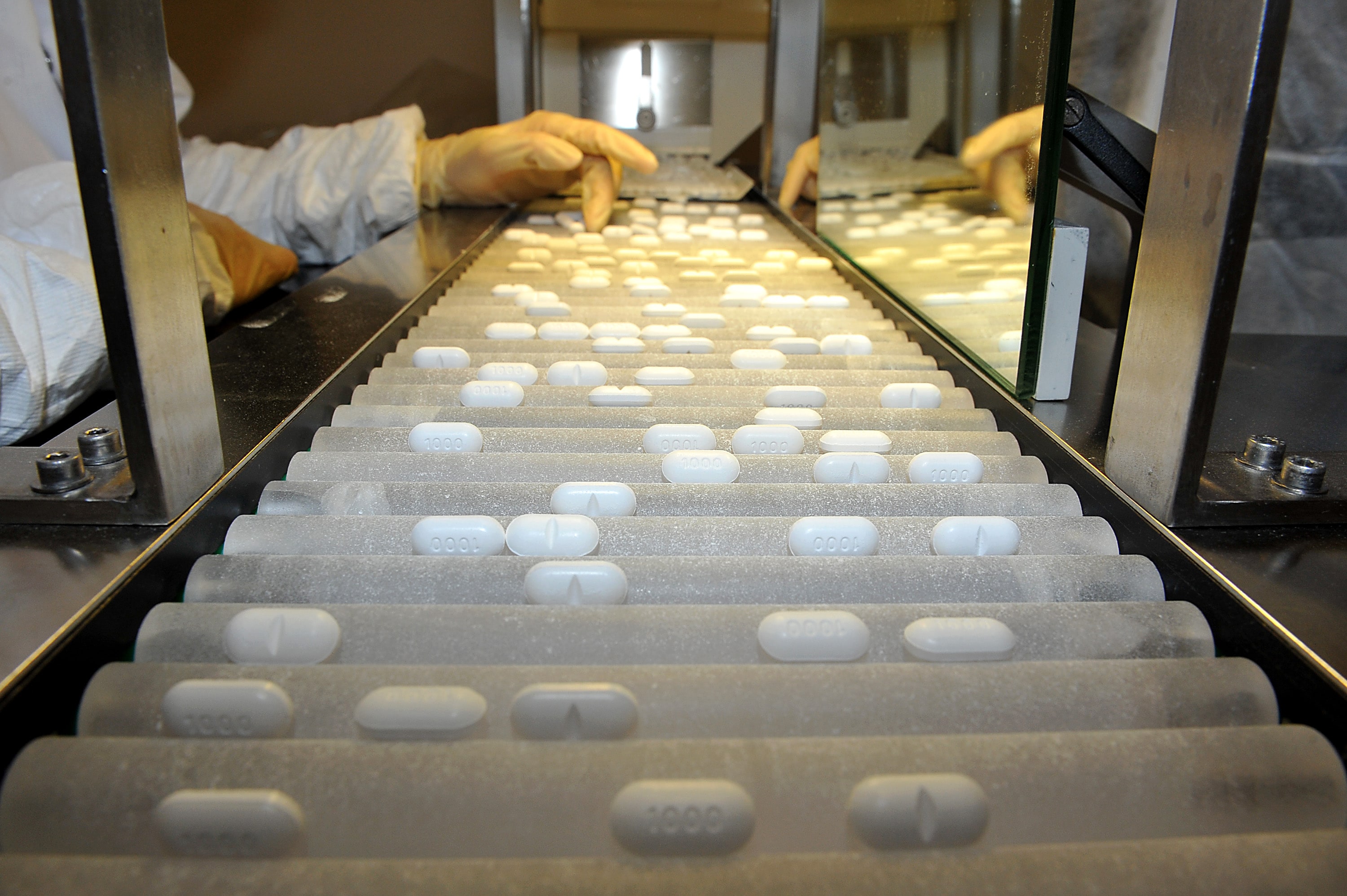
Shares of Dr. Reddy's Laboratories Ltd. returned best gains among peers in the past 12 months as India's second-largest drugmaker by revenue shook off U.S. regulatory troubles, sold unprofitable portfolios and focused on reviving its domestic business.
The company's troubles began at the end of 2015 when the U.S. Food and Drug Administration effectively barred fresh approvals from three of its facilities. That came even as Indian pharma companies faced pricing pressure in the U.S., one of their largest markets, hurting their margins.
Dr. Reddy's has gained 41 percent in the past 12 months, beating its peers. By comparison, the Nifty Pharma Index rose 3.13 percent during the period.

While Dr. Reddy's declined to comment on its strategy or the turnaround citing silent period ahead of the earnings, BloombergQuint analyses at what may have led to the change in its fortune.
Receding U.S. Regulatory Woes
The U.S. FDA in November 2015 issued a warning letter highlighting concerns about manufacturing standards at three of the company's plants—Srikakulam API and Duvvada units in Andhra Pradesh and Miryalguda plan in Telangana. A warning letter puts future approvals on hold.
Dr. Reddy's managed to resolve the regulatory issues at Miryalguda in June 2017 and at Duvvada in February this year. The Srikakulam API facility remains under the U.S. FDA scanner. The company also received observations for manufacturing practices at its Bachupally, Telangana plant in February but it was cleared in April.
Focus On India And Other Emerging Markets
Dr. Reddy's has changed its strategy to focus more on India, China and other emerging markets compared to the U.S. It has a 2 percent market share in India, according to IQVIA.
It recently appointed new heads for the Indian and the chronic businesses to boost growth. The management, in an interaction with Citi, said it aims to be among the top five drugmakers in India, without giving a timeline. It currently ranks 14.
And Dr. Reddy's is banking on in-licensing of patent products from multinationals to boost performance in the domestic market, Alok Dalal, pharma analyst at CLSA, said in a note.
The company also expects better sales of biosimilars and in-licenced portfolio in Russia as the impact of currency devaluation has been fully factored in. And it's been reporting operating profit in Latin America, Southeast Asia and North Africa over the last few quarters.
The company's strategy to focus on growth in India, Russia and China, generics business in North America, and institution business and biologics is a positive as it reduces dependence on U.S. generics, according to Saion Mukherjee, head of equity research at Nomura.
The China Opportunity
China is on a mission to drive down the cost of healthcare. The world's second-biggest drug market is importing more medicines, reimbursing for more and speeding up approvals of new products to ensure they reach patients faster. At a time the pharma companies are reeling under a brutal pricing war in the U.S., this offers an opportunity.
Dr. Reddy's, present in China for about two decades through its joint venture partner Rotam Group, expects new launches to drive growth. It has received approval for Clopidogrel—anti-blood clotting drug used for reducing the risk of heart disease and stroke—in China. That's the company's biggest product in China by market potential. The market size for Clopidogrel in China is $1.6 billion, according to Edelweiss.
Dr. Reddy's plans to file multiple oncology injectable products in 2019, which could be launched after two years, to drive growth in China, Credit Suisse said quoting MV Narasimham, global head, business finance at Dr. Reddy's. The company generates $100 million in sales in China, it said.
Sun Pharmaceuticals Ltd., India's biggest drugmaker, too, is scouting for a partner in China to gain market share in the country, Bloomberg reported quoting founder Dilip Shanghvi as saying.
Changing U.S. Dynamics
Dr. Reddy's continues to focus on developing complex generic drugs in the U.S. using its own active pharmaceutical ingredients as that helps lower costs. The company aims to cut losses in its proprietary products by selling non-core assets, the management said in a conference call after the third-quarter earnings. It's also looking at selective biosimilars.
Deepak Malik, pharma analyst at Edelweiss, said Dr. Reddy's is “getting fitter and leaner” as it divests loss-making ventures and bolsters core competencies across geographies.
The company is betting on Nuvaring and Copaxone to drive its growth in the U.S., it had told BloombergQuint after announcing the third-quarter earnings.
Last month, Dr. Reddy's bought 42 abbreviated new drug applications in the U.S., of which more than 30 are for injectable products. Nomura's Mukherjee said the acquisition is likely to be boost earnings once the portfolio is commercialised.
Alankar Garude, pharma analyst at Macquarie, said cost advantage after site transfers will also help the company launch these products outside the U.S.
Exit Unprofitable Businesses
The company sold three dermatology brands—Sernivo (plaque psoriasis), Promiseb (Seborrheic Dermatitis) and Trianex (eczema, dermatitis, allergies and rash, among others)—and moved 60 marketing representatives to Encore Dermatology Inc.
Morgan Stanley said the sale indicates that Dr. Reddy's plans to sell unprofitable assets. Other cost cuts include the sale of API unit in Hyderabad, antibiotic unit in Bristol and dermatology brand Cloderm.
Suboxone Opportunity
Dr. Reddy's relaunched a generic version of Indivior Plc's opioid addiction treatment Suboxone Film after receiving an approval from a U.S. court in February. The company can make $50-70 million in the $800-million drug (Suboxone) market in the U.S., according to Morgan Stanley.
Analysts View
Of the 44 analysts tracking the stock, 20 recommend a ‘Buy', while 12 each suggest ‘Hold' and ‘Sell'.

-
High US Salaries, No Green Card Certainty: The Financial Calculation Facing Indian H-1B Families

The suspension of PERM processing at eight technology employers does not cancel existing H-1B visas. What it does is force a question many Indian families have been avoiding: is the US salary worth tying your career and family plans to one employer?
-
Unhedged Position: Can India See An Indonesia-Style Time Correction?
The Nifty is trading below levels it first clocked in 2024. Is there, then, as I have suggested in the headline, potential that the current time correction drags on painfully for the next three-five, even ten years?
-
Navigating Friction And Energy Realities: An Analysis Of Marco Rubio's October Visit To India
Occurring at a critical juncture marked by stalled trade negotiations and escalating geopolitical pressures over global energy supplies, the visit offers a profound window into modern US-India relations.
-
India Exports Capital. Why Not Export Trusteeship?
The big question, then, is whether India can build an institution that global borrowers, investors, banks, and lawyers can trust, even without an Indian connection.
-
France's Economy & Politics Are In Crisis | The Reason Why
Let's look at how the French economy and politics evolved under Nicolas Sarkozy, Franois Hollande and Emmanuel Macron.
-
You May Inherit The Business. You Must Earn Its Credibility.
Succession tests the founder's ability to share authority as much as it tests the next generation's readiness to assume it.
-
Signing Deals Is One Thing; Making Them Work Is Another | The Week In Whys
Sometimes, things don't turn out as planned. Indian companies have lost some bids to rivals, some projects won't produce until 2030.
-
FOMC Wall, PERM Suspension, Hospital Stocks | Talking Points This Week
A PERM suspension would directly affect green-card sponsorship rather than H-1B visas, so the near-term earnings impact could remain relatively limited. The key question is whether this marks a new phase in US scrutiny of Indian IT.
-
Everything, Everywhere, All At Once: Dalal Street's Week To Forget | Joining The Dots
Visa curbs, a Starlink spat and cancer drug caps: what connects this week's shocks for Indian markets
-
India Is Going Abroad For Critical Minerals. But It May Take Years To Pay Off | The Reason Why
Although India's steps are in the right direction, they remain modest compared with India's growing dependence.









