Warren Buffett’s Favorite Valuation Indicator Flashes Buy Signal
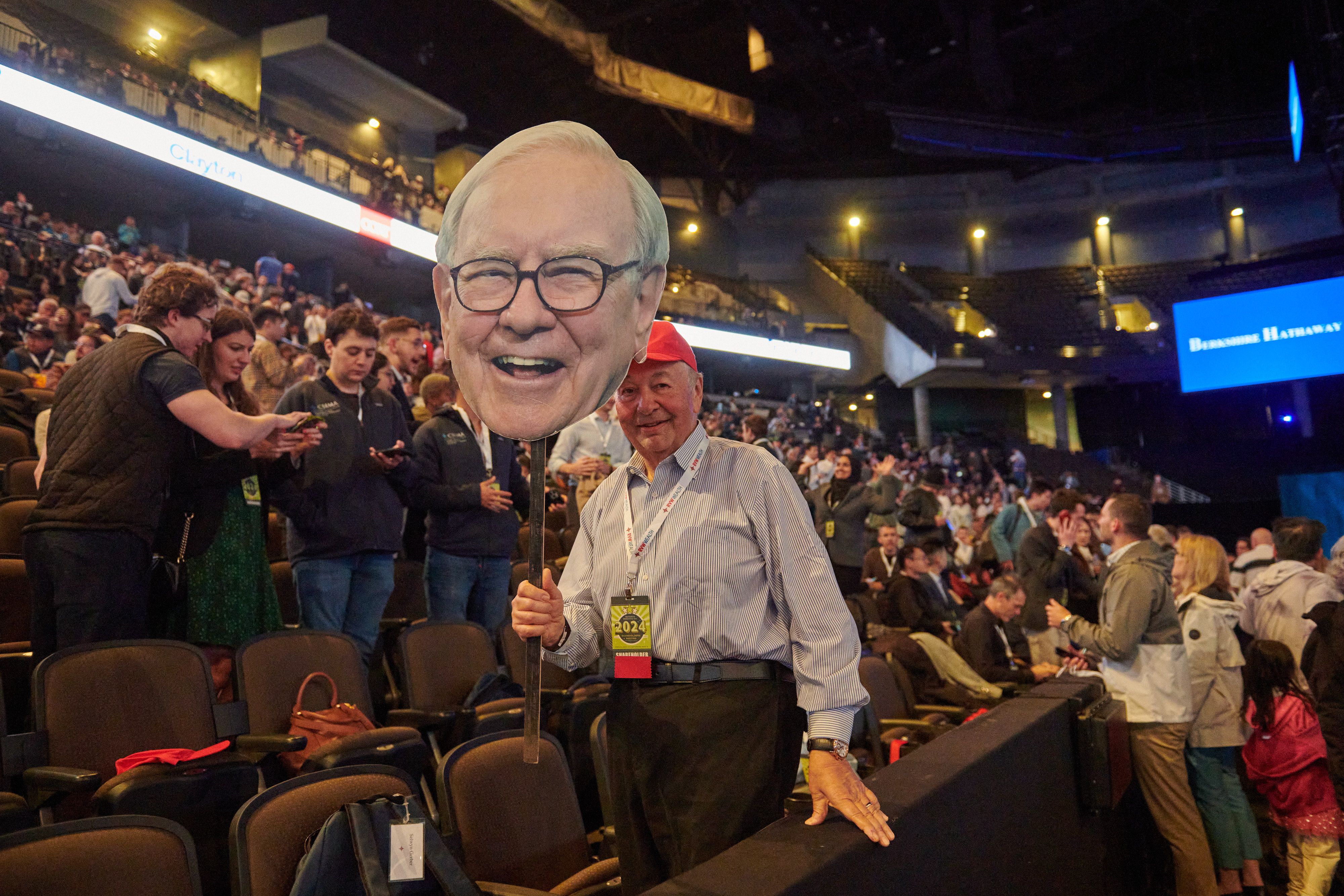
A key valuation metric touted by legendary investor Warren Buffett is signaling that equities are relatively cheap, bolstering the case that the sizzling rebound in US stocks has room to run.
The “Buffett Indicator” measures the ratio of the total value of the US stock market via the Wilshire 5000 Index divided by the dollar value of US gross domestic product. It stands at its lowest level since early September — even after a bounce that has sent stocks screaming higher in recent weeks.

The 94-year-old chief executive of Berkshire Hathaway, which will hold its annual meeting in Omaha, Nebraska, this weekend, has said the “single best measure of where valuations stand” was the ratio of the value of US publicly traded companies to the country's GDP. The indicator blared a warning late last year when it shot to a historic high, echoing similar signals sent during market peaks in 2021 and before the bursting of the dot-com bubble in 2000.
The measure is now at 180%, around where it stood after an unwind of the Japanese yen carry trade sparked a brief but intense selloff last year. That stock-market rout cleared the path for a powerful S&P 500 Index rally in the closing months of 2024.
“This is a crucial indicator because it helps traders know when to deploy capital and buy stocks,” said Adam Sarhan, founder of 50 Park Investments, who has been piling into Big Tech stocks. “There are reasons to still be concerned about the global trade war, but if Trump isn't playing hardball with tariffs, people are going to buy, buy, buy with valuations much more reasonably priced now.”
Valuation metrics of all types have taken on added significance this year, as investors try to determine if a tariff-fueled selloff has left stocks cheaper relative to their fundamentals. Those calculations are complicated by the S&P 500's 12% bounce from its April lows, which has traders wondering whether to bet on momentum carrying the index further — or beef up hedges and place bearish bets on a trip back down. The index is still down nearly 9% from its February record.
In addition to the unpredictable twists of President Donald Trump's trade war, investors are bracing for several more weeks of earnings season and next week's Federal Reserve meeting as potential catalysts that could determine the trajectory of stocks.
For its part, the indicator is still above levels it plumbed during past market bottoms, including the Covid-19 selloff of early 2020, when it fell to nearly 100%. Other commonly used valuation gauges tell a similar story: The S&P 500, for example, now sits at 20.6 times forward earnings, down about 8% from earlier this year, though still above the 10-year average of 18.6 times.
Critics of the Buffett indicator argue that, among other things, the measure may ignore the effects of elevated interest rates. Higher borrowing costs can eat into company profits and weigh on stock prices. Some strategists also maintain that valuation is a poor tool for timing market moves, since assets can stay cheap or expensive for a long time before correcting.
That said, few investors would ignore a measured lauded by Buffett, who is famous for buying on the cheap. Traders are eagerly awaiting Berkshire's annual meeting on Saturday, in part to glean any clues on whether Buffett has dipped into the company's cash pile — last reported at a record $321 billion — to take advantage of bargains in the market.
It may be one of the last meetings for Buffett, who told shareholders in the company's annual letter earlier this year that “it won't be long before” a successor takes over as chief executive, likely Berkshire's Greg Abel.
Buffett “has always been a long-term investor,” said Scott Colyer, chief executive at Advisors Asset Management. “It will be crucial to hear what he says about the economy and whether cheaper valuations indeed pushed him to deploy all that cash to buy stocks during the selloff.”

-
Talking Points This Week: Tech Nerves, FII Buying, And A Faraway Banking Shock

The global markets are not shining this Diwali. The exception in the large markets is, India.
-
Midterm Rally Lasted A Day. The Hard Reality Of A Divided US May Last Two Years | Opinion
Between a contested AI boom, a debt ceiling that arrives in 2027 and a president with every incentive to act alone, the next two years may prove more volatile than the first day's rally suggests.
-
Blue Wave Will Derail the AI Trade but Won't Dismantle the AI Era | Unhedged Position
The Democrats' sweep of the US Congress will see politics collide with economic forces both over the long and short term.
-
It's Time To Take The GST Council's Bet On Trust Global
Payment records can prove India's services exports, and clear, proportionate rules can bring foreign digital sellers into the tax net.
-
Opinion | India at 38: From Innovation Overperformer to Innovation Powerhouse
India now has 453 VC-backed deep science startups, 18 of them late-stage, after 117 percent growth since 2020. Laurus Labs, at USD 9.3 billion, is the most valuable deep science company in any middle-income economy outside China.
-
Navigating Energy Crossroads: S Jaishankar's Call For Diversified Supply Chains At G20 Ministerial Meeting
As geopolitical fault lines continue to test maritime trade routes and commodity flows, Jaishankar's message remains pertinent: true economic resilience requires open markets, protected transit lines, and a genuine commitment to multilateral cooperation rather than coercion.
-
Indians Are Travelling, But Not Every Journey Is A Holiday | The Week In Whys
Pilgrims, patients and working women are the real travellers, and the system hasn't quite caught up with them.
-
Getting To Work Costs Women More | The Reason Why
It is not just about women paying more than men. It is about women paying much more in cities than in villages.
-
AI Bias In Investing Cannot Be Eliminated, But It Can Be Governed
Framing is a particularly important example as identical financial information presented in terms of gains rather than losses can lead an LLM to reach a different assessment.









