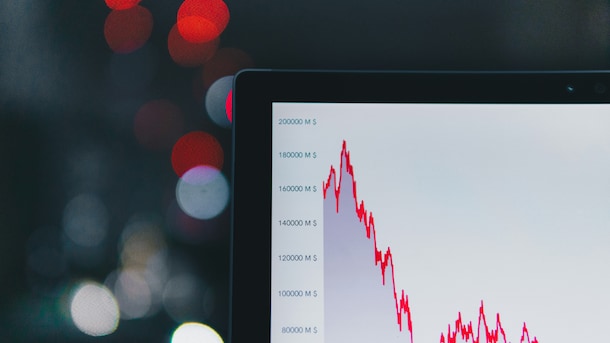
Wall Street’s View On S&P 500 Profits Is Souring As Tariffs Loom
Wall Street's confidence in Corporate America's profit engine is fraying, threatening more turbulence ahead for a badly bruised US stock market.
Though the broad outlook for corporate earnings remains strong, analysts have been steadily trimming their expectations for company results in the next 12 months. Profit forecasts for S&P 500 Index companies have seen more downgrades than upgrades for 22 of the past 23 weeks, according to Bloomberg Intelligence, the longest stretch since early 2023.
A darkening earnings picture would be an unwelcome development for stock investors, after worries over the economic impact of President Donald Trump's tariff policies spurred a selloff that has dragged the S&P 500 around 8% from last month's record. With robust earnings expansion needed to justify the market's still-elevated valuations, signs that companies may struggle to meet profit expectations in the months ahead could further sour sentiment.
“The earnings outlook is starting to crack,” said Eric Beiley, executive managing director of wealth management at Steward Partners. “This drawdown in stocks is signaling to sell-side analysts that they need to bring down their annual profit outlooks even further from here.”

While first quarter earnings season kicks off on April 11 with a report from JPMorgan Chase & Co. and other banks, some US companies are already sending worrying signals.
American Airlines Group Inc. on Tuesday predicted its first-quarter loss would be roughly twice as big as expected, a day after bellwether Delta Air Lines Inc. cut its profit outlook in half, with both carriers citing weakening demand for air travel. Retailers including Kohl's Corp., Abercrombie & Fitch Co. and Walmart Inc. have also sounded a cautious note.
Analysts still see a 10% advance in S&P 500 earnings in 2025, down from a 13% forecast in early January, BI data show. But there may be ample room on the downside: Yung-Yu Ma, chief investment officer at BMO Wealth Management, said analysts will likely need to trim their annual S&P 500 profit estimates for 2025 to the high single-digits to account for the restraint tariffs would put on corporate profit margins.

“There's still the risk of estimates falling as more companies guide around Trump's tariff policies,” said Scott Chronert, head of US equity strategy at Citigroup Inc.
Others have already reeled in their earnings estimates. David Kostin, chief US equity strategist at Goldman Sachs Group Inc., on Tuesday reduced his full-year earnings growth estimate to 9% from 11%. He now sees the index ending the year at 6,200, down from a previous forecast of 6,500. That would still be a nearly 10% gain from Friday's close.
An earnings picture that grows too bleak could weigh on stocks. Evidence that investors are already bracing for more downside ahead can be seen in the record highs in gold, a popular safe haven. Prices for US government bonds, another popular destination for nervous investors, have risen since mid-February.
Keith Buchanan, partner and senior portfolio manager at Globalt Investments, has been selling some large-cap growth shares and raising his cash allocation.
“It only makes sense to err on the side of caution,” he said.

Of course, corporate results in recent years have shown resilience in the face of everything from soaring inflation to the highest interest rates in decades. Investors hope Trump will either soften or remove tariffs before they pinch profits.
It could also take months before more sell-side analysts and companies guide forecasts lower, according to Michael Casper, equity strategist at BI. Such a scenario played out during Trump's first term: though the US trade war with China heated up in the early months of 2018, the hit to corporate profits only showed up about a year later, according to BI data.
Still, Casper noted that the economy had the tailwind of big corporate tax cuts during that period. Pressure has grown on Trump to push through a sweeping tax bill in his second term, as economic worries mount.
For Michael Shaoul, chief executive officer and founding partner at Ion Macro Management, earnings have not figured into the recent selloff, which he said has been driven by investors unwinding overstretched positions in US megacaps and reallocating funds to Europe and Asia.
He remains optimistic on corporate profits and the longer term performance of stocks. However, “if any negative earnings surprises are injected into the market, things will get more turbulent from here,” he said.

-
Talking Points This Week: Tech Nerves, FII Buying, And A Faraway Banking Shock

The global markets are not shining this Diwali. The exception in the large markets is, India.
-
Midterm Rally Lasted A Day. The Hard Reality Of A Divided US May Last Two Years | Opinion
Between a contested AI boom, a debt ceiling that arrives in 2027 and a president with every incentive to act alone, the next two years may prove more volatile than the first day's rally suggests.
-
Blue Wave Will Derail the AI Trade but Won't Dismantle the AI Era | Unhedged Position
The Democrats' sweep of the US Congress will see politics collide with economic forces both over the long and short term.
-
It's Time To Take The GST Council's Bet On Trust Global
Payment records can prove India's services exports, and clear, proportionate rules can bring foreign digital sellers into the tax net.
-
Opinion | India at 38: From Innovation Overperformer to Innovation Powerhouse
India now has 453 VC-backed deep science startups, 18 of them late-stage, after 117 percent growth since 2020. Laurus Labs, at USD 9.3 billion, is the most valuable deep science company in any middle-income economy outside China.
-
Navigating Energy Crossroads: S Jaishankar's Call For Diversified Supply Chains At G20 Ministerial Meeting
As geopolitical fault lines continue to test maritime trade routes and commodity flows, Jaishankar's message remains pertinent: true economic resilience requires open markets, protected transit lines, and a genuine commitment to multilateral cooperation rather than coercion.
-
Indians Are Travelling, But Not Every Journey Is A Holiday | The Week In Whys
Pilgrims, patients and working women are the real travellers, and the system hasn't quite caught up with them.
-
Getting To Work Costs Women More | The Reason Why
It is not just about women paying more than men. It is about women paying much more in cities than in villages.
-
AI Bias In Investing Cannot Be Eliminated, But It Can Be Governed
Framing is a particularly important example as identical financial information presented in terms of gains rather than losses can lead an LLM to reach a different assessment.