Wall Street Hunts AI Winners Beyond Nvidia In Emerging Markets

(Bloomberg) -- Some of the world's biggest money managers are searching for the next wave of artificial intelligence winners beyond the US.
At a time when the global euphoria about AI has propelled a three-fold surge in Nvidia Corp. and a 50% jump in a key US index for semiconductor manufacturers in less than a year, investors are pointing toward emerging markets for better value and a bigger pool of options.
The asset management arm of Goldman Sachs Group Inc. said it's looking specifically for stakes in the manufacturers of AI supply-chain components, such as cooling systems and power supplies. JPMorgan Asset Management favors traditional manufacturers of electronics that are morphing into AI leaders, while investment managers at Morgan Stanley are betting on players where AI is reshaping business models in non-tech sectors.
“We see AI as a growth driver in emerging markets,” said Jitania Kandhari, deputy chief investment officer at Morgan Stanley Investment Management. “While we have previously invested in direct AI beneficiaries like semiconductors, going forward it will be key to look for companies in different industries that are adopting AI to enhance earnings.”
AI stocks are already leading a $1.9 trillion rebound in emerging markets this year, with Taiwanese and South Korean chip companies such as Taiwan Semiconductor Manufacturing Co. and SK Hynix Inc. accounting for 90% of the gains, according to data compiled by Bloomberg.
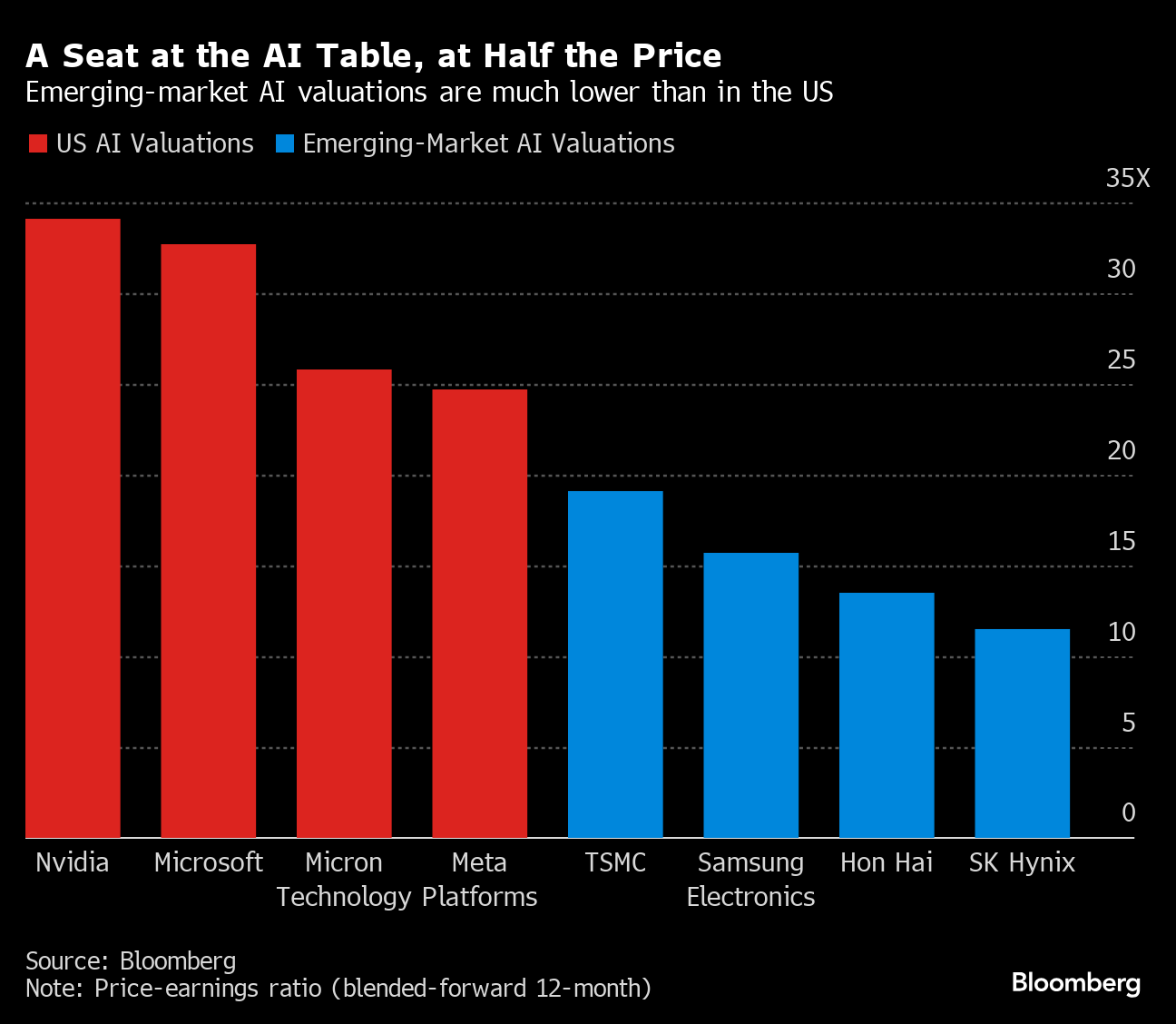
Despite this rally, most emerging-market AI stocks still offer far better value than their US peers. While Nvidia trades at 35 times its projected earnings, Asian AI giants are typically valued between 12 and 19 times.
Developing markets also offer faster growth. Analysts see a 61% increase in earnings for emerging-market technology companies as a whole, compared to the 20% rise that they were penciling in for US peers, according to data compiled by Bloomberg.
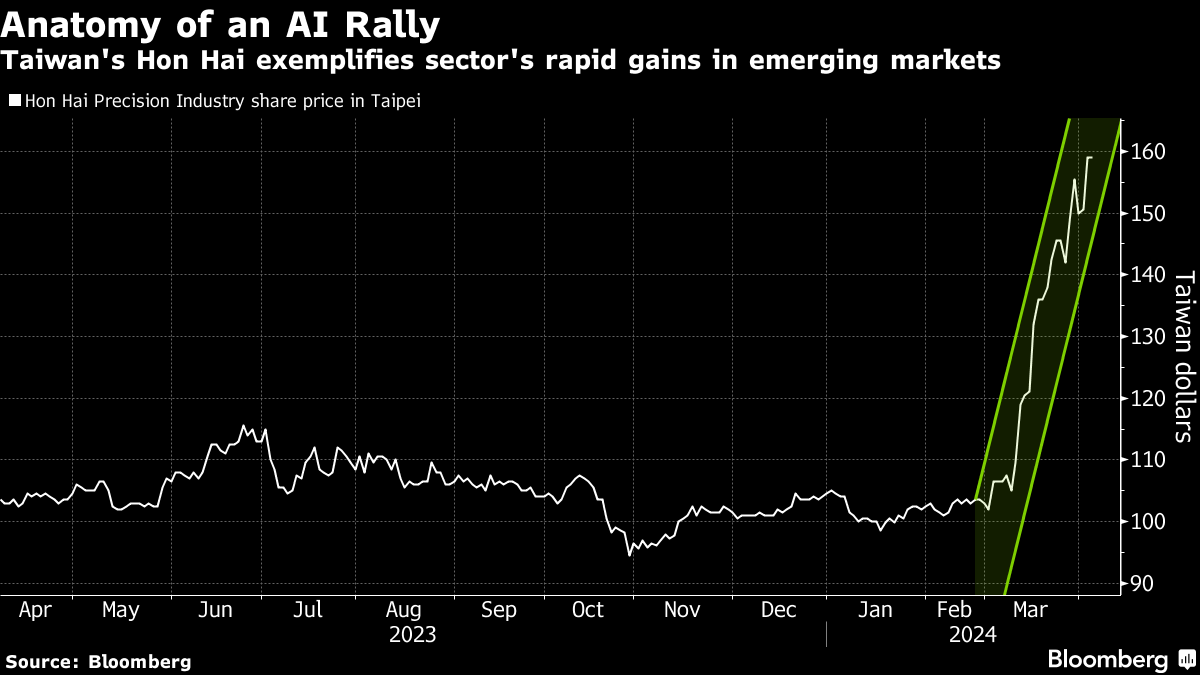
So far, the stars of the show are those companies which already were technology leaders prior to the AI rally, such as TSMC and Hon Hai Precision Industry Co.
The duo and MediaTek Inc., also a chipmaker, feature in a JPMorgan single-country fund that invests in Taiwanese equities and has outperformed 96% of more than 1,400 peers. The three stocks are also among the top-10 holdings of the iShare MSCI EM Ex-China ETF, which has doubled in value over the past five months.
“The tech companies that have historically been the suppliers to the big names, may well emerge as the big players themselves,” said Anuj Arora, head of emerging markets and Asia Pacific equities at JPMorgan Asset Management. “The early adaption of this technology means these companies are far ahead of their competitors in leveraging newer evolutions.”
Still, the buzz is widening and more investors are pouring in money.
For example, Korea's Hanmi Semiconductor Co., majority-owned by billionaire Kwak Dong Shin's family, has surged about 120% this year for the best gains among members of the MSCI Emerging Markets Index. It as also seen its share of foreign ownership increase in recent weeks, according to data compiled by Bloomberg.
In Vietnam, IT services provider FPT Corp. has jumped almost 20% this year, lifting the Ashmore EM Frontier Equity Fund as the best performer among actively managed emerging market funds in the US.
For EM-focused exchange-traded funds, more than half of all inflows this year have gone into the iShares MSCI EM ex-China ETF, whose top 10 holdings include companies that are investing in AI, according to data compiled by Bloomberg.
Elsewhere, established businesses have attracted fresh investor interest after signaling that they're moving into AI.
Saudi Arabia is becoming a hotbed for Chinese AI ventures, such Alibaba Group Holding Ltd.'s cloud partnership with Saudi Telecom Co.
India's Reliance Industries Ltd., the petroleum giant run by billionaire Mukesh Ambani, has developed a chatGPT-style model with capabilities in 22 Indian languages. The company is also part of the digital transformation in the country of 1.4 billion people.
“We would point to the potential ‘national champions' mindset that is developing around AI in some markets,” said Luke Barrs, global head of fundamental equity client portfolio management at Goldman Sachs. “Countries are focused on fostering homegrown companies that can be future leaders.”
The trade is not without its risks.
Emerging markets are tied closely to the US, meaning that an AI selloff could echo across the world. Alternatively, if stock-market gains broaden out, then other sectors may catch up and AI names could lag behind.
Still, investors are increasingly finding EM alternatives to US tech stocks that have over-extended themselves, said Morgan Stanley's Kandhari.
“In emerging markets, they are seeing AI as an under-appreciated driver going forward,” she said. “There's a lot of low-hanging fruit to juice there.”
What to Watch
- In Brazil, March inflation data will offer clues on whether the central bank can dial down its hawkish message, according to Bloomberg Economics.
- In Argentina, inflation has probably decelerated for a third month in March.
- Mexico's headline inflation will likely rise in March, with non-core food and energy prices accounting for most of the advance.
- Central banks in Philippines, Thailand and South Korea are scheduled to announce rate decisions.
More stories like this are available on bloomberg.com
©2024 Bloomberg L.P.

-
High US Salaries, No Green Card Certainty: The Financial Calculation Facing Indian H-1B Families

The suspension of PERM processing at eight technology employers does not cancel existing H-1B visas. What it does is force a question many Indian families have been avoiding: is the US salary worth tying your career and family plans to one employer?
-
Unhedged Position: Can India See An Indonesia-Style Time Correction?
The Nifty is trading below levels it first clocked in 2024. Is there, then, as I have suggested in the headline, potential that the current time correction drags on painfully for the next three-five, even ten years?
-
Navigating Friction And Energy Realities: An Analysis Of Marco Rubio's October Visit To India
Occurring at a critical juncture marked by stalled trade negotiations and escalating geopolitical pressures over global energy supplies, the visit offers a profound window into modern US-India relations.
-
India Exports Capital. Why Not Export Trusteeship?
The big question, then, is whether India can build an institution that global borrowers, investors, banks, and lawyers can trust, even without an Indian connection.
-
France's Economy & Politics Are In Crisis | The Reason Why
Let's look at how the French economy and politics evolved under Nicolas Sarkozy, Franois Hollande and Emmanuel Macron.
-
You May Inherit The Business. You Must Earn Its Credibility.
Succession tests the founder's ability to share authority as much as it tests the next generation's readiness to assume it.
-
Signing Deals Is One Thing; Making Them Work Is Another | The Week In Whys
Sometimes, things don't turn out as planned. Indian companies have lost some bids to rivals, some projects won't produce until 2030.
-
FOMC Wall, PERM Suspension, Hospital Stocks | Talking Points This Week
A PERM suspension would directly affect green-card sponsorship rather than H-1B visas, so the near-term earnings impact could remain relatively limited. The key question is whether this marks a new phase in US scrutiny of Indian IT.
-
Everything, Everywhere, All At Once: Dalal Street's Week To Forget | Joining The Dots
Visa curbs, a Starlink spat and cancer drug caps: what connects this week's shocks for Indian markets
-
India Is Going Abroad For Critical Minerals. But It May Take Years To Pay Off | The Reason Why
Although India's steps are in the right direction, they remain modest compared with India's growing dependence.