Wall Street Braces For Souring Corporate Earnings Amid Trade War

US stocks reeling from the impact of President Donald Trump's tariffs face another big test starting later this week: corporate earnings. And they're not looking good.
Investors have already chopped more than $5 trillion off the value of companies in the S&P 500 Index over the last three sessions as they fret that an escalating trade war risks slashing profits. Across Wall Street, analysts are echoing that gloomy take as worries mount that the economy is headed for a recession.
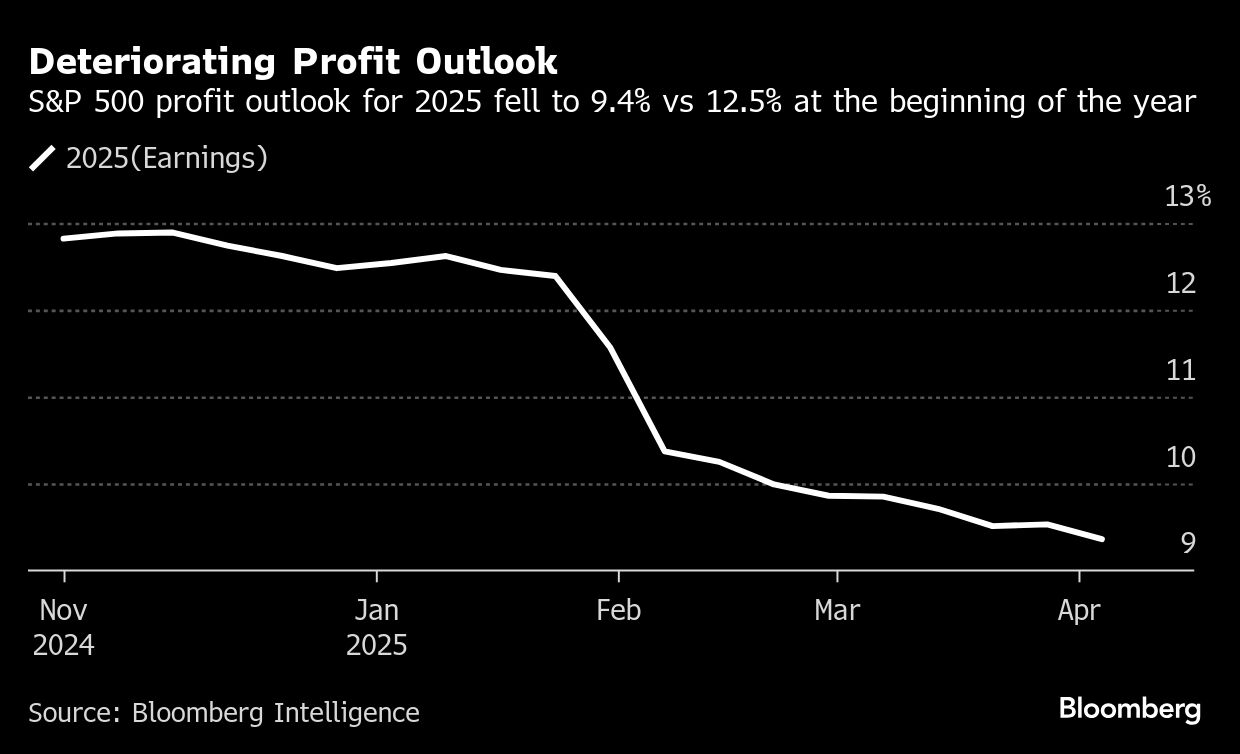
For the first quarter, analysts now see year-over-year earnings growth of 6.7% for the S&P 500, down from about 11.1% in early November when Trump was elected, according to data compiled by Bloomberg Intelligence. For all of 2025, they see profits rising 9.4%, compared with a projection of 12.5% at the beginning of the year.
“With all this tariff uncertainty, when companies start reporting their results, the risk for the earnings outlook is definitely to the downside,” said Sarah Hunt, chief market strategist and partner of Alpine Saxon Woods.
Earnings season kicks off Friday with announcements from big US banks including JPMorgan Chase & Co. and Wells Fargo & Co.
Trump's tariffs are threatening to upend multinational companies' supply chains and weigh on export demand. Meanwhile, recession fears are shaking consumer confidence.
UBS Investment Bank's chief strategist Bhanu Baweja said Monday tariffs could hit consumers so hard that there's a risk that S&P 500 companies will see zero earnings growth this year.
Foggy Outlook
Corporate America's profit outlooks began to sour even before Trump unleashed a litany of levies on US trading partners. As of the fourth-quarter earnings cycle, the ratio of companies issuing earnings forecasts for 2025 that beat expectations versus those that fell short hit the lowest since 2010, BI data show.
When companies start reporting they “won't have anything they can actually say other than that everything is so uncertain,” said Joe Gilbert, portfolio manager at Integrity Asset Management. “We've gone from the fog of a trade war to the fog of the earnings outlook.”
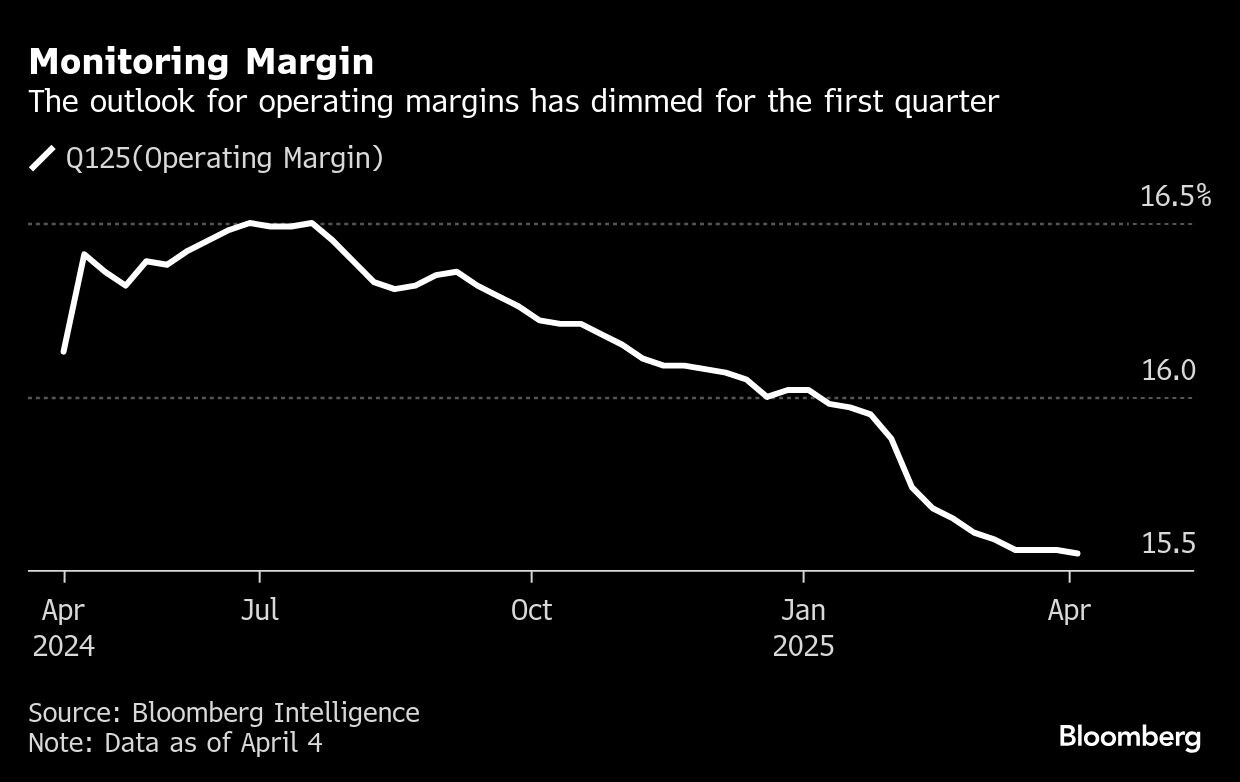
Investors will be keeping a close eye on operating margins as they indicate if companies can successfully pass rising costs on to consumers. Margin forecasts for the first quarter are currently sitting at 15.6%, down from the level of 16% seen in January, BI data show.
But those expectations may be too optimistic, according to Dave Mazza, chief executive officer of Roundhill Financial.
“A big risk to further downside in the US stocks is that operating margins come down due to the tariffs,” Mazza said.
Meanwhile, sentiment toward the so-called Magnificent Seven shares which drove stock-market gains for much of the past two years is also dimming as investors turn skeptical. The cohort's net income is expected to hit the lowest level since the first quarter of 2023, according to BI.
“If these companies disappoint or give more clarity in a negative way around data centers or capital spending on AI, that's going to point to further weakness in the stocks,” said Mazza.

-
Talking Points This Week: Tech Nerves, FII Buying, And A Faraway Banking Shock

The global markets are not shining this Diwali. The exception in the large markets is, India.
-
Midterm Rally Lasted A Day. The Hard Reality Of A Divided US May Last Two Years | Opinion
Between a contested AI boom, a debt ceiling that arrives in 2027 and a president with every incentive to act alone, the next two years may prove more volatile than the first day's rally suggests.
-
Blue Wave Will Derail the AI Trade but Won't Dismantle the AI Era | Unhedged Position
The Democrats' sweep of the US Congress will see politics collide with economic forces both over the long and short term.
-
It's Time To Take The GST Council's Bet On Trust Global
Payment records can prove India's services exports, and clear, proportionate rules can bring foreign digital sellers into the tax net.
-
Opinion | India at 38: From Innovation Overperformer to Innovation Powerhouse
India now has 453 VC-backed deep science startups, 18 of them late-stage, after 117 percent growth since 2020. Laurus Labs, at USD 9.3 billion, is the most valuable deep science company in any middle-income economy outside China.
-
Navigating Energy Crossroads: S Jaishankar's Call For Diversified Supply Chains At G20 Ministerial Meeting
As geopolitical fault lines continue to test maritime trade routes and commodity flows, Jaishankar's message remains pertinent: true economic resilience requires open markets, protected transit lines, and a genuine commitment to multilateral cooperation rather than coercion.
-
Indians Are Travelling, But Not Every Journey Is A Holiday | The Week In Whys
Pilgrims, patients and working women are the real travellers, and the system hasn't quite caught up with them.
-
Getting To Work Costs Women More | The Reason Why
It is not just about women paying more than men. It is about women paying much more in cities than in villages.
-
AI Bias In Investing Cannot Be Eliminated, But It Can Be Governed
Framing is a particularly important example as identical financial information presented in terms of gains rather than losses can lead an LLM to reach a different assessment.