US Stock Futures Tumble As Trump Imposes 10% Global Tariff
US stocks reversed course to turn sharply lower after President Donald Trump said the US will start imposing 10% tariffs on its global trading partners, with dozens of countries with the largest trade imbalances facing sharply higher rates.
Futures tracking the S&P 500 Index and the Nasdaq 100 Index were down 1.5% and 2.3% respectively as of 4:45 p.m. in New York, driven by losses in Big Tech stocks like Nvidia Corp., Tesla Inc., Microsoft Corp. and Apple Inc. Airline shares dropped, with Delta Air Lines Inc., Southwest Airlines Co. and United Airlines Holdings Inc. all down.
Trump said Wednesday he will apply a minimum 10% tariff on all exporters to the US. China will face a 34% rate, while the European Union will have a 20% levy and Vietnam sees a 46% duty.
“This was worse than what investors were expecting,” said Eric Beiley, executive managing director of wealth management at Steward Partners. “At first, futures jumped after hours because Trump said this would be ‘reciprocal' but the reality is this is worse, with these hefty tariffs on Japan and the EU.”
The losses came after the S&P 500 rose 0.7% during the regular trading session, while the Nasdaq 100 recovered to climb by nearly 0.8%.
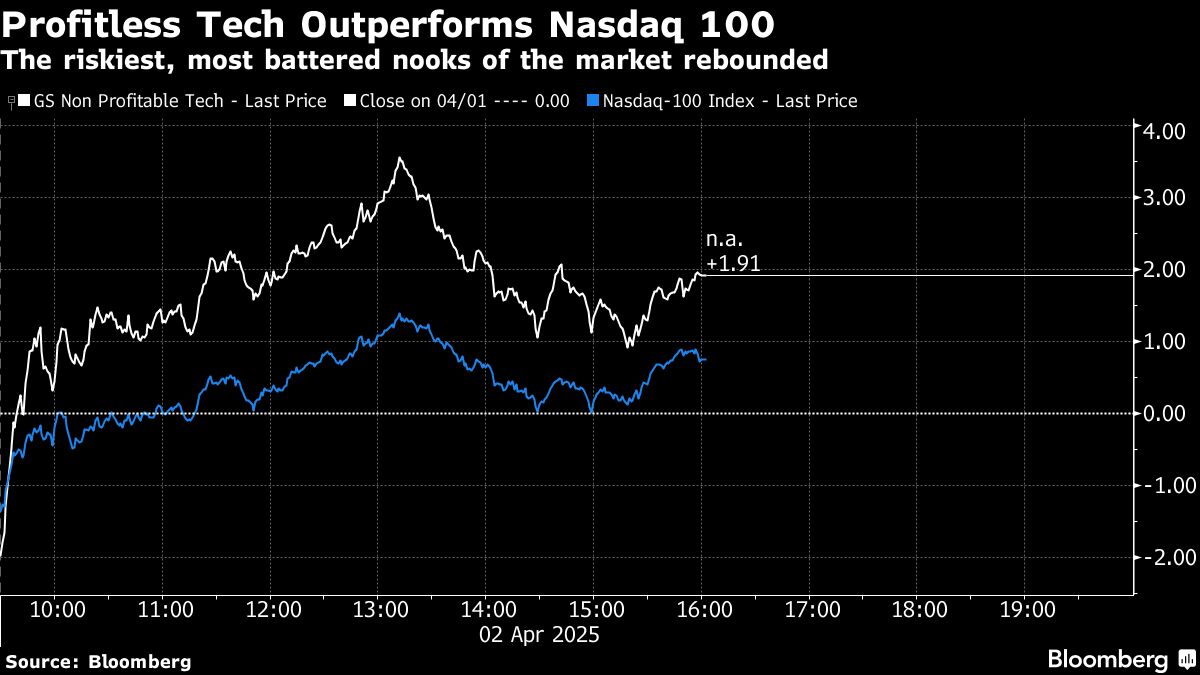
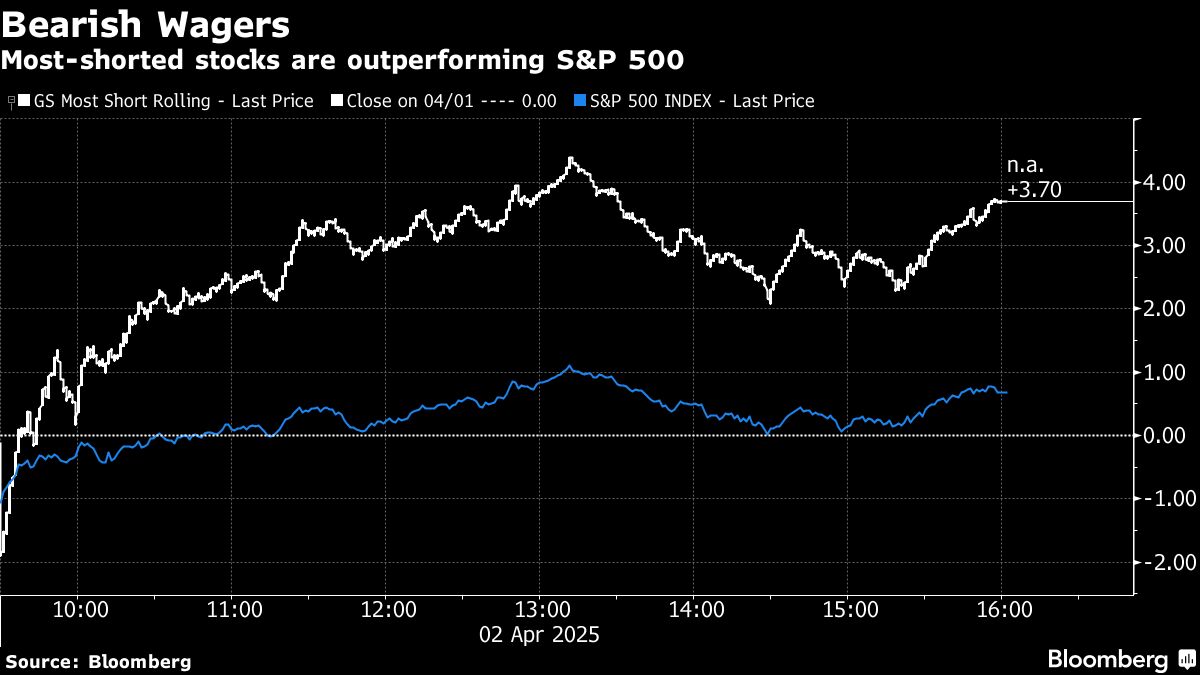
But, if there's one reason behind the brief recovery in US stocks before Trump's announcement, it would be short-covering. Shares of unprofitable technology companies and firms with a high short interest were among the big gainers. A Goldman Sachs Group Inc. gauge of the most-shorted stocks, which includes firms like Roku Inc. and Peloton Interactive Inc. outpaced the S&P 500, rising 3.7%. A separate gauge tracking unprofitable tech firms rose 1.9%.
“Traders are short-covering and getting really nervous,” said Eric Diton, president and managing director of Wealth Alliance, an investment advisory firm. “But we're not out of the woods. This is the beginning of tariffs, not the end.”
The S&P 500 has shed more than $4 trillion in market value since February's peak as tariff-related anxiety pushed investors to the exits. Many Wall Street trading desks — including at Goldman Sachs and Bank of America Corp. — expect Wednesday's tariffs to further deepen the slide in the benchmark US equity gauge.
Read: Trading Desks Say S&P 500 Selloff Isn't Over: Taking Stock
Companies are already feeling the effects of Trump's trade war, with markets gyrating in recent weeks. Chicago Federal Reserve President Austan Goolsbee said one-time tariffs should have a transitory impact on prices, but if consumers and businesses stop spending and investing, “that would be a bit of a mess.”
The derivatives market is pricing in more volatility ahead, at least in the near-term. The Cboe Volatility Index topped 21, above the 20 level that usually indicates growing concern among traders. Options traders are betting that the S&P 500 will move roughly 1.1% in either direction on Thursday based on the price of at-the-money straddles, according to Stuart Kaiser, Citigroup Inc.'s head of US equity trading strategy.
But not everyone on Wall Street expects the stock-market selloff to continue. To Jeff Buchbinder, chief equity strategist at LPL Financial, Wednesday's tariff announcement will likely provide answers to some of the biggest questions investors have right now.
Traders are looking ahead to Thursday when the Institute for Supply Management will release data on services activity for March, after costs paid for materials and services increased to one of the firmest readings since early 2023 the prior month. Meanwhile, hiring in the private sector has picked up pace, according to the ADP National Employment report released Wednesday.
On Friday, investors will get a look at the government's monthly jobs report — the first major piece of data for the quarter — which could have wide-ranging implications for bond, stock and currency markets as well as the Fed's next moves. Chair Jerome Powell is scheduled to deliver remarks at the end of the week, which will be parsed for signs of weakness spreading to the workforce.

-
Talking Points This Week: Tech Nerves, FII Buying, And A Faraway Banking Shock

The global markets are not shining this Diwali. The exception in the large markets is, India.
-
Midterm Rally Lasted A Day. The Hard Reality Of A Divided US May Last Two Years | Opinion
Between a contested AI boom, a debt ceiling that arrives in 2027 and a president with every incentive to act alone, the next two years may prove more volatile than the first day's rally suggests.
-
Blue Wave Will Derail the AI Trade but Won't Dismantle the AI Era | Unhedged Position
The Democrats' sweep of the US Congress will see politics collide with economic forces both over the long and short term.
-
It's Time To Take The GST Council's Bet On Trust Global
Payment records can prove India's services exports, and clear, proportionate rules can bring foreign digital sellers into the tax net.
-
Opinion | India at 38: From Innovation Overperformer to Innovation Powerhouse
India now has 453 VC-backed deep science startups, 18 of them late-stage, after 117 percent growth since 2020. Laurus Labs, at USD 9.3 billion, is the most valuable deep science company in any middle-income economy outside China.
-
Navigating Energy Crossroads: S Jaishankar's Call For Diversified Supply Chains At G20 Ministerial Meeting
As geopolitical fault lines continue to test maritime trade routes and commodity flows, Jaishankar's message remains pertinent: true economic resilience requires open markets, protected transit lines, and a genuine commitment to multilateral cooperation rather than coercion.
-
Indians Are Travelling, But Not Every Journey Is A Holiday | The Week In Whys
Pilgrims, patients and working women are the real travellers, and the system hasn't quite caught up with them.
-
Getting To Work Costs Women More | The Reason Why
It is not just about women paying more than men. It is about women paying much more in cities than in villages.
-
AI Bias In Investing Cannot Be Eliminated, But It Can Be Governed
Framing is a particularly important example as identical financial information presented in terms of gains rather than losses can lead an LLM to reach a different assessment.