US Long Yield Hits Two-Week High On Signs Of Economic Strength
US long-end Treasuries fell as market participants priced a higher term premium amid signs the world's largest economy is more resilient than previously thought.
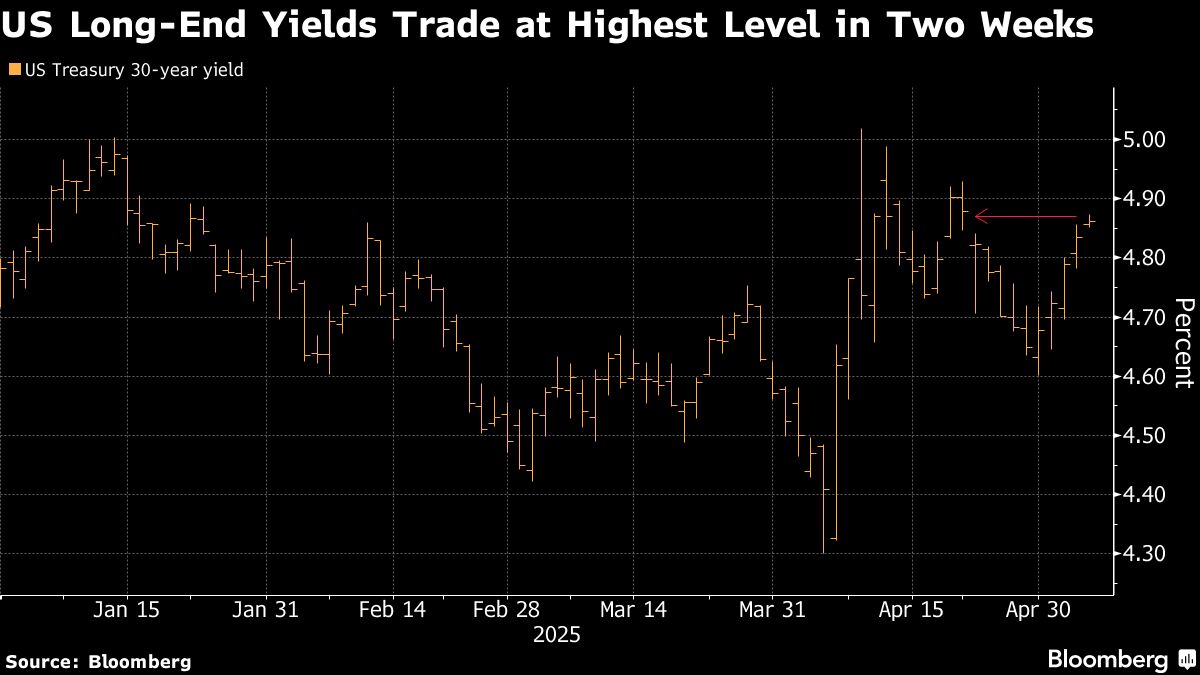
The yield on 30-year notes rose for a fifth straight session, up three basis points on Tuesday to a two-week high at 4.87%. The two-year yield dropped by the same amount to 3.80%, bear steepening the curve.
Rates traders are recalibrating their outlook for the US economy after data last week showed strong jobs growth and resilience in the manufacturing sector. Bets on Federal Reserve interest-rate cuts have been pared to 75 basis points by year-end, from as much as 107 basis points on Thursday.
There's “little prospect of a near-term interest-rate cut,” said Benjamin Schroeder, a senior rates strategist at ING. With not much new data scheduled “markets will have the chance to ride the high of stronger payrolls.”
Fed officials are widely expected to keep policy on hold when they meet on Wednesday, signaling they need to wait for more data to show how the new trade policies are affecting the economy, even though President Donald Trump has been ratcheting up pressure for lower rates.
Read more: Bond Traders Swing to Powell's Side as Trump Calls for Rate Cuts
The FOMC meeting will offer “few fireworks,” according to John Velis, Americas macro strategist at BNY. “Tariff policies as announced would have large effects on prices and economic production, but it's too early – and still too uncertain – to be prescriptive on rate policy.”
Trader focus turns to data on the US trade balance for March out Tuesday, with the goods and services deficit expected to widen to a record, alongside an auction of 10-year notes. This comes as optimism that tariff measures may be dialed back builds, after Trump suggested his administration could strike deals with some countries as soon as this week.
“Friday's solid US labor report eased investor worries over an immediate recession,” said Mark Haefele, chief investment officer at UBS Global Wealth Management. “Ongoing tariff negotiations should lead to more positive headlines.”

-
Talking Points This Week: Tech Nerves, FII Buying, And A Faraway Banking Shock

The global markets are not shining this Diwali. The exception in the large markets is, India.
-
Midterm Rally Lasted A Day. The Hard Reality Of A Divided US May Last Two Years | Opinion
Between a contested AI boom, a debt ceiling that arrives in 2027 and a president with every incentive to act alone, the next two years may prove more volatile than the first day's rally suggests.
-
Blue Wave Will Derail the AI Trade but Won't Dismantle the AI Era | Unhedged Position
The Democrats' sweep of the US Congress will see politics collide with economic forces both over the long and short term.
-
It's Time To Take The GST Council's Bet On Trust Global
Payment records can prove India's services exports, and clear, proportionate rules can bring foreign digital sellers into the tax net.
-
Opinion | India at 38: From Innovation Overperformer to Innovation Powerhouse
India now has 453 VC-backed deep science startups, 18 of them late-stage, after 117 percent growth since 2020. Laurus Labs, at USD 9.3 billion, is the most valuable deep science company in any middle-income economy outside China.
-
Navigating Energy Crossroads: S Jaishankar's Call For Diversified Supply Chains At G20 Ministerial Meeting
As geopolitical fault lines continue to test maritime trade routes and commodity flows, Jaishankar's message remains pertinent: true economic resilience requires open markets, protected transit lines, and a genuine commitment to multilateral cooperation rather than coercion.
-
Indians Are Travelling, But Not Every Journey Is A Holiday | The Week In Whys
Pilgrims, patients and working women are the real travellers, and the system hasn't quite caught up with them.
-
Getting To Work Costs Women More | The Reason Why
It is not just about women paying more than men. It is about women paying much more in cities than in villages.
-
AI Bias In Investing Cannot Be Eliminated, But It Can Be Governed
Framing is a particularly important example as identical financial information presented in terms of gains rather than losses can lead an LLM to reach a different assessment.









