Trump’s First Month Has Traders Ditching America-First Wagers
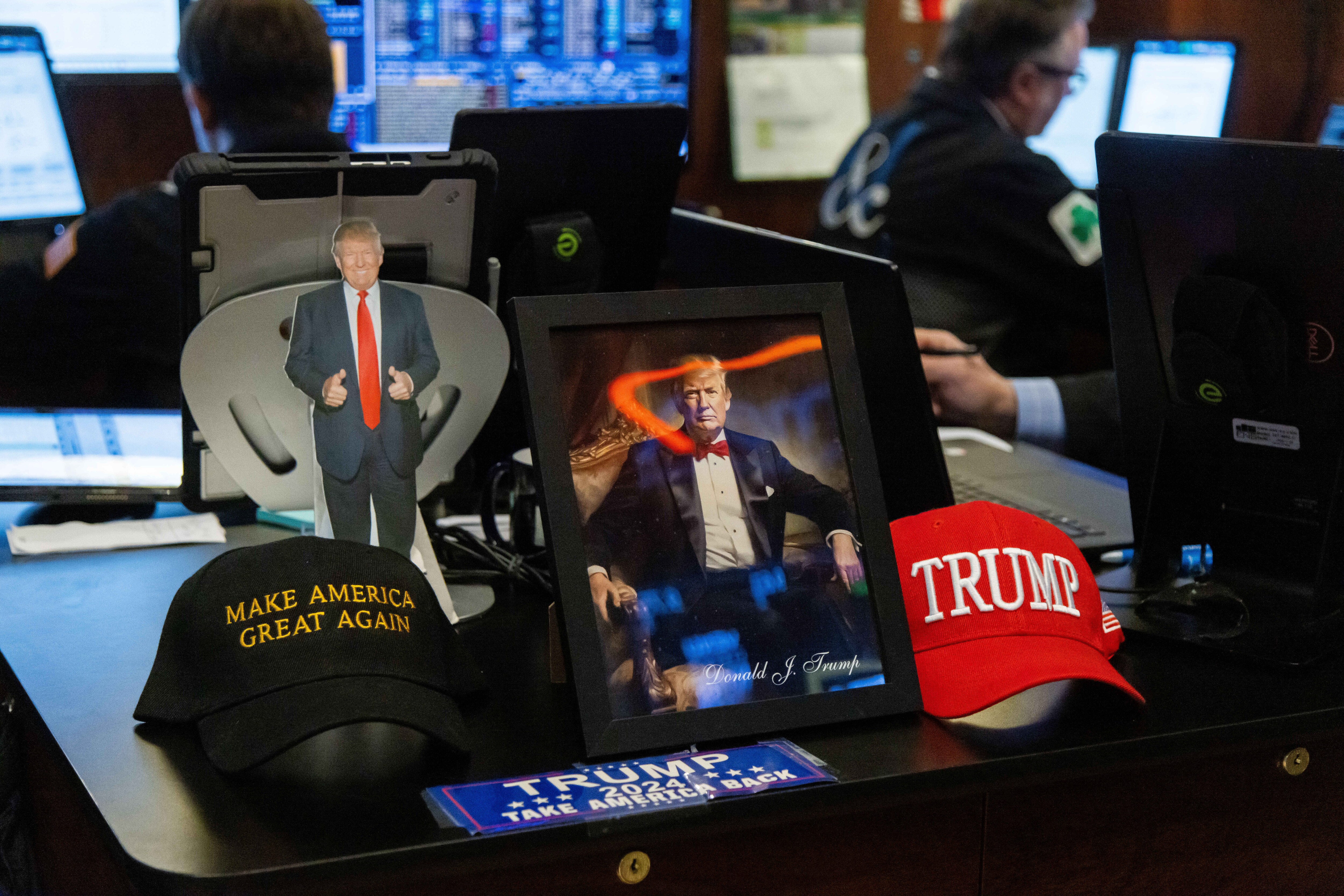
A month into President Donald Trump's second term, the euphoria is fading around many of the trades that investors piled into after his November victory, from stocks to the dollar to Bitcoin.
Instead of extending the period of US exceptionalism in global equities, the S&P 500 Index's record run has still left it trailing European, Chinese and Mexican benchmarks. The dollar's strength and bearish bets on US Treasuries are both losing steam. Even the breathless rally in cryptocurrencies and related stocks has wilted.

That's not how investors saw things playing out immediately after the Nov. 5 election, which unleashed a wave of risk-on wagers that sent stocks, the dollar, Treasury yields and Bitcoin soaring. The bet was that Trump's pledged policy mix of deregulation, tax cuts and protectionist measures would ignite economic growth and inflation.
Instead, investors say, the hallmark of the first 30 days of his term has been a dizzying blitz of tariff threats. The latest came this week as the president said he would likely impose levies on automobile, semiconductor and pharmaceutical imports of around 25%, potentially widening his trade war.
Investor sentiment has been growing steadily more bearish over the past month, reflecting worries that tariffs may spark quicker inflation, keeping the Federal Reserve from cutting rates further and weighing on growth.
“There was an overshooting of rampant optimism without investors really thinking it through,” said Eric Diton, president of Wealth Alliance.
Here's how so-called Trump trades are playing out across asset classes, one month after Inauguration Day:
Small-Cap Reversal
The biggest winner within US equities in the immediate aftermath of Trump's victory was small-cap stocks.
Investors bet that these companies, which are typically more domestic-focused, would be among the primary beneficiaries of an administration that wanted to boost the economy and protect local businesses with tariffs. The day after the vote, the Russell 2000 Index of small-cap shares surged 5.8%, its biggest gain in three years. Yet by the end of November it had peaked, and it's now roughly 1% above its Nov. 5 close.

“Mid- and small-cap stocks were projected to shine under Trump's second term as these asset classes are more insulated from probable trade wars,” said Eric Sterner, chief investment officer at Apollon Wealth.
They have struggled to keep up with large caps, he said, because elevated interest rates put pressure on smaller firms, which usually have a higher debt burden.
Energy and financial stocks were also a focus after Trump's win. The S&P 500 Energy Index rallied right after the election, but has surrendered that advance and is currently little changed from Nov. 5 levels, similar to the price of oil. The S&P 500 Financials Index, on the other hand, is up 12%, driven mainly by solid bank earnings.
“Investors had big hopes for this sector due to deregulation and potential increased M&A activity, but the strongest tailwinds have been earnings,” Sterner said. The prospect of a stronger environment for deals appeared to dim somewhat as Trump's antitrust enforcers said they will follow tougher merger review rules adopted under President Joe Biden.
Of course, some equities wagers worked as expected. Shares of renewable energy companies have weakened as the administration has largely stuck to its pro-fossil-fuel stance.
Dollar Peak
What had been the strongest macro expression of the Trump trade — going long the dollar, in part on the view that tariffs would reignite inflation and drive up US bond yields — has withered. The Bloomberg Dollar Spot Index gained roughly 4.5% from Election Day through Jan. 15. But since then, it's down about 1.5%.
One reason the greenback has lost momentum, traders say, is that the market had been overestimating the positive impact of tariffs on the dollar ahead of Trump's inauguration. The currency market has still seen plenty of turbulence as a result of tariff announcements. The president's vow to slap 25% levies on imports from Canada and Mexico by Feb. 1, for example, punished the peso and loonie — only for the moves to quickly reverse once he paused those levies.
“People who were waiting for Trump trades to extend have been disappointed,” said Kyle Chapman, a foreign-exchange markets analyst at Ballinger Group in London.

Fading Steepener
Wagers on higher Treasury yields and a steeper yield curve went hand-in-hand with the bullish dollar trade. The idea was that Trump's pledge of lower taxes — coupled with the inflationary impulse from tariffs — would weigh on the bond market.
The US yield curve from two- to 10 years steepened sharply from November through early January, peaking at the highest in more than two years. Part of the bet was based on expectations that the administration would have to increase debt issuance as deficits swelled.
As it turned out though, the Treasury under Trump has signaled that it plans to keep bond sales steady for now. That policy, along with the administration's vows to cut spending, eased some angst around federal deficits, helping pull long-term yields down over the past month.

“We had this bond vigilante-driven Trump trade in the run-up to the election and after,” said Guneet Dhingra, the head of US rates strategy at BNP Paribas in New York. “But if you look at what's happened since the inauguration, it's been the exact opposite and the curve has been flattening.”
Crypto Fervor
Crypto assets surged after the election as the industry threw its support behind Trump, who promised a more friendly regulatory environment.
But those gains have moderated as there haven't been many new developments to extend the bullishness. For example, Trump's campaign promise to create a national Bitcoin reserve has yet to reach fruition — White House crypto and AI czar David Sacks said this month that a working group within the administration needed to study the plan's feasibility.

Bitcoin rallied around 50% in the two months after the election. But since peaking above $100,000 in January, it dropped to below $97,000 as of Wednesday afternoon in New York. Scandals involving memecoins such as Libra have also undermined investors' appetite for crypto.
“The vibes are just extremely negative in crypto right now,” said Matthew Hougan, chief investment officer at Bitwise.

-
Opinion | India at 38: From Innovation Overperformer to Innovation Powerhouse

India now has 453 VC-backed deep science startups, 18 of them late-stage, after 117 percent growth since 2020. Laurus Labs, at USD 9.3 billion, is the most valuable deep science company in any middle-income economy outside China.
-
Navigating Energy Crossroads: S Jaishankar's Call For Diversified Supply Chains At G20 Ministerial Meeting
As geopolitical fault lines continue to test maritime trade routes and commodity flows, Jaishankar's message remains pertinent: true economic resilience requires open markets, protected transit lines, and a genuine commitment to multilateral cooperation rather than coercion.
-
Indians Are Travelling, But Not Every Journey Is A Holiday | The Week In Whys
Pilgrims, patients and working women are the real travellers, and the system hasn't quite caught up with them.
-
Getting To Work Costs Women More | The Reason Why
It is not just about women paying more than men. It is about women paying much more in cities than in villages.
-
AI Bias In Investing Cannot Be Eliminated, But It Can Be Governed
Framing is a particularly important example as identical financial information presented in terms of gains rather than losses can lead an LLM to reach a different assessment.
-
Joining The Dots | Dark Skies, Steady Diya: Why Hope Holds This Diwali
With war, a weak rupee and foreign outflows weighing on sentiment, policymakers at the NDTV World Summit and market veterans at NDTV Profit Ignite: Diwali Edition offered the same advice: stay invested and filter out the noise.
-
The Curious Case of Equitas Small Finance Bank And A CEO Who Quit For Stock
PN Vasudevan believes persistent investor concerns over a perceived conflict of interest had become a governance overhang on Equitas Small Finance Bank's stock, even as the lender improved profitability and asset quality.
-
Talking Points This Week: AI Cash Burn, A Tiger Comeback And An India That Still Finds Its Own Path
India is not immune to higher oil or tighter global liquidity, yet its earnings base is broader, its domestic policy levers are still available.
-
Foreign Investors Own Half Of HDFC Bank and ICICI Bank. An LTCG Cut Could Matter Most Here
Foreign portfolio investors have US$115 billion parked in HDFC Bank, ICICI Bank. If the government cuts long-term capital gains tax, Jefferies says returning foreign money could land here first.










