Treasury Yields Extend Slide Fueled By Weak Data, Fed Comments

(Bloomberg) -- US bond yields were near session lows in late US trading after weaker-than-expected economic data and comments by Federal Reserve officials in support of slowing the pace at which it's shedding Treasury securities from its asset portfolio.
The two-year note's yield fell as much as 10 basis points on the day to 4.52%, the lowest level since Feb. 15. It drew 4.69% in an auction on Monday. Longer-maturity yields declined less. The rally overrode bearish sentiment that had gripped the marker earlier in the day, based in part on a contrarian forecast that the Fed won't cut interest rates this year.
Yields reached the lowest levels of the day after a large block trade in Treasury five-year note futures at a price consistent with a purchase. However, the bulk of the move occurred earlier in the session, when weaker-than-anticipated data was followed shortly by comments by Fed Governor Christopher Waller in support of slowing the pace at which Treasury securities are rolling off its balance sheet.
“We've seen a lot of buying today,” said Andrew Brenner, head of international fixed income at Natalliance Securities LLC. “There's been a lot of information that has led to better rates,” including economic data and Waller's comments.
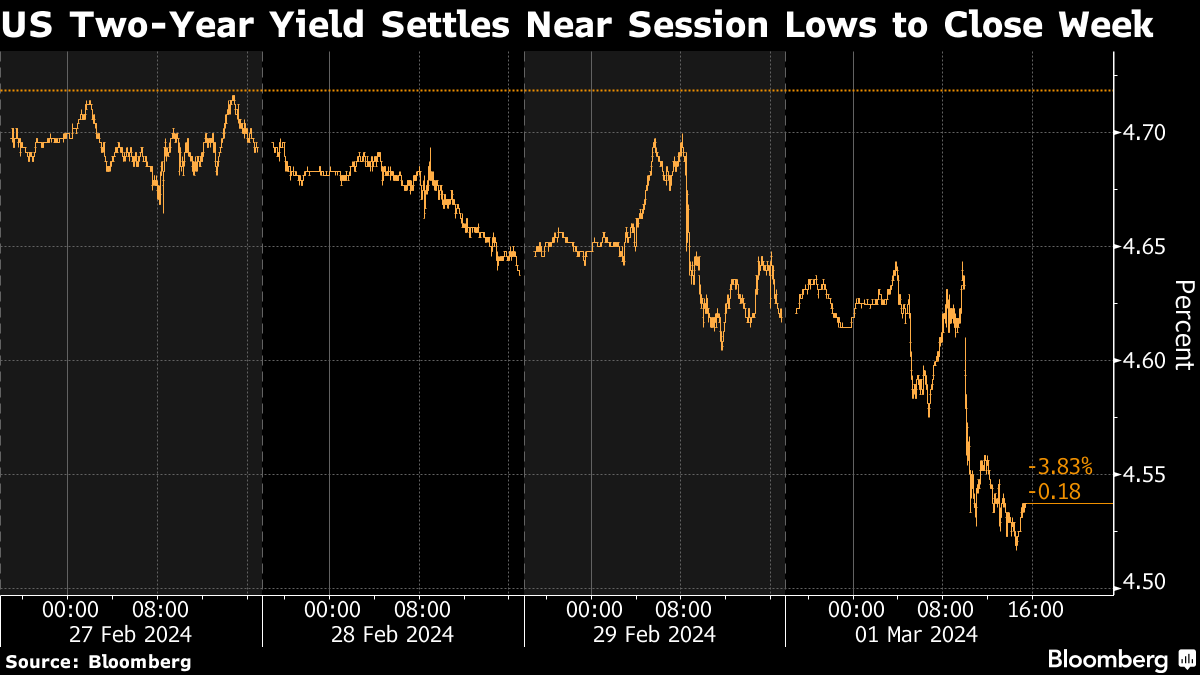
Treasuries began the day with gains against the backdrop of a collapse in the shares of New York Community Bancorp that stoked concerns about US regional banks' real estate exposure. The gains briefly faded as US equity index futures recovered early in the session, and following a prediction by Torsten Slok, chief economist at Apollo Management, that economic growth and inflation won't allow the Fed to cut interest rates this year.
Fed officials' most recent quarterly forecast in December was for three quarter-point cuts this year, and the bond market has embraced that view, based on the prices of swap contracts that reference future Fed meeting dates. But growth and inflation have slowed less than most people expected after 11 Fed rate increases over the past two years, and officials have an opportunity to revise their forecasts next month.
Interest-rate strategists at Bank of America said in report that the risk of a signal for fewer rate cuts this year had risen because policymakers are likely to increase their forecasts for the economy and inflation.
Data released Friday clashed with that view though. The ISM manufacturing report for February was weaker than economists predicted, and included the second-lowest employment gauge in recent years. And the University of Michigan's consumer sentiment gauges for February were revised lower. On the labor market front, the US government's February employment report is slated to be released March 8.
Fed Governor Waller said he favored a shift in the Fed's holdings toward a larger share of short-term Treasuries. During the same event, Dallas Fed President Lorie Logan reiterated her view that it'll likely be appropriate for the central bank to start slowing the pace at which it shrinks its balance sheet as the quantity of reserves in the banking system declines.
Their comments “may have helped move rates lower,” said Gennadiy Goldberg, head of US interest-rate strategy at TD Securities. Treasuries outperformed swaps Friday, suggesting “that the market thinks the end of QT is nigh.”
--With assistance from Edward Bolingbroke and Alexandra Harris.
(Adds comments, context and chart and updates yield levels.)
More stories like this are available on bloomberg.com
©2024 Bloomberg L.P.

-
Love, Sex Aur Dhokha: The Audacious Plot To Spy On Jensen Huang

A Taipei dinner, a Singapore chip buyer and a suspected Chinese asset: inside the alleged spy operation that got close to NVIDIA's Jensen Huang.
-
Ten Things I Learnt This Samvat
Patience can be a trap. Cheap stocks can stay cheap. Leverage can wipe you out. What did Samvat 2082 teach us? Niraj Shah writes on 10 lessons from the year gone by.
-
Talking Points This Week: Tech Nerves, FII Buying, And A Faraway Banking Shock
The global markets are not shining this Diwali. The exception in the large markets is, India.
-
Midterm Rally Lasted A Day. The Hard Reality Of A Divided US May Last Two Years | Opinion
Between a contested AI boom, a debt ceiling that arrives in 2027 and a president with every incentive to act alone, the next two years may prove more volatile than the first day's rally suggests.
-
Blue Wave Will Derail the AI Trade but Won't Dismantle the AI Era | Unhedged Position
The Democrats' sweep of the US Congress will see politics collide with economic forces both over the long and short term.
-
It's Time To Take The GST Council's Bet On Trust Global
Payment records can prove India's services exports, and clear, proportionate rules can bring foreign digital sellers into the tax net.
-
Opinion | India at 38: From Innovation Overperformer to Innovation Powerhouse
India now has 453 VC-backed deep science startups, 18 of them late-stage, after 117 percent growth since 2020. Laurus Labs, at USD 9.3 billion, is the most valuable deep science company in any middle-income economy outside China.
-
Navigating Energy Crossroads: S Jaishankar's Call For Diversified Supply Chains At G20 Ministerial Meeting
As geopolitical fault lines continue to test maritime trade routes and commodity flows, Jaishankar's message remains pertinent: true economic resilience requires open markets, protected transit lines, and a genuine commitment to multilateral cooperation rather than coercion.
-
Indians Are Travelling, But Not Every Journey Is A Holiday | The Week In Whys
Pilgrims, patients and working women are the real travellers, and the system hasn't quite caught up with them.









