Trade Outlook Volatility Needs To Reduce For Money To Flow Into Asia EMs, Says Goldman Sachs' Timothy Moe

Goldman Sachs believes foreign fund inflows into emerging Asian markets will only get reflected when trade outlook volatility on the global front reduces. The upheaval triggered by trade tariffs has sparked a risk-aversion mood in investors across the globe. This is driving traders to safer havens like gold, if not the dollar index, as of now, said Timothy Moe, chief Asia-Pacific equity strategist, Goldman Sachs.
The dollar index is on a downward trajectory, according to the brokerage. The dollar index is 15% overvalued, according to several long-term, fair-value models Goldman Sachs refers to.
"Significantly, the US current administration has publicly said that they would like dollar to be weaker."Timothy Moe, Chief Asia Pacific Equity Strategist, Goldman Sachs
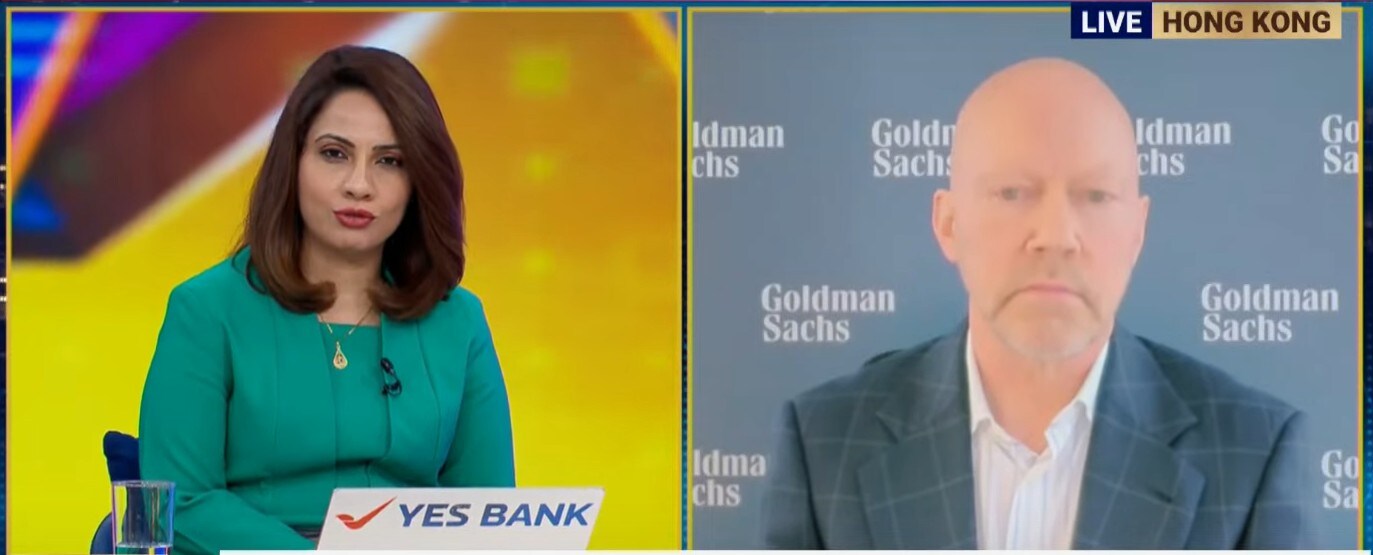
Goldman Sachs Chief Asia-Pacific Equity Strategist, Timothy Moe, was speaking to NDTV Profit Executive Editor Tamanna Inamdar.
Historically, a decline in the US dollar causes money flow into Asian and emerging markets. The key point is that a moderation in the global environment is required, Moe said in an interview with NDTV Profit.
The recent news from London is encouraging. However, markets have not received any substantial details yet. The direction where the US and China are heading in terms of trade talks appears to be better than where they were in early April. However, a degree of uncertainty remained, he said.
The second day of trade talks between US and China concluded in London. Both sides have reached a consensus and a final framework is needed to get approval from presidents of both countries, as reported by Bloomberg.
US Treasury Secretary Scott Bessent, Commerce Secretary Howard Lutnick, and Trade Representative Jamieson Greer are leading the country's delegation, while China's Vice Premier Hi Lifeng is leading Chinese delegation.
View On India
Goldman Sachs maintained a marketweight rating on India. Recovery in agriculture, consumption, and earnings growth were positive, he said.
Goldman Sachs is looking at 12% earning-per-share growth for calendar year 2025 in India. Fundamentally, things have stabilised and look constructive, Moe said.
India's challenge is that valuation is high. The MSCI India Index's forward multiple was 23.23 times price-to-earning ratio, which is 1.4 times above the 10-year PE. Hence, investors may focus on certain pockets of Indian markets.
US Economic Growth To Fall To 1% In Q4
Goldman Sachs is estimating that economic growth in the US will fall to 1% in the fourth quarter year-on-year, from a strong run rate in the second quarter. GDP numbers of the first two quarters are volatile and it is hard to get a real grasp, Moe said.
The key debate for market watchers is the tension between hard data and soft data. Soft data, affected by expectations, got compressed very significantly, which is expected to recover once market participants get clarity on trade outlook, he said.
Goldman Sachs projects a two-third recovery in the soft data, while deceleration in the hard data will likely continue, he said.
The brokerage's US portfolio strategy team found out that the markets have already factored in some of the expected decline in hard data, and expect recovery in soft data. It's likely the reason why markets have recovered very swiftly from April lows in the US, and in many regions, Moe said.

-
Opinion | India at 38: From Innovation Overperformer to Innovation Powerhouse

India now has 453 VC-backed deep science startups, 18 of them late-stage, after 117 percent growth since 2020. Laurus Labs, at USD 9.3 billion, is the most valuable deep science company in any middle-income economy outside China.
-
Navigating Energy Crossroads: S Jaishankar's Call For Diversified Supply Chains At G20 Ministerial Meeting
As geopolitical fault lines continue to test maritime trade routes and commodity flows, Jaishankar's message remains pertinent: true economic resilience requires open markets, protected transit lines, and a genuine commitment to multilateral cooperation rather than coercion.
-
Indians Are Travelling, But Not Every Journey Is A Holiday | The Week In Whys
Pilgrims, patients and working women are the real travellers, and the system hasn't quite caught up with them.
-
Getting To Work Costs Women More | The Reason Why
It is not just about women paying more than men. It is about women paying much more in cities than in villages.
-
AI Bias In Investing Cannot Be Eliminated, But It Can Be Governed
Framing is a particularly important example as identical financial information presented in terms of gains rather than losses can lead an LLM to reach a different assessment.
-
Joining The Dots | Dark Skies, Steady Diya: Why Hope Holds This Diwali
With war, a weak rupee and foreign outflows weighing on sentiment, policymakers at the NDTV World Summit and market veterans at NDTV Profit Ignite: Diwali Edition offered the same advice: stay invested and filter out the noise.
-
The Curious Case of Equitas Small Finance Bank And A CEO Who Quit For Stock
PN Vasudevan believes persistent investor concerns over a perceived conflict of interest had become a governance overhang on Equitas Small Finance Bank's stock, even as the lender improved profitability and asset quality.
-
Talking Points This Week: AI Cash Burn, A Tiger Comeback And An India That Still Finds Its Own Path
India is not immune to higher oil or tighter global liquidity, yet its earnings base is broader, its domestic policy levers are still available.
-
Foreign Investors Own Half Of HDFC Bank and ICICI Bank. An LTCG Cut Could Matter Most Here
Foreign portfolio investors have US$115 billion parked in HDFC Bank, ICICI Bank. If the government cuts long-term capital gains tax, Jefferies says returning foreign money could land here first.










