The Scary Side Of 'Super Quality Stocks' Is Now In The Spotlight

As portfolio managers, we spend considerable amount of time in finding a great business which can compound our investor's capital on high probability basis over long periods of time. But does identification of a great business automatically qualify the company as a great stock which can then be bought virtually at all points of time and at any valuations?
That's has been one of the very important questions in front of investors at large. This is truer in the Indian context in last few years where scores of great businesses had started trading at astronomical valuations by late 2019 and early 2020 and after a brief break during Covid fall, these stocks marched further to new heights by end of 2021. These high-quality growth stocks had long been market's favorites and were considered as perpetual ‘buy & hold' stocks or ‘buy at any price' stocks. They were supposed to keep compounding the capital for the investors although many of them had been delivering lower than expected earnings in the past or trading with virtually no margin of safety.
To deconstruct the puzzle of what should investors do with these kinds of businesses, we at Monarch AIF did a fact-based, analytical deep dive on the valuations of India's great businesses and identified a basket of 54 such stocks (identified through filters of consistent growth, high return rations and excellent corporate governance over a decade) which we then called a ‘Super Quality Stocks' basket.
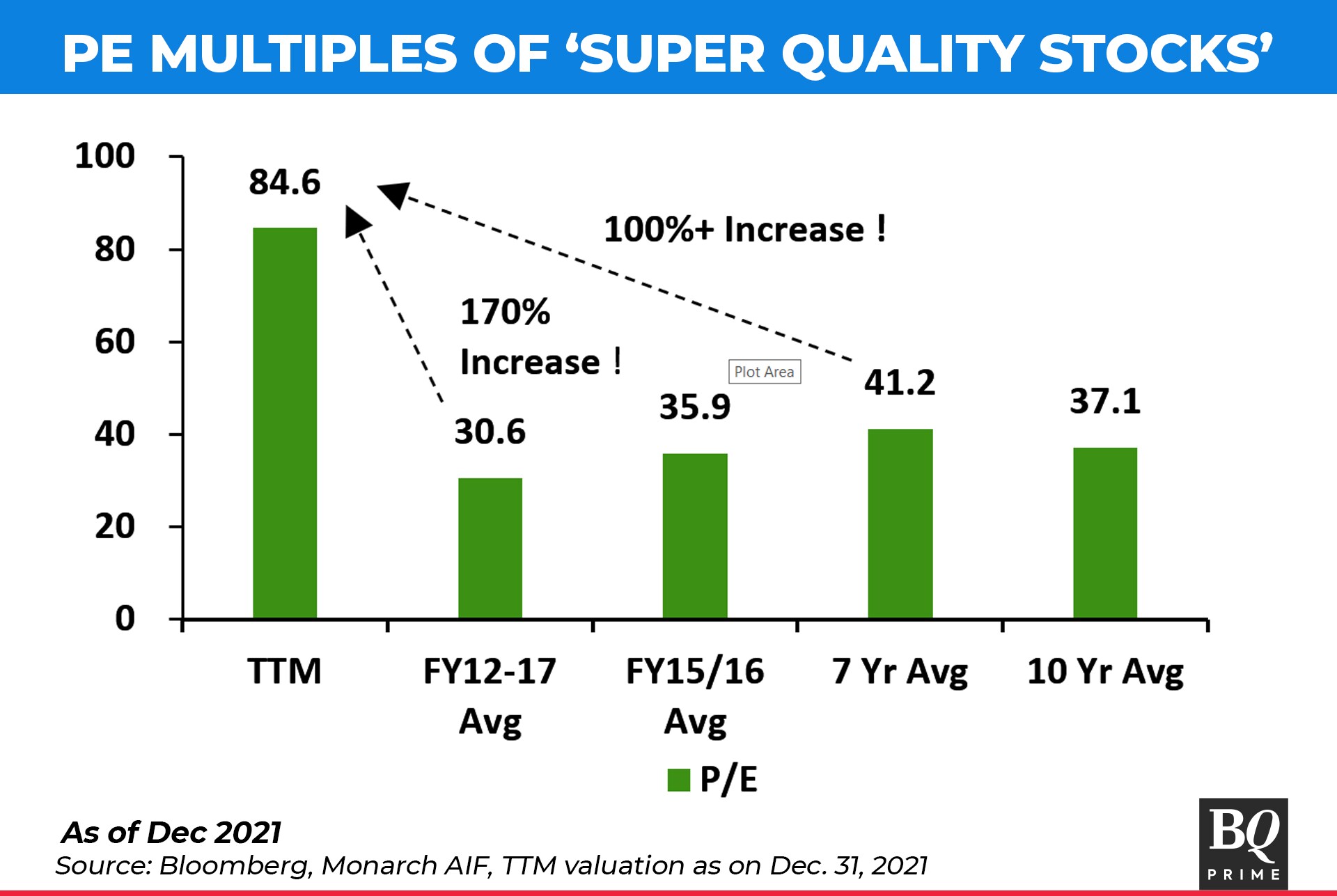
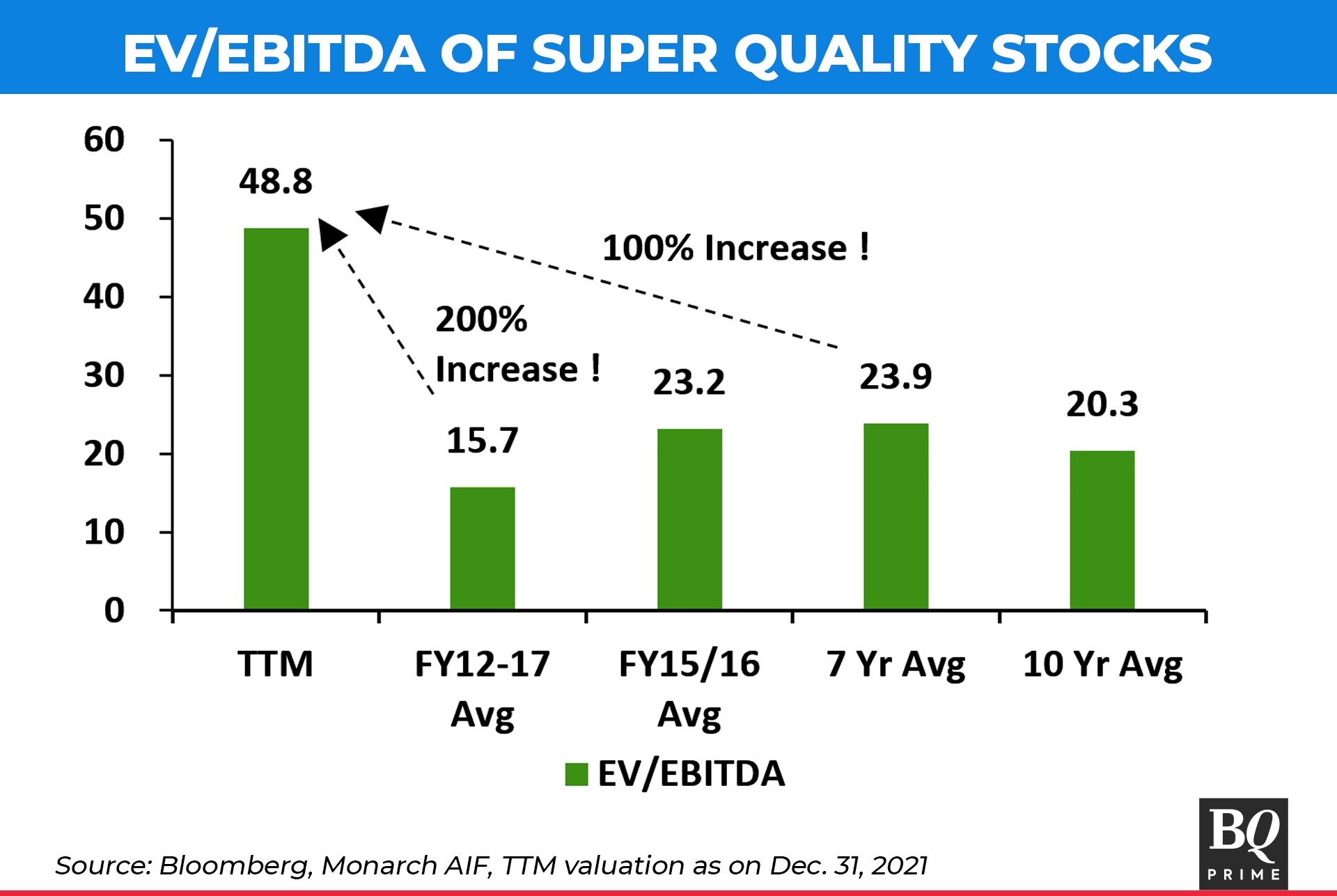
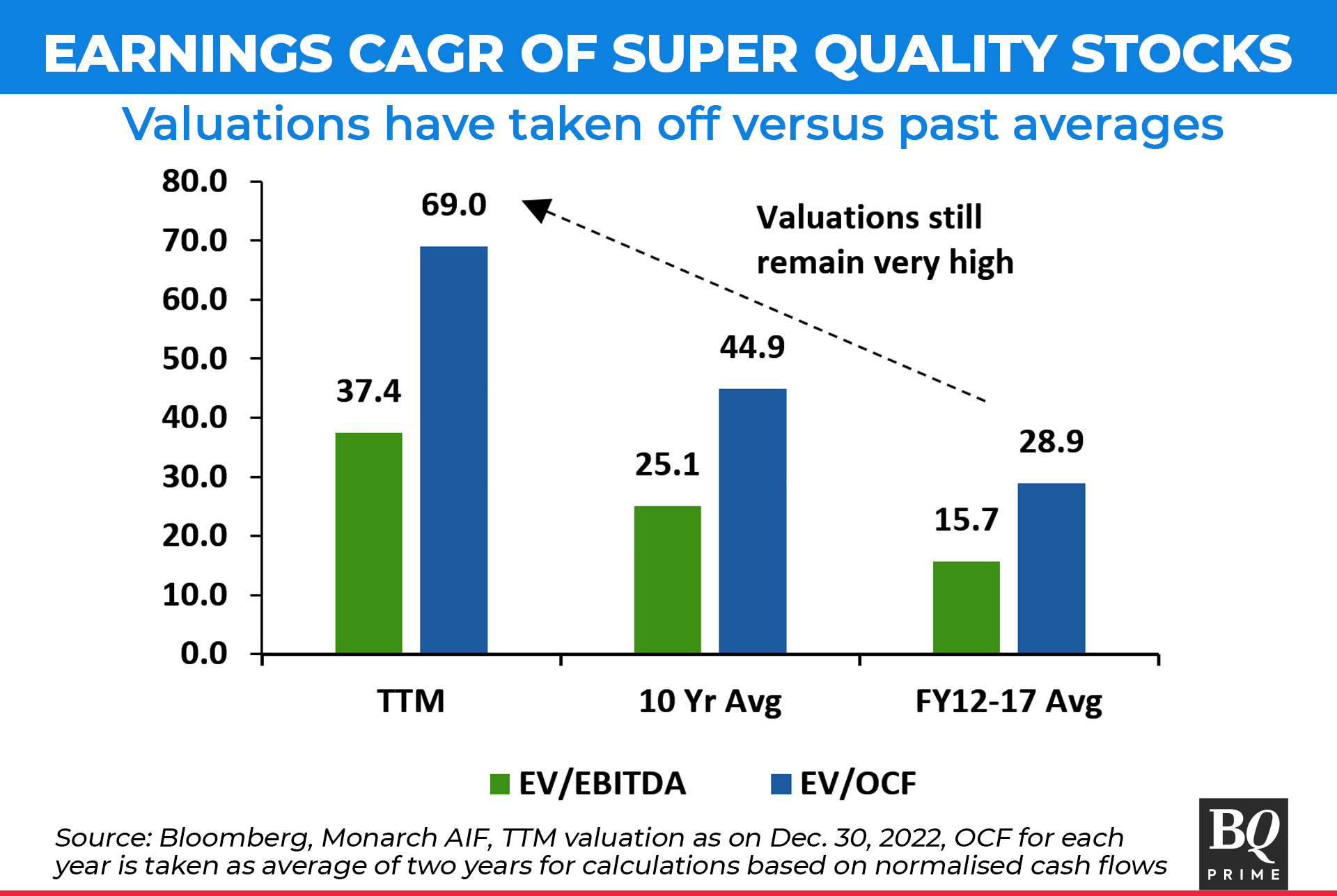
This basket was trading at an average PE of 85x and EV/Ebitda of 48x at end of 2021, which was the scary part hiding in plain sight for everyone to see and notice. However, the market's nonchalance instead of showing surprise on the same was egregious. It seemed that a vast majority was comfortable buying more into these companies only based on excellent past track record of price appreciation. There was no dearth of inflows coming to these stocks at all valuations and benign liquidity conditions in last many years also worked in their favor on top of the quality angle; it was a case of a rising tide lifting the heavier boats. While the absolute valuations were mind-boggling by any standards, they were also at a premium of 110-130% to the basket's own average of previous 10 years and 170-200% premium to its average of FY12-17.
Our study also showed that the valuation expansion was very sharp after FY17, driven by several disruptions in the general economy (demonetisation, GST, NBFC crisis and finally Covid crisis) which led to investors flocking for safety in these ‘Super Quality Stocks' and in the process pushed the valuation from “high premium for quality” to “unsustainable valuation bubble in quality”.
In other words, disruptive situations coupled with unprecedented levels of liquidity led to the risk premiums on these stocks collapsing to the point of unreasonableness. As the valuation bubble was hard to miss, we provided a framework to rationally analyze them while also prognosticated years of underperformance from this very set of highly coveted stocks.
Fast forward one year, with some of the concerns on valuations getting noticed by the market coupled with tightening of liquidity conditions, we note that the ‘Super Quality Stocks' basket has fallen by (11.6)% vs Nifty 50/Nifty 500 gain of 4.3%/3% in 2022 (staggering underperformance of 16% vs Nifty 50). The fall for the ‘Super Quality Stocks' basket has been a more dramatic 30% from its all-time highs (vs 5% fall for Nifty 50).
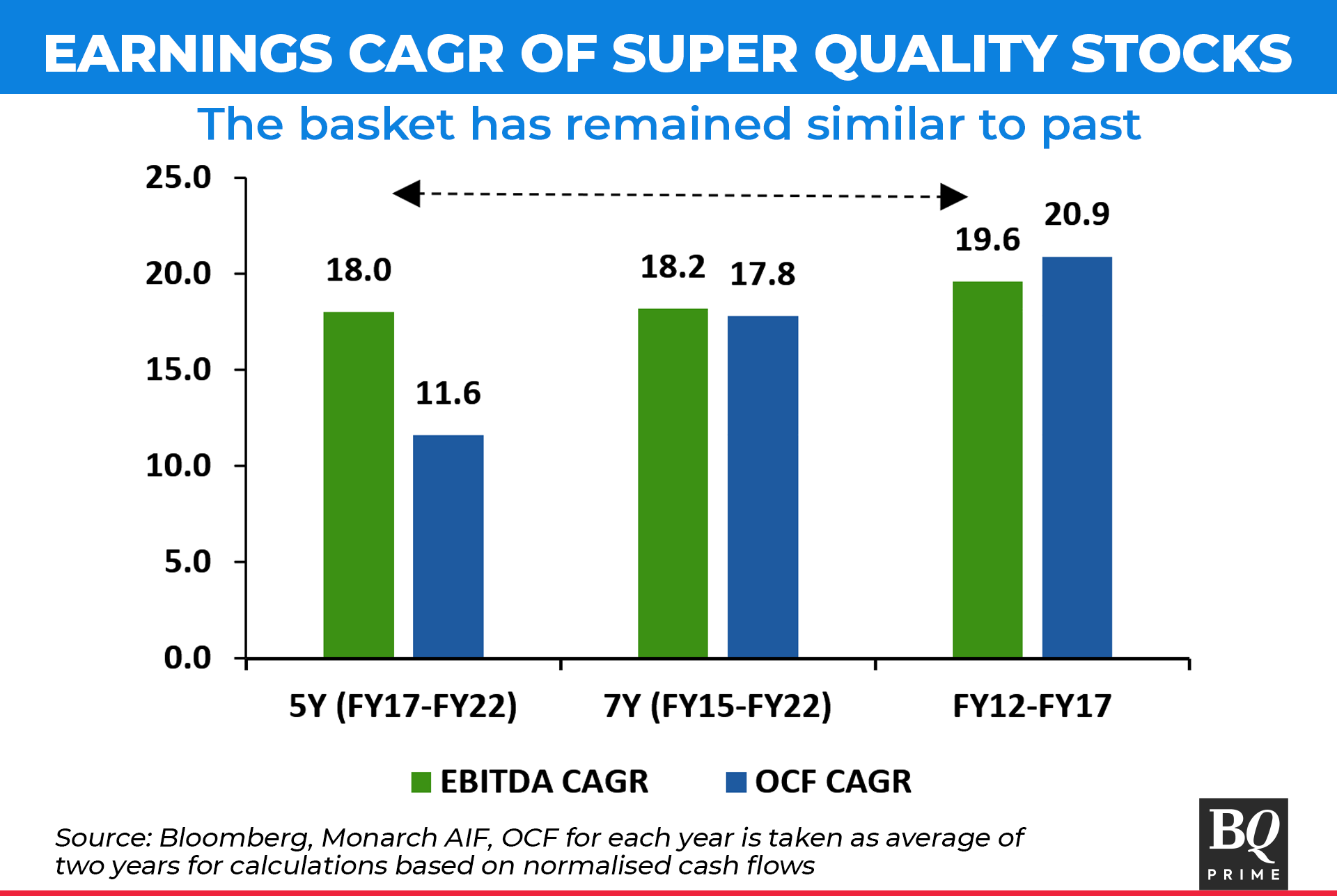
We are reminded of the timeless quote from Anthony Bolton – ‘Mean reversion is one of the greatest truism of capitalism' and this is what has started playing out for the ‘Super Quality Stocks'. However, notwithstanding the underperformance seen in 2022, the absolute valuations remain extremely high even today for these stocks even though the earnings growth is largely similar to its past period averages. We have thus maintained our view that the underperformance from these stocks is a likely outcome even for the coming year(s), notwithstanding the great business qualities because there is no margin of safety in these companies' stocks.
This brings us to the key implications for investors from our last two years study:
1. We believe that rational investing involves dispassionate analysis of all facets of right stock selection, one of which is premised on margin of safety or the valuations. Investors often get carried away in ignoring valuations particularly for high-quality past winners or for new upcoming hot trend. Many market intermediaries including some sharp minds (at many times) lure the investor community into believing that the prospects for such stocks are so great that money can be made from them at any or all valuations. In the process the margin of safety aspect is ignored and future outcomes on returns can become environment-dependent or matter of luck.
2. There can be no guarantee that a great business is also a great stock at all points of time. While this has been repeatedly seen from the actions of great investors like Buffett/Munger, it is conveniently forgotten by market participants during times of euphoria or easy liquidity conditions.
We hope that our study would act as a guardrail for investors to think about investment decisions cogently, balancing risk-reward suitably and doesn't keep them in an illusion that ‘Super Quality' means ‘Super Safe' at all price points. Remarkably, each of these 54 stocks represents a great and illustrious business with a long track record—and indeed that is the only reason for them being market favourites. Simultaneously, that very same pedigree fostered an indifference towards valuations.
Abhisar Jain is CFA (fund manager) at Monarch AIF.
This article is part of two-part investor newsletter knowledge series covered by Monarch AIF in January 2022 and 2023.
The views expressed here are those of the author, and do not necessarily represent the views of BQ Prime or its editorial team.

-
Where You Live Shapes How You Get To Work | The Reason Why

Two-wheelers are the most popular way to get to work in India, accounting for nearly 43% of workplace commutes.
-
High US Salaries, No Green Card Certainty: The Financial Calculation Facing Indian H-1B Families
The suspension of PERM processing at eight technology employers does not cancel existing H-1B visas. What it does is force a question many Indian families have been avoiding: is the US salary worth tying your career and family plans to one employer?
-
Unhedged Position: Can India See An Indonesia-Style Time Correction?
The Nifty is trading below levels it first clocked in 2024. Is there, then, as I have suggested in the headline, potential that the current time correction drags on painfully for the next three-five, even ten years?
-
Navigating Friction And Energy Realities: An Analysis Of Marco Rubio's October Visit To India
Occurring at a critical juncture marked by stalled trade negotiations and escalating geopolitical pressures over global energy supplies, the visit offers a profound window into modern US-India relations.
-
India Exports Capital. Why Not Export Trusteeship?
The big question, then, is whether India can build an institution that global borrowers, investors, banks, and lawyers can trust, even without an Indian connection.
-
France's Economy & Politics Are In Crisis | The Reason Why
Let's look at how the French economy and politics evolved under Nicolas Sarkozy, Franois Hollande and Emmanuel Macron.
-
You May Inherit The Business. You Must Earn Its Credibility.
Succession tests the founder's ability to share authority as much as it tests the next generation's readiness to assume it.
-
Signing Deals Is One Thing; Making Them Work Is Another | The Week In Whys
Sometimes, things don't turn out as planned. Indian companies have lost some bids to rivals, some projects won't produce until 2030.
-
FOMC Wall, PERM Suspension, Hospital Stocks | Talking Points This Week
A PERM suspension would directly affect green-card sponsorship rather than H-1B visas, so the near-term earnings impact could remain relatively limited. The key question is whether this marks a new phase in US scrutiny of Indian IT.
-
Everything, Everywhere, All At Once: Dalal Street's Week To Forget | Joining The Dots
Visa curbs, a Starlink spat and cancer drug caps: what connects this week's shocks for Indian markets