Temasek-Backed Licious Seeks $2-Billion IPO Valuation

Licious, a Temasek Holdings Pte-backed online seller of meat and seafood in India, is seeking to become profitable as it prepares to list in 2026, adding to a slew of consumer-facing firms eyeing the country's public markets.
Delightful Gourmet Pvt., which operates Licious, is opening more brick-and-mortar stores, speeding up deliveries to take on quick commerce rivals and aims to post a profit at the Ebitda level by August, according to Vivek Gupta, chief executive officer and firm's co-founder. Ebitda refers to Earnings before interest, tax, depreciation and amortisation.
“We want to be an IPO-ready company in 12 months,” Gupta said in an interview.
The Bengaluru-based firm is targeting a valuation of more than $2 billion in the listing, according to people familiar with the matter who did not want to be named. Licious was valued at $1.5 billion in its last funding round in 2023 and counts Avendus Capital Pvt., and Kotak Investment Advisors among its investors, data from Tracxn Technologies Ltd. show.
Licious, founded in 2015, is the latest to join the queue for India's IPO market after a blockbuster year for listings in 2024 when more than $20 billion was raised by local firms, making it the world's second-busiest market after the US.
Gupta and co-founder Abhay Hanjura didn't comment on the target valuation before the firm starts the IPO process.
Mom-And-Pop Shops
Nearly three quarters of India's 1.4 billion population consumes fish, chicken or meat — most of it bought from mom-and-pop retailers. Licious is betting on India's increasingly affluent and smartphone-savvy population that's willing to pay more to avoid stepping out.
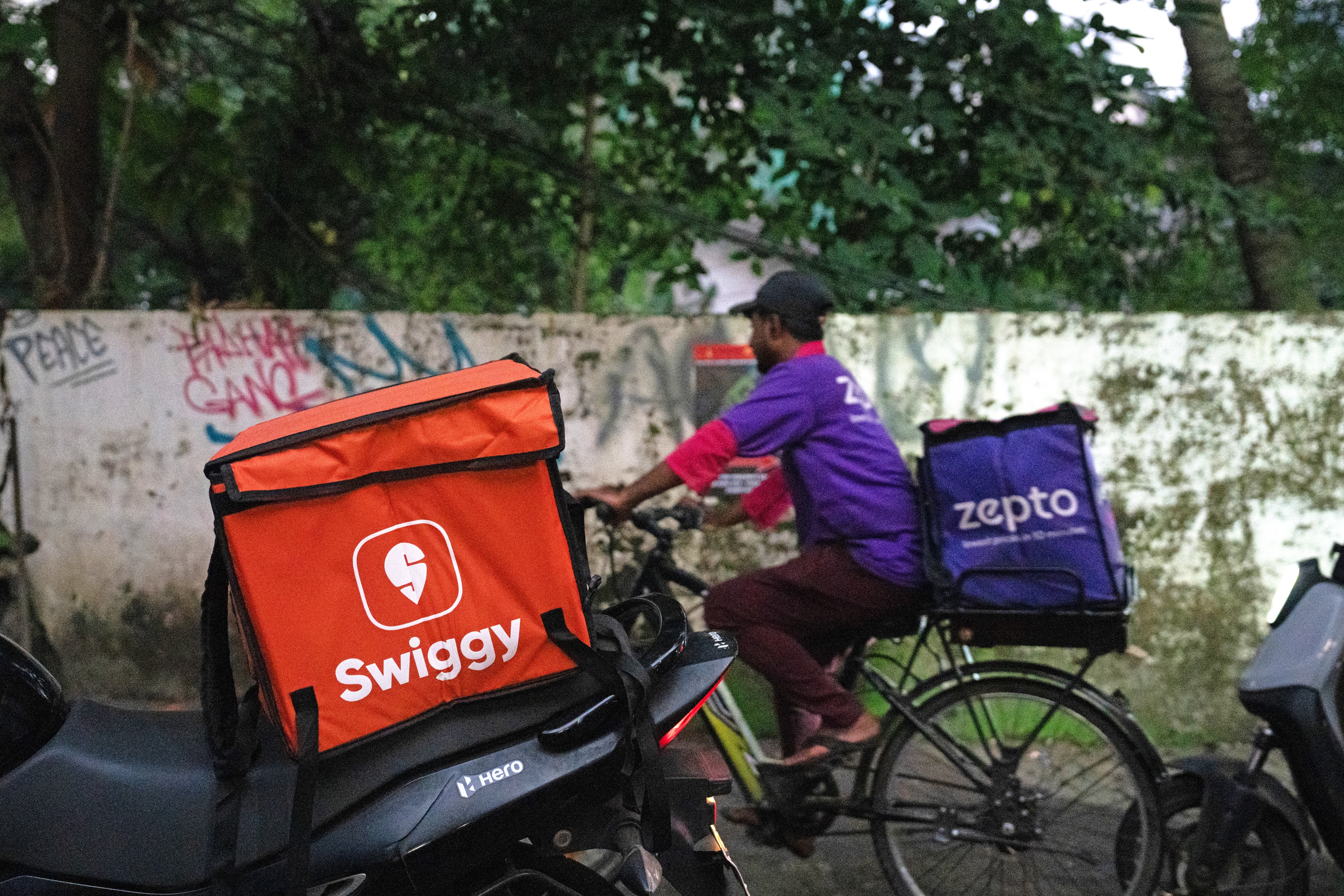
A Swiggy Ltd. branded delivery box mounted on a motorcycle in Mumbai, India. A rider carries a Zepto branded box on the bicycle in the background. (Abeer Khan/ Bloomberg)
India's fish and seafood market has an estimated annual revenue of $59 billion, according to data provider Statista, while the meat market was valued at $26 billion.
Licious is present in 20 Indian cities and sells different cuts of chicken and goat meat, fish and other seafood, as well as spice mix, spreads and ready-to-eat items.
The firm plans to use the IPO proceeds for expanding across India's highly unorganized meat and fish market and acquiring smaller off-line stores, Hanjura said. The listing will also give some of its backers an exit opportunity.
Licious promises an average delivery time of 90 minutes to customers but is working toward 30-minute deliveries as it takes quick commerce rivals including Zomato Ltd. and Swiggy Ltd.
The company has already started quick deliveries in Gurugram, a satellite city on the outskirts of New Delhi, and will extend it to most of Licious' markets by June, Gupta said.
Consumption Slack
Licious, which earns about one-fifth of its revenue from 10-minute delivery apps such as Zomato and Swiggy, has seen sales growth slump from pandemic-era highs.
It is battling a broader consumption slack in India's urban centers and a slower shift to buying meat online in smaller cities. Also, peers including quick commerce company Zepto, with its in-house meat brand Relish, and Amazon.com Inc backed FreshtoHome are eyeing a larger piece of this market.

Licious is planning on adding more ready-to-cook marinated items as well as a newer products such as momos, Hanjura said, referring to Tibetan-style dumplings loved in India.
It aims to have 50 stores by March 2026 up from three currently for the more traditional meat-eaters who might prefer picking their own cuts. It acquired Bengaluru-based retailer My Chicken and More with 22 outlets last year.
The stores are also a great marketing exercise, said Hanjura. “If you see my fish in the offline world three times, you would start buying online, right?”

-
High US Salaries, No Green Card Certainty: The Financial Calculation Facing Indian H-1B Families

The suspension of PERM processing at eight technology employers does not cancel existing H-1B visas. What it does is force a question many Indian families have been avoiding: is the US salary worth tying your career and family plans to one employer?
-
Swiggy vs Eternal: Food Delivery's Two Rivals Are No Longer In The Same Race
Eternal is building a private AI assistant, dark.ai. Swiggy is still working out how to make Instamart pay, with an operating loss of Rs 895 crore in the July-September quarter while Blinkit stayed profitable.
-
Where You Live Shapes How You Get To Work | The Reason Why
Two-wheelers are the most popular way to get to work in India, accounting for nearly 43% of workplace commutes.
-
Unhedged Position: Can India See An Indonesia-Style Time Correction?
The Nifty is trading below levels it first clocked in 2024. Is there, then, as I have suggested in the headline, potential that the current time correction drags on painfully for the next three-five, even ten years?
-
Navigating Friction And Energy Realities: An Analysis Of Marco Rubio's October Visit To India
Occurring at a critical juncture marked by stalled trade negotiations and escalating geopolitical pressures over global energy supplies, the visit offers a profound window into modern US-India relations.
-
India Exports Capital. Why Not Export Trusteeship?
The big question, then, is whether India can build an institution that global borrowers, investors, banks, and lawyers can trust, even without an Indian connection.
-
France's Economy & Politics Are In Crisis | The Reason Why
Let's look at how the French economy and politics evolved under Nicolas Sarkozy, Franois Hollande and Emmanuel Macron.
-
You May Inherit The Business. You Must Earn Its Credibility.
Succession tests the founder's ability to share authority as much as it tests the next generation's readiness to assume it.
-
Signing Deals Is One Thing; Making Them Work Is Another | The Week In Whys
Sometimes, things don't turn out as planned. Indian companies have lost some bids to rivals, some projects won't produce until 2030.
-
FOMC Wall, PERM Suspension, Hospital Stocks | Talking Points This Week
A PERM suspension would directly affect green-card sponsorship rather than H-1B visas, so the near-term earnings impact could remain relatively limited. The key question is whether this marks a new phase in US scrutiny of Indian IT.









