Tata Technologies Makes The Best Debut Of 2023 As Shares Surge 180% Over IPO Price
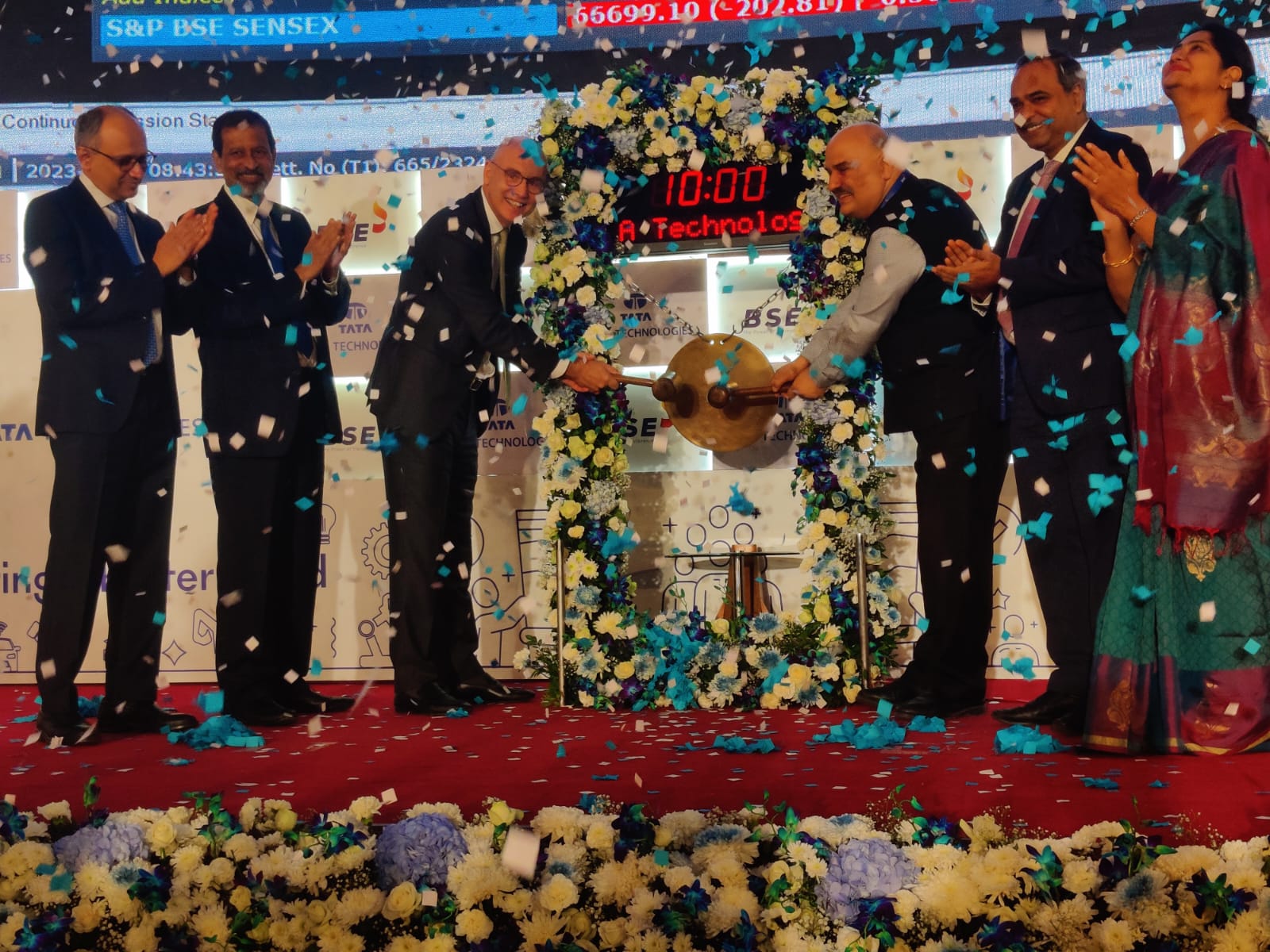
Tata Technologies Ltd. shares made the best debut on the stock market this year as the stock surged up to 180% over the issue price on the first day of trading.
The shares listed at Rs 1,200 on the National Stock Exchange and Rs 1,199 on the BSE, marking a premium of 140% over its IPO price.
It jumped as much as 180% to Rs 1,400 apiece in early trade. The shares ended at a premium of 165.34% over the IPO price and gained 10.56% from its listing price to end at Rs 1,326.70 apiece.
Tata Technologies' initial public offering was fully subscribed within 36 minutes on the first day of opening, underscoring demand for the first public issue from the Tata Group since 2004.
The IPO was subscribed 69.43 times on its final day. The bids were led by institutional investors (203.41 times), non-institutional investors (62.11 times), retail investors (16.50 times), employee reserved (3.7 times), and reservation portion shareholders (29.2 times).
The Tata Motors Ltd.-promoted company, which provides engineering and design services to automotive clients, is expected to benefit from the sector's transition to electric and autonomous mobility. And that complements the track record and pedigree of the group that last took Tata Consultancy Services Ltd. public in 2004.
The company raised Rs 791 crore from anchor investors ahead of its initial public offering.
The engineering services company allotted 1.58 crore shares at Rs 500 apiece to 67 anchor investors. The buyers include Fidelity International, Nippon Life India, BNP Paribas, SBI Mutual Fund, HSBC, Kotak, DSP, Motilal Oswal, Edelweiss, and Goldman Sachs, among others.
SBI Multi Asset Allocation Fund secured 4.30% of the allocation, the highest in the list.
Tata Technologies is the cheapest stock in the space, with a price-to-earnings ratio of 32.8–30.8 times for the fiscal ended March 31. That's at a discount to peers KPIT Technologies Ltd. (80.31 times), Tata Elxsi Ltd. (61.55 times) and L&T Technology Services Ltd. (37.47 times).
Business Model
Founded in 1994, Tata Technologies is a global engineering services company offering product development and digital solutions, including turnkey solutions, to original equipment manufacturers and their Tier-I suppliers. The company is primarily focused on the automotive industry and is currently engaged with seven out of the top 10 automotive engineering, research and development spenders and five of the top 10 prominent new energy ER&D spenders.
The company operates two lines of business:
1. Services: The company provides outsourced engineering services and digital transformation services to global manufacturing clients to help them conceive, design, develop and deliver better products. The services line contributed Rs 3,531 crore and Rs 1,986 crore to revenue from operations in FY23 and H1 FY24, respectively. That's 80% and 78.62% of the top line for the respective periods.
2. Technology solutions: This business is two-pronged.
Through its products business, Tata Technologies sells third-party software applications, primarily product lifecycle management software and solutions. It also provides value-added services such as consulting, implementation, system integration and support.
Through its education business, it provides “phygital” education solutions in manufacturing skills, including upskilling and reskilling public and private sector employees in the latest engineering and manufacturing technologies through its iGetIT platform.
The technology solutions segment contributed Rs 883 crore and Rs 540.3 crore to the company's revenue from operations in FY23 and H1 FY24, respectively.
Tata Technologies CEO On Strategies Post Bumper Listing

-
High US Salaries, No Green Card Certainty: The Financial Calculation Facing Indian H-1B Families

The suspension of PERM processing at eight technology employers does not cancel existing H-1B visas. What it does is force a question many Indian families have been avoiding: is the US salary worth tying your career and family plans to one employer?
-
Swiggy vs Eternal: Food Delivery's Two Rivals Are No Longer In The Same Race
Eternal is building a private AI assistant, dark.ai. Swiggy is still working out how to make Instamart pay, with an operating loss of Rs 895 crore in the July-September quarter while Blinkit stayed profitable.
-
Where You Live Shapes How You Get To Work | The Reason Why
Two-wheelers are the most popular way to get to work in India, accounting for nearly 43% of workplace commutes.
-
Unhedged Position: Can India See An Indonesia-Style Time Correction?
The Nifty is trading below levels it first clocked in 2024. Is there, then, as I have suggested in the headline, potential that the current time correction drags on painfully for the next three-five, even ten years?
-
Navigating Friction And Energy Realities: An Analysis Of Marco Rubio's October Visit To India
Occurring at a critical juncture marked by stalled trade negotiations and escalating geopolitical pressures over global energy supplies, the visit offers a profound window into modern US-India relations.
-
India Exports Capital. Why Not Export Trusteeship?
The big question, then, is whether India can build an institution that global borrowers, investors, banks, and lawyers can trust, even without an Indian connection.
-
France's Economy & Politics Are In Crisis | The Reason Why
Let's look at how the French economy and politics evolved under Nicolas Sarkozy, Franois Hollande and Emmanuel Macron.
-
You May Inherit The Business. You Must Earn Its Credibility.
Succession tests the founder's ability to share authority as much as it tests the next generation's readiness to assume it.
-
Signing Deals Is One Thing; Making Them Work Is Another | The Week In Whys
Sometimes, things don't turn out as planned. Indian companies have lost some bids to rivals, some projects won't produce until 2030.
-
FOMC Wall, PERM Suspension, Hospital Stocks | Talking Points This Week
A PERM suspension would directly affect green-card sponsorship rather than H-1B visas, so the near-term earnings impact could remain relatively limited. The key question is whether this marks a new phase in US scrutiny of Indian IT.









