Stocks Show Signs Of Buyer Exhaustion After Rally: Markets Wrap
(Bloomberg) -- Stocks retreated after a rally to all-time highs spurred calls for a near-term pullback amid signs of buyer fatigue.
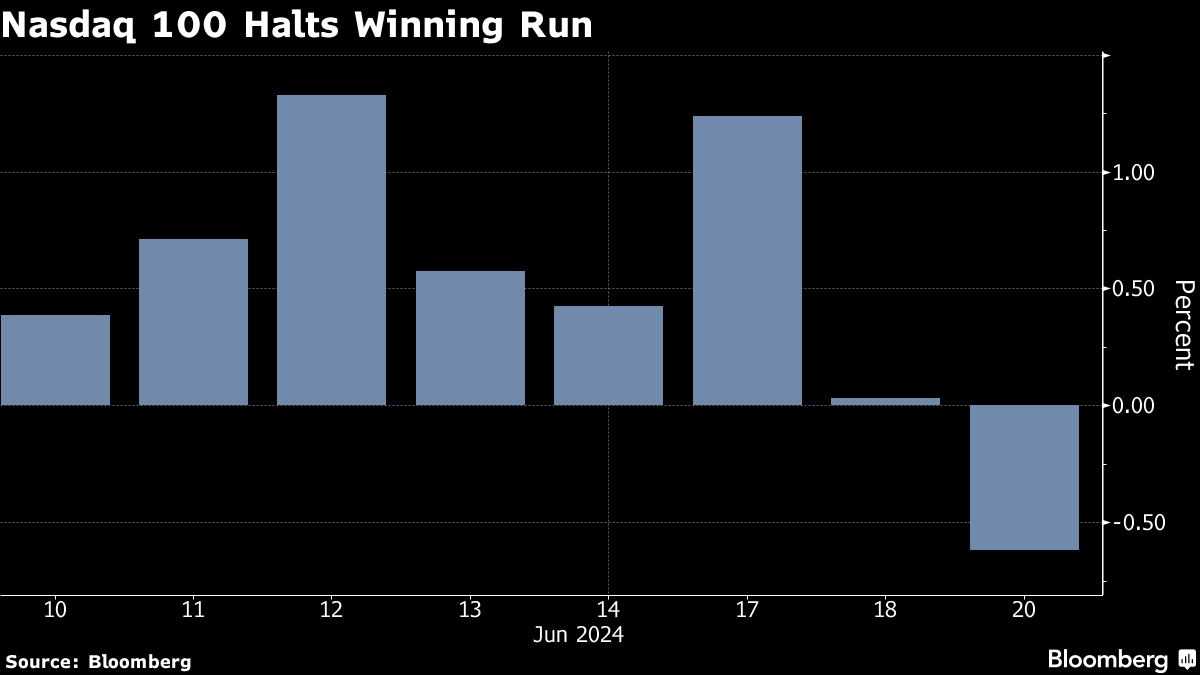
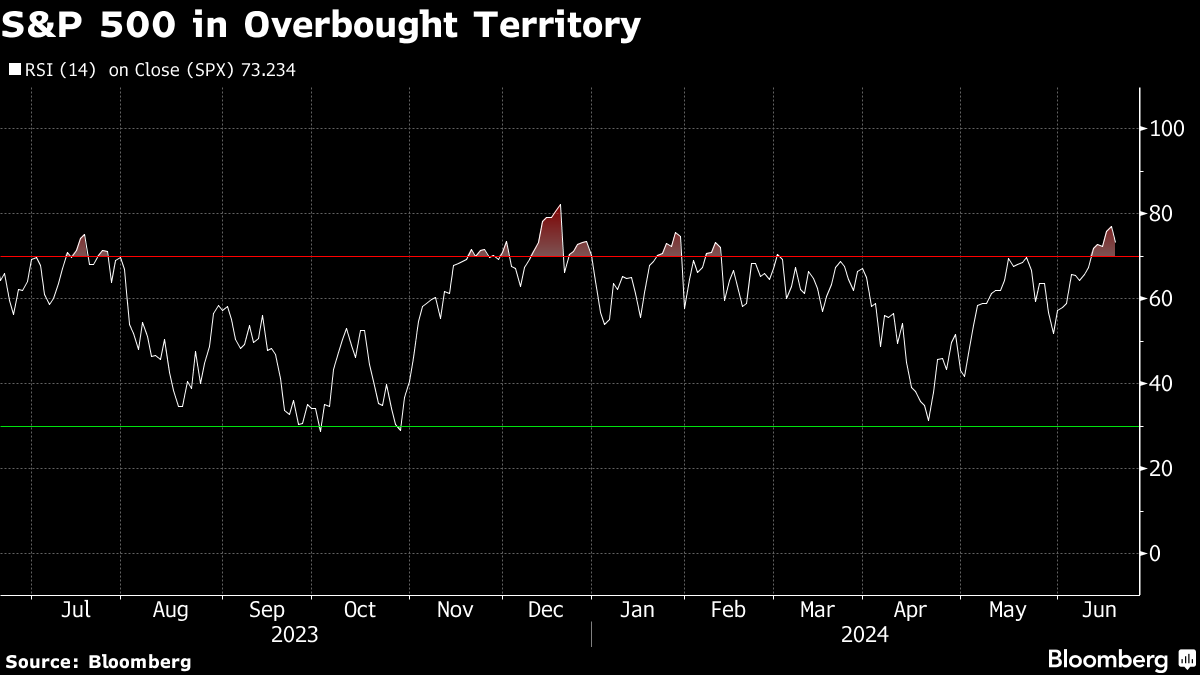
The S&P 500 briefly topped 5,500 before losing traction — while still remaining above a technical threshold that typically hints at an overstretched market. The high-flying tech group that has powered the bull run came under pressure, with the Nasdaq 100 down after a seven-day advance. Nvidia Corp. and Apple Inc. led losses in megacaps. The Dow Jones Industrial Average outperformed.
“Bullish momentum remains intact for the S&P 500 and Nasdaq, but near-term overbought conditions coupled with deteriorating breadth make equities vulnerable to a pullback or correction,” said Craig Johnson at Piper Sandler.
After coming close to erasing this year's losses, Treasuries fell despite data that mostly pointed to economic softening. A $21 billion TIPS auction was strong. Federal Reserve Bank of Minneapolis President Neel Kashkari said the central bank will return inflation to 2%, but estimated it will likely take a year or two to do so.
Wall Street also geared up for a quarterly event known as “triple witching” — in which derivatives contracts tied to equities, index options and futures mature — compelling traders en masse to roll over their existing positions or to start new ones. About $5.5 trillion are set to expire Friday, according to an estimate from options platform SpotGamma.
Traders are betting the Bank of England will cut rates in August after dovish signals from policymakers. The franc led losses in developed-world currencies as the Swiss National Bank lowered borrowing costs. The yen dropped for a sixth straight day, ramping up the risk that Japan will step in to prop up the currency.
While the S&P 500 has set 31 new records this year, few of its members outside of technology have participated in the advance.
In the last three months, the 10 largest stocks in the index by market capitalization — mostly tech giants — have largely outperformd the rest, according to data compiled by Bloomberg Intelligence equity strategist Gillian Wolff.
“Sellers are entering the market, and bulls are dancing on the edge of a knife,” said Andrew Thrasher at Financial Enhancement Group. “Everything is now dependent on pretty much just Nvidia and Apple. It wont take a whole lot to take this market down.”
To Nicholas Bohnsack at Strategas, equity valuations have shifted higher into the upper strata of their historical range where the forward return profile is not particularly robust for new money.
“Still, there appears little to put the domestic bull market into abeyance – we remain ,” he noted. “The economy, while showing some signs of softening momentum, is generally strong globally. Corporate profits expectations are broadening.”
The S&P 500 may rally close to an additional 10% this year, if past market manias are any guide, according to Stifel, Nicolaus & Co. But like prior “bubble” episodes, this one eventually has to pop too.
Stifel's Barry Bannister says the US stock benchmark has a shot at reaching the 6,000 mark before the end of 2024 as investors keep piling in, up from just below 5,500 Thursday. But by mid-2026, he expects the gauge to sink back to where it began this year — around the 4,800 level — erasing a fifth of its value.
Ned Davis Research strategist Ed Clissold raised his year-end outlook on the S&P 500 to 5,725, saying that a modest pickup in earnings growth and the likelihood that policymakers' next move will be a cut set up equities for more gains in the second half of 2024.
“The outlook is not without potential pitfalls,” Clissold wrote. “High valuations and narrowing leadership leave the market vulnerable for bigger drawdowns should the bullish fundamental/macro backdrop falter.”
On the economic front, data came mostly on the soft side, with new home construction slumping to the slowest pace in four years and the Philadelphia Fed Index trailing estimates. US initial jobless claims were little changed.
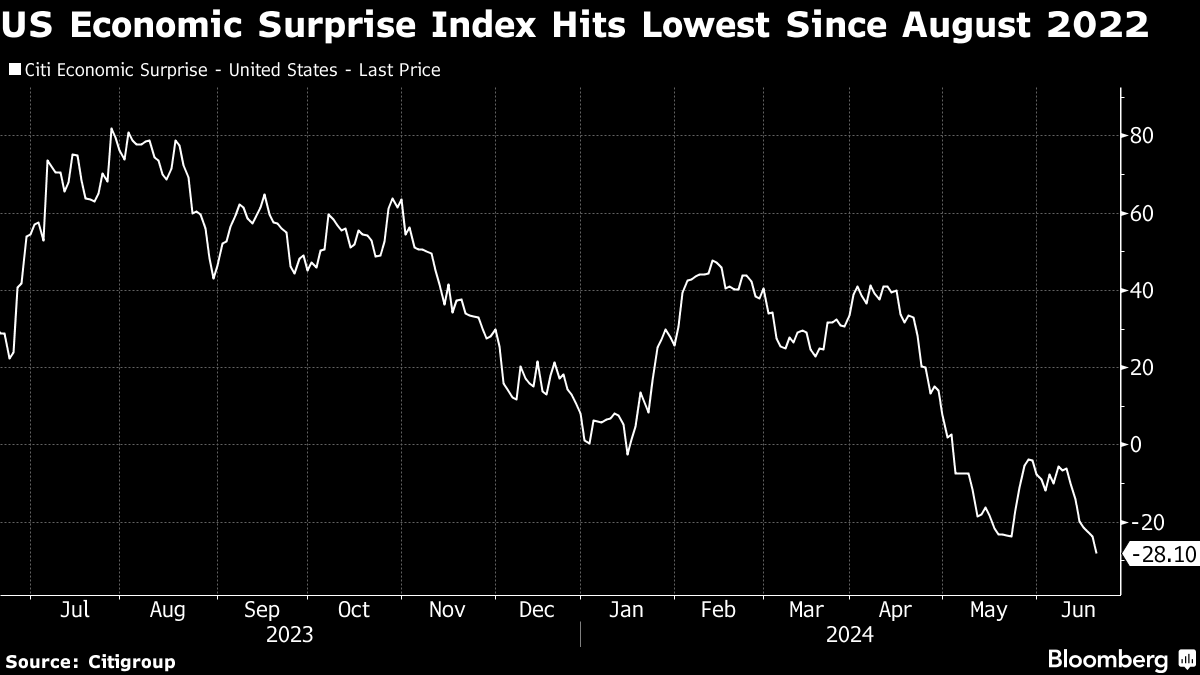
A string of weaker-than-estimated data points has sent the US version of Citigroup's Economic Surprise Index to the lowest since August 2022. The gauge measures the difference between actual releases and analyst expectations.
To Don Rissmiller at Strategas, until employment weakens significantly there remains a fundamental support for the economy, even with some pressure on rate-sensitive sectors such as housing.
“The US economy still looks robust enough currently to take an extended rate pause (mixed news is not weak news),” he noted. “We continue to monitor jobless claims closely for any signs that cracks are widening, however.”
Corporate Highlights:
- Dell Technologies Inc.'s Chief Executive Officer Michael Dell said the company is building a “Dell AI factory” for Elon Musk's startup xAI alongside Nvidia Corp.
- Hertz Global Holdings Inc. increased the size of a junk-bond sale by a third to $1 billion, as the car-rental company works to bolster its balance sheet after a misstep on its electric vehicle fleet.
- A United Airlines Holdings Inc. plane returned to a Connecticut airport after losing part of a liner from inside the engine's cover, another incident for a carrier already under scrutiny over a series of flight mishaps this year.
- Kroger Co.'s executives flagged a dip in profit due to pressure in the supermarket operator's pharmacies and an increase in promotions.
- MGM Resorts International plans to offer online betting with live dealers based at two of its Las Vegas resorts in what the company said was a first for a casino operator on the city's famous Strip.
- Honeywell International Inc. agreed to buy aerospace and defense company CAES Systems from private equity firm Advent International for $1.9 billion.
- Gilead Sciences Inc.'s experimental twice-yearly shot prevented 100% of HIV cases in women and adolescent girls in Africa, the first successful big trial of what's hoped to become a powerful new drug regimen for fending off the virus.
- Vertex Pharmaceuticals Inc. has reached a pricing deal for its cystic fibrosis drugs with the National Health Service in England, ending a yearslong campaign by patients to secure access to the medicines.
Key events this week:
- Eurozone S&P Global Manufacturing PMI, S&P Global Services PMI, Friday
- US existing home sales, Conf. Board leading index, Friday
- Fed's Thomas Barkin speaks, Friday
Some of the main moves in markets:
Stocks
- The S&P 500 fell 0.3% as of 4 p.m. New York time
- The Nasdaq 100 fell 0.8%
- The Dow Jones Industrial Average rose 0.8%
- The MSCI World Index fell 0.1%
Currencies
- The Bloomberg Dollar Spot Index rose 0.2%
- The euro fell 0.4% to $1.0705
- The British pound fell 0.4% to $1.2663
- The Japanese yen fell 0.5% to 158.89 per dollar
Cryptocurrencies
- Bitcoin rose 0.3% to $65,027.49
- Ether fell 0.6% to $3,531.58
Bonds
- The yield on 10-year Treasuries advanced three basis points to 4.25%
- Germany's 10-year yield advanced three basis points to 2.43%
- Britain's 10-year yield declined one basis point to 4.06%
Commodities
- West Texas Intermediate crude rose 0.7% to $82.17 a barrel
- Spot gold rose 1.3% to $2,358.98 an ounce
This story was produced with the assistance of Bloomberg Automation.
--With assistance from Alexandra Semenova, Jessica Menton, Jan-Patrick Barnert, Carly Wanna, Sujata Rao, Chiranjivi Chakraborty, Winnie Hsu and Matthew Burgess.
More stories like this are available on bloomberg.com
©2024 Bloomberg L.P.

-
Navigating Energy Crossroads: S Jaishankar's Call For Diversified Supply Chains At G20 Ministerial Meeting

As geopolitical fault lines continue to test maritime trade routes and commodity flows, Jaishankar's message remains pertinent: true economic resilience requires open markets, protected transit lines, and a genuine commitment to multilateral cooperation rather than coercion.
-
Indians Are Travelling, But Not Every Journey Is A Holiday | The Week In Whys
Pilgrims, patients and working women are the real travellers, and the system hasn't quite caught up with them.
-
Getting To Work Costs Women More | The Reason Why
It is not just about women paying more than men. It is about women paying much more in cities than in villages.
-
AI Bias In Investing Cannot Be Eliminated, But It Can Be Governed
Framing is a particularly important example as identical financial information presented in terms of gains rather than losses can lead an LLM to reach a different assessment.
-
Joining The Dots | Dark Skies, Steady Diya: Why Hope Holds This Diwali
With war, a weak rupee and foreign outflows weighing on sentiment, policymakers at the NDTV World Summit and market veterans at NDTV Profit Ignite: Diwali Edition offered the same advice: stay invested and filter out the noise.
-
The Curious Case of Equitas Small Finance Bank And A CEO Who Quit For Stock
PN Vasudevan believes persistent investor concerns over a perceived conflict of interest had become a governance overhang on Equitas Small Finance Bank's stock, even as the lender improved profitability and asset quality.
-
Talking Points This Week: AI Cash Burn, A Tiger Comeback And An India That Still Finds Its Own Path
India is not immune to higher oil or tighter global liquidity, yet its earnings base is broader, its domestic policy levers are still available.
-
Foreign Investors Own Half Of HDFC Bank and ICICI Bank. An LTCG Cut Could Matter Most Here
Foreign portfolio investors have US$115 billion parked in HDFC Bank, ICICI Bank. If the government cuts long-term capital gains tax, Jefferies says returning foreign money could land here first.
-
'Never Seen This Level Of Negativity': Sandeep Tandon Says The Next Rally May Be Closer Than You Think
Veteran investor Sandeep Tandon says foreign selling is easing, large-caps are due a comeback and mid-caps are crowded, while he turns positive on gold, power and pharma this Diwali.
-
Indians Stay With Family, Not In Hotels | The Reason Why
India still lacks enough clean, reliable and affordable hotels for budget-conscious travellers.










