Singapore Stocks Index Is Sole Winner Among Developed Markets This Year
(Bloomberg) -- As stagflation concerns mar the outlook for the world's biggest developed markets, shares in a small Asian city-state have held up surprisingly well this year.
Singapore's Straits Times Index has eked out gains of about 1% in 2022, the only developed-market gauge in positive territory in dollar terms. In contrast, a world gauge is down 22% in what could be its worst year since the 2008 global financial crisis.
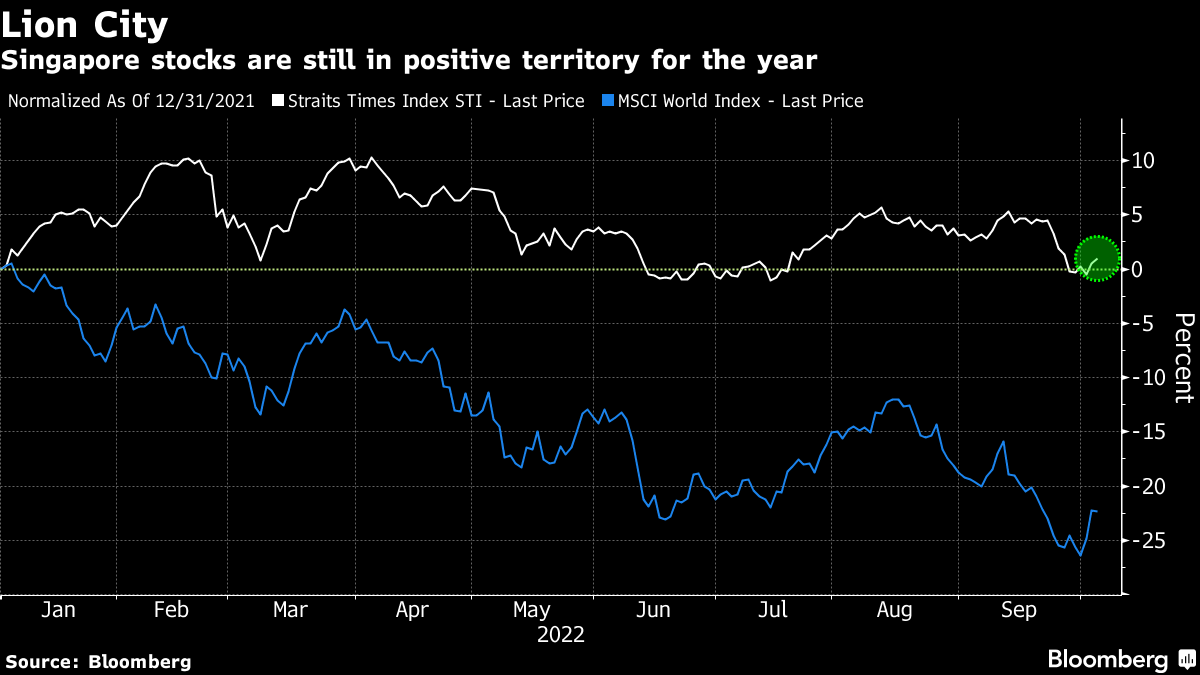
A rising interest-rate environment, a shift toward cheaper valuations and economic tailwinds generated by Singapore's pandemic recovery have helped underpin the benchmark, where banks account for about half of the weighting.
“Singapore's performance correlates with the outperformance of value over growth, which is expected to continue as long as the Fed remains committed to bringing down inflation to the long-term target rate,” said Alan Richardson, portfolio manager at Samsung Asset Management (HK) Ltd.
The benchmark's lack of exposure to tech shares has helped as well, contrasting its performance with the US and Europe, economies that are struggling with issues ranging from inflation and energy shortages to supply-chain disruptions.
“Until the Fed slows or pivots, developed markets probably won't catch up” with Singapore, said Daniel Dubrovsky, strategist at DailyFX. The market is focused on the Fed, even after Australia's smaller-than-expected rate hike this week, and “there is still room for the labor market to absorb a near-term slowdown” in the US, he added.
Forward earnings estimates for Singapore stocks are up about 16% year-to-date, about four times the increase seen for members in the global gauge. Still, Singapore's trade-dependent economy isn't without risk -- factory activity contracted in September for the first time since June 2020 and retail sales show signs of slowing.
Auto distributor Jardine Cycle & Carriage Ltd. is the top performer on the Straits Times Index this year, up 72%, followed by utilities firm Sembcorp Industries Ltd.'s 53% advance. Shares of DBS Group Holdings Ltd., the biggest stock on the gauge, are up 2.3%.
(Adds comment from fund manager in fourth paragraph.)
More stories like this are available on bloomberg.com
©2022 Bloomberg L.P.

-
Love, Sex Aur Dhokha: The Audacious Plot To Spy On Jensen Huang

A Taipei dinner, a Singapore chip buyer and a suspected Chinese asset: inside the alleged spy operation that got close to NVIDIA's Jensen Huang.
-
Ten Things I Learnt This Samvat
Patience can be a trap. Cheap stocks can stay cheap. Leverage can wipe you out. What did Samvat 2082 teach us? Niraj Shah writes on 10 lessons from the year gone by.
-
Talking Points This Week: Tech Nerves, FII Buying, And A Faraway Banking Shock
The global markets are not shining this Diwali. The exception in the large markets is, India.
-
Midterm Rally Lasted A Day. The Hard Reality Of A Divided US May Last Two Years | Opinion
Between a contested AI boom, a debt ceiling that arrives in 2027 and a president with every incentive to act alone, the next two years may prove more volatile than the first day's rally suggests.
-
Blue Wave Will Derail the AI Trade but Won't Dismantle the AI Era | Unhedged Position
The Democrats' sweep of the US Congress will see politics collide with economic forces both over the long and short term.
-
It's Time To Take The GST Council's Bet On Trust Global
Payment records can prove India's services exports, and clear, proportionate rules can bring foreign digital sellers into the tax net.
-
Opinion | India at 38: From Innovation Overperformer to Innovation Powerhouse
India now has 453 VC-backed deep science startups, 18 of them late-stage, after 117 percent growth since 2020. Laurus Labs, at USD 9.3 billion, is the most valuable deep science company in any middle-income economy outside China.
-
Navigating Energy Crossroads: S Jaishankar's Call For Diversified Supply Chains At G20 Ministerial Meeting
As geopolitical fault lines continue to test maritime trade routes and commodity flows, Jaishankar's message remains pertinent: true economic resilience requires open markets, protected transit lines, and a genuine commitment to multilateral cooperation rather than coercion.
-
Indians Are Travelling, But Not Every Journey Is A Holiday | The Week In Whys
Pilgrims, patients and working women are the real travellers, and the system hasn't quite caught up with them.









