Global Silver Market Under Strain As Tariffs Trigger Dislocation

The global silver market is under stress as trade-war concerns unsettle investors, with key indicators flashing red, millions of ounces on the move between trading hubs and months of disruption in prospect.
A surge in rates to borrow the precious metal has become the latest sign of alarm, with anxiety building over the impact of further tariffs from US President Donald Trump. That's sparked a dash to ship silver into the US in a bid to capture premium prices in New York, possibly causing a squeeze in London.
Precious metals — gold as well as silver — have been upended this year, as Trump challenges the global trade order. That's spurred demand for havens, and also opened up rare pricing dislocations between key markets. While spot silver has gained about 17% this year — making it one of the best performing commodities — futures in New York have done even better.
On a physical level, the tariff concerns — especially levies against Canada and Mexico, as well as wider reciprocal curbs that may kick in next month — have drawn vast quantities of both gold and silver out of London into US vaults. But given their relative value and density, gold tends to be air-freighted, with silver often taking far longer voyages, typically by ship.
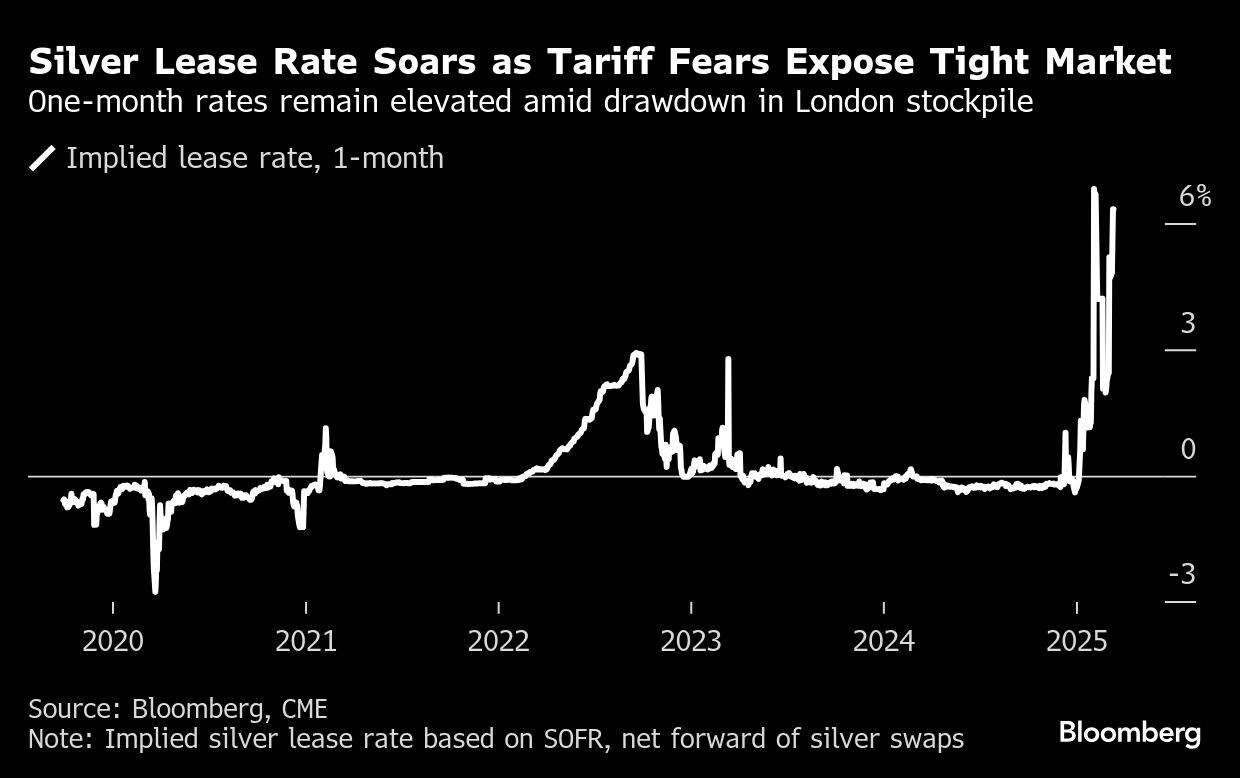
Lease rates — the cost of borrowing metal, generally for a short period — have jumped. One-month rates for silver topped 6% this month after a larger spike in February. That partly reflects concerns about fast-depleting stockpiles in the UK capital, with holdings hitting a record low last month. In addition, not all of what remains is available given it's tied to exchange-traded products.
“I expect the lease rate in London to remain high for about two to three months,” said Cao Shanshan, an analyst at COFCO Futures Co. With the UK-to-US transfer under way, “silver is a lot bulkier than gold, so the transfer of silver will likely take longer,” she said.
Exchange-reported totals in the US reflect the turmoil. Comex-tallied inventories of silver have expanded to the highest level ever in data going back to 1992 after surging by 40% so far this quarter, a record rise. While New York is still drawing in metal at present, there are also concerns the flows may be thrown into a drawn-out reverse if silver faces a shortage in London vaults.
“Should the long-fabled ‘silver squeeze' materialize, this slower tradeflow will be a key contributor to prolonging” any potential disruption BMO Capital Markets analyst George Heppel said in a note. That's because it would take time for silver stockpiles to flow from the US back to London, he said.
The US imports about 70% of its silver from Canada and Mexico, which have borne the brunt of the Trump administration's moves on trade so far. Ottawa subsequently announced 25% counter tariffs on about C$30 billion ($20.8 billion) of US-made items, including silver. Since then, Trump has reiterated his desire for April 2 to mark a wave of new levies.
“The market may be underpricing the scale and impact of the upcoming April 2 US reciprocal tariffs,” Citigroup Inc. analysts including Max Layton said in a note, highlighting the pricing dislocation. There may be “substantial potential upside should reciprocal tariffs be implemented over the next six months,” they said, adding that silver is unlikely to be exempted from levies.
TD Securities also signaled its concern. “If reciprocal tariffs are really like-for-like, you would expect retaliatory tariffs on Canadian silver and that's about 20% of US imports — so there is a higher risk associated with silver,” said Daniel Ghali, senior commodity strategist at TD. “Even if the disruptions were to completely resolve overnight, we can't go back to the prior world because you'd never know what will happen the next day.”

-
Talking Points This Week: Tech Nerves, FII Buying, And A Faraway Banking Shock

The global markets are not shining this Diwali. The exception in the large markets is, India.
-
Midterm Rally Lasted A Day. The Hard Reality Of A Divided US May Last Two Years | Opinion
Between a contested AI boom, a debt ceiling that arrives in 2027 and a president with every incentive to act alone, the next two years may prove more volatile than the first day's rally suggests.
-
Blue Wave Will Derail the AI Trade but Won't Dismantle the AI Era | Unhedged Position
The Democrats' sweep of the US Congress will see politics collide with economic forces both over the long and short term.
-
It's Time To Take The GST Council's Bet On Trust Global
Payment records can prove India's services exports, and clear, proportionate rules can bring foreign digital sellers into the tax net.
-
Opinion | India at 38: From Innovation Overperformer to Innovation Powerhouse
India now has 453 VC-backed deep science startups, 18 of them late-stage, after 117 percent growth since 2020. Laurus Labs, at USD 9.3 billion, is the most valuable deep science company in any middle-income economy outside China.
-
Navigating Energy Crossroads: S Jaishankar's Call For Diversified Supply Chains At G20 Ministerial Meeting
As geopolitical fault lines continue to test maritime trade routes and commodity flows, Jaishankar's message remains pertinent: true economic resilience requires open markets, protected transit lines, and a genuine commitment to multilateral cooperation rather than coercion.
-
Indians Are Travelling, But Not Every Journey Is A Holiday | The Week In Whys
Pilgrims, patients and working women are the real travellers, and the system hasn't quite caught up with them.
-
Getting To Work Costs Women More | The Reason Why
It is not just about women paying more than men. It is about women paying much more in cities than in villages.
-
AI Bias In Investing Cannot Be Eliminated, But It Can Be Governed
Framing is a particularly important example as identical financial information presented in terms of gains rather than losses can lead an LLM to reach a different assessment.









