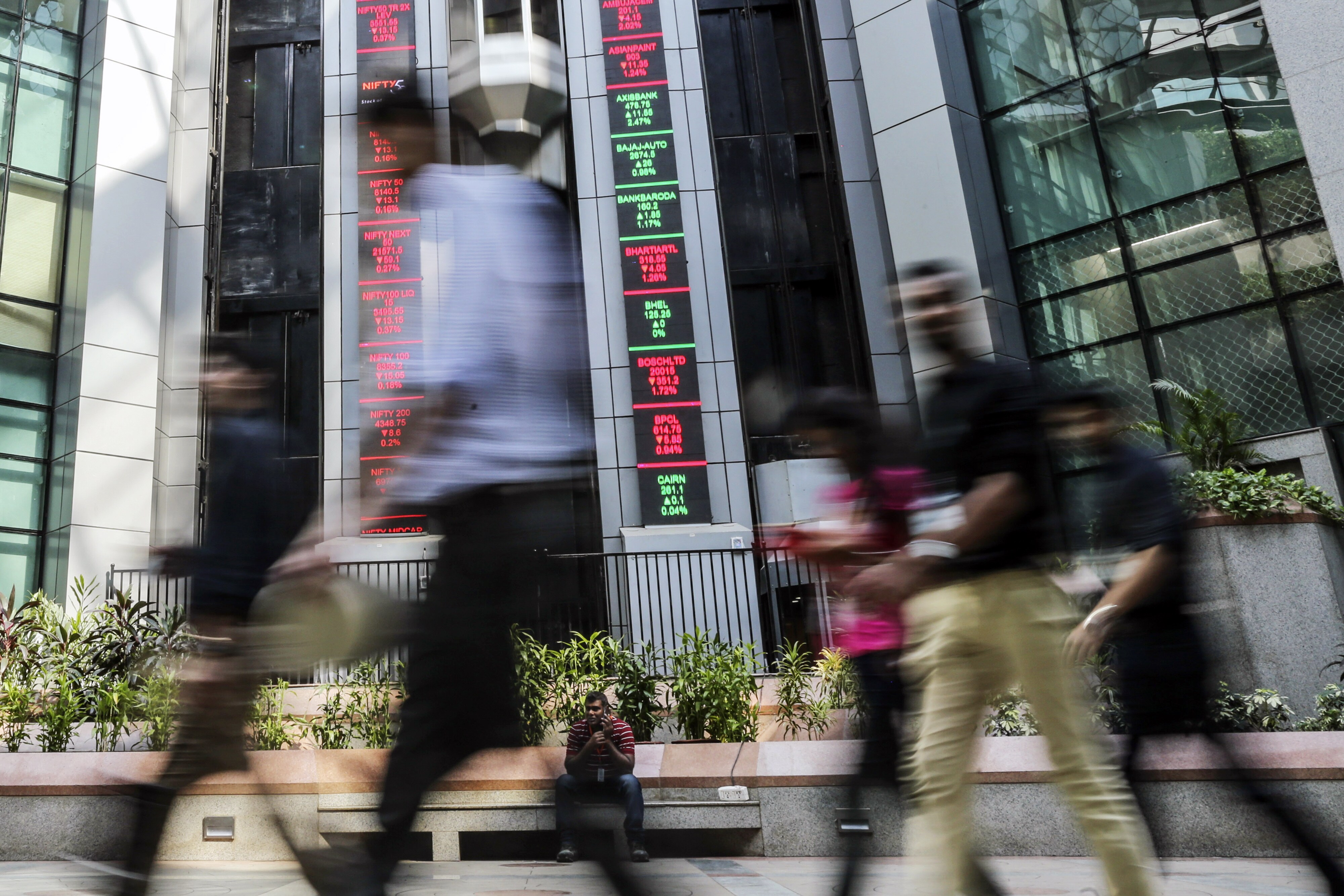
This week on Thank God It's Friday, we spoke to Sankaran Naren, executive director and chief investment officer, ICICI Prudential Asset Management on the Reserve Bank of India (RBI) status quo policy, the aftermath of demonetisation and his outlook on markets in 2017.
Below is an edited transcript of the interview.
What is your reading of RBI's status quo on the interest rates? The focus was predominantly on inflation and not on growth. Do you think that the markets probably overestimated the negative impact or the hit from demonetisation?
No, basically I think that RBI disagreed to postpone the decision watching exactly what is happening in this market. If you look at the inflation rate, that actually came out pretty low. So, if their concern was inflation rate, then it has been steadily going down. We believe that the rate cut will now happen in February. We had believed that there will be a rate cut in December, but that didn't happen.
We think that the scenario in India is such that we still are in a deleveraging to deflationary world relative to where we were and we could have interest rate cuts in India.
RBI Rate Cut Post Budget
But did the RBI's statement on inflation concerns rather than on addressing growth concerns really surprise you?
We have historically seen that the RBI has always been cautious, particularly before a Fed meeting where a rate increase is likely. They are not looking at only inflation, but also at foreign exchange.
They were possibly worried about excessive volatility due to dollar moves, which I believe, was more responsible for the decision. Our view is that if the Chinese yuan has depreciated, for Indian rupee to depreciate in line with Chinese yuan is something which we find acceptable and we believe that India requires lower interest rates and may be a more depreciated currency for the next few quarters. This is our view.
We think maybe it will play out of now in January or February. By February, the other advantage would be that the Budget would have been announced because next year's Budget is on February 1. So, maybe they [RBI] will have all the information available to take the right decisions in February, which is why they decided to pass on in December.
Demonetisation: A Long-Term Positive
Let's talk about demonetisation. Whatever data we have so far and whatever data you read so far, how would you assess whether or not this exercise has been fruitful to what the government was targeting?
I think it is very difficult at this stage to think about it. A lot of money has come back to the banking system. There is a trail; money cannot come in or out without an account number into the banking system. It is too early for us to say as to what is the real impact of demonetisation and our view is that see whenever a step is taken to reduce black money and I go back to the 90's where we use to see physical share certificates and these transfer deeds, which were greenish in colour, and most of you would not have seen them.
There was a process where those share certificates, transfer deeds and physical documents, got converted to demat and similarly there was a face conversation where all trading used to happen and then internet came and it became electronic trading. So that process was not as smooth as what people think of. But the impact has been seen subsequently in the 20 years from then.
I believe that a step where you are trying to reduce black money cannot be an easy step because people are used to dealing in cash. So you know cash is different from black money and India has a culture of dealing in cash. In fact, what I discovered is most people don't know that they can use their debit cards in many places other than the bank for drawing money because the culture doesn't exist.
So I think you know there is a process and I think the long-term impact it will be seen much later. I remember way back in the 70's when noon meal scheme was started in Tamil Nadu, it was perceived to be a scheme which was like a hand out. But it improved a lot of indicators on the non-socio-economic side which has helped the Tamil Nadu economy in last 20 years.
That's how we view demonetisation and not look at it from the point of view from queues and problems that people are facing at this point of time. But I think there will be a long-term positive impact.
But there is no factor which will make you worried about the success of this move?
I think if you manage to reduce the size of black economy, if you manage to improve the compliance and income tax—if you are managing to do these things it will be a massive achievement. That achievement cannot be measured. So, at this stage it is very difficult to say whether it is successful or not. But I would say that government is very determined to move in this direction and I think that will make India very different over a period of time compared to the old India which was always cash driven, black money driven economy that we had many years back.
“Invest With 2018 In Mind”
Third and fourth quarter earnings are expected to be a washout. Obviously, you won't look at it from a short-term perspective, but what sort of a FY17 earnings growth number would clearly cause disappointment or rather what number that we see could be reasonably acceptable?
I don't think that we look at that number. What we have believed is that there are three factors of production: land, labour and capital. The effect of demonetisation will reduce land cost in our view and clearly the Interest rates will also go lower. So, labour prices have been coming down from last two years. Our view is that if you had all these three cost of production coming down that is land, labour and capital, that sets a stage for a big bull market. If we go back to the bull market of 2002-2007, land was very cheap in 2002; interest rates were low in 2002 and the labour cost were very cheap and that set a stage for a good bull market. So, I would say similar to that having a situation in 2017 first half where all three factors of production prices are coming down and that could lead to a big benefit. In the near-term earnings growth are quite meaningless because it is very difficult to predict them. If you have a postponement in sales due to these reasons do I have to worry about one quarter earnings or not; has it going to change the growth rate of the economy or not in the long run? The answer is: No. Is it likely to create a more transparent India? The answer is: Yes. Can a transparent India lead to lower tax rates? Yes. So these are things which we see, but I doubt that we will see in first six months of 2017. I think the real benefit we will see in the second-half of 2018 and we have been recommending investors to invest over these 4-6 months, with a two-year view because we think it is volatile because of the risk on earnings.
Expectations On The Budget
What is the upcoming budget going to be all about and how will you decide if it's going to be a good one?
I think there is so little written about the budget at this time, the focus has not been on the budget, so it will be difficult for me to say. I have not seen a single article about the budget even in the media so I don't know what this budget is going to be focussed on. But we think that this government has made it clear that we are looking forward to digital India, less black money. We are looking at ways to plug loopholes on taxation so that black money goes down. I think that is what they are looking at and the budget will be focussed on these areas and this is what we think. Having said that, this is the last important budget for this government because the remaining budgets are closer to the elections so from that point of view this budget is going to be important. And it would also be important on where we see GST. Suppose we see GST implementation in next 6 months, there is no point in tinkering with excise duty rate just before GST. So, it can be a budget which can be focussed on direct tax area and not on the indirect tax area. These things we will come to know only in January. It will be too early at this point in time.
Higher Spending In Infra
Given we are so close to the budget and we could see a lower fiscal deficit this year, there are high chances that the government could spend more on infrastructure. So is that a space that you have started looking at already?
Yes, clearly. Over the last 3 months we have always been believers, that infrastructure is the thing to invest in, with a two-year view, and from the portfolio point of view, as a fund manager of my schemes I have been underweight on many of the consumption sectors, because I believe that the trust would go into infrastructure. It can both create employment and that is the biggest area where there is a problem. Most of the stocks in those sectors haven't done well for the last 10 years I would say, so that made us focus on infrastructure significantly in the last three months. But because people haven't made money in that area, not too much money comes into that sector.
Consumer Discretionary Space Looking Expensive
You brought up consumption right now. Many believe the pain owing to demonetisation in the consumer discretionary space may last longer than expected. This delays recovery. Are you of that opinion as well?
I would say even two months back, our portfolios were basically positioned with a underweight stance on consumer discretionary. Primarily because those sectors were really cheap. There is no part of the world where you see automotive stocks trading at 30 and 40 trailing price to earnings. Embedded growth in those companies were very large. See, we always believe in a cyclical approach, and in that cyclical approach, we believe that the baton will move from consumption oriented sectors to either low unit value areas, or infrastructure sectors. And that's how we have been positioned as a mutual fund. So, to us, a correction in some of these stocks were something we were believing in, and we continue to think that many of these sectors are trading at reasonably high valuations, that there is scope for correction even from here.
Telecom: A Contrarian Bet
Bharti Airtel is your top holding in one of your funds and I am talking about ICICI Prudential Dynamic Fund as of the month of November. Was it a purely contrarian call or was it a valuation bet? Your thoughts on telecommunications?
I think none of us can actually recognize that telecom has changed significantly. It is because telecom has changed so significantly that you can start off as a digital channel today and expect most of us to see it on a digital channel. Now go back 10 years, could you have started a channel which was just started on a digital platform?So things have changed drastically in the last 10 years, the most important product for most people is their mobile phone and not their purse, and I believe in that despite the entire telecom sector in India trading less than the market cap of a single automotive stock in India. So I felt it was quite unlikely as it has touched almost 70-80 crore Indians, and for 70-80 crore Indians, it is the most important consumer durable. And the market cap is lower than that of a car company or something like that. So I felt that it is a very simple call that we are more dependent on telecom than before and with data also coming up, it is something which is very critical, and you have the bottom of pricing at this point of time, due to the entry of new entrants. That becomes a very good contrarian opportunity for long term investors. I was very surprised to see that the market cap of telecom sector in countries like Indonesia, Malaysia and Thailand, which have a population which is a fraction of India, being higher than the market cap of telecom companies in India. So I saw that as a very good long term investment opportunity, based on your consumption and my consumption.
The Absence Of TCS
Another stock that was missing from your portfolio was TCS. Whereas you have increased allocations to HCL technologies, Infosys, Tech Mahindra and even Wipro. Is the Tata versus Mistry war that is bothering you?
Not an area I'll talk on, but I think you should look at the entire portfolio and see where we stand, and I am not allowed to talk on all these things on media, but if you see my portfolio, you'll find all the data, if you look at the top 5 holdings you'll know which stocks are there and there are ways in which you can invest in different stocks and it is based on our analyst, who covers the sector, what his views are on the different stocks in that sector. And it has nothing to do with an individual company, it is more to do with valuations, and less to do with the outlook for that company.
Expect Short-Term Volatility
How have you read 2016? how are you looking at 2017. You have already mentioned that you expect some amount of volatility in 2017, but on the whole can we expect 2017 much more positive for markets?
See clearly we'll have a positive view but the near term is going to be very volatile. I think we can't look at it from a domestic point of view. You would have seen the massive increase in interest rates in U.S and bond yields have gone to 2.6 percent. There was a second rate hike on Thursday and we have promises of more rate hikes in 2017 in the U.S. So, I would say that if you look at it from a global point of view, there is a lot of scope for near-term volatility. Having said that, our view has always been that for the next two years, the operating cycle will improve. You will see capacity utilization going up, you will see earnings going up, and that would lead to market returns improving. Having said that, we don't have an outlook for the next three months and we have been believers that volatility could be higher once people come back from their leave because many of them have actually gone and seen a massive move in the dollar, massive moves in bond yields, and therefore we think the volatility can only increase, not come down.