Russian Stocks Take Worst Hit Since Crimea on Sanctions, Syria
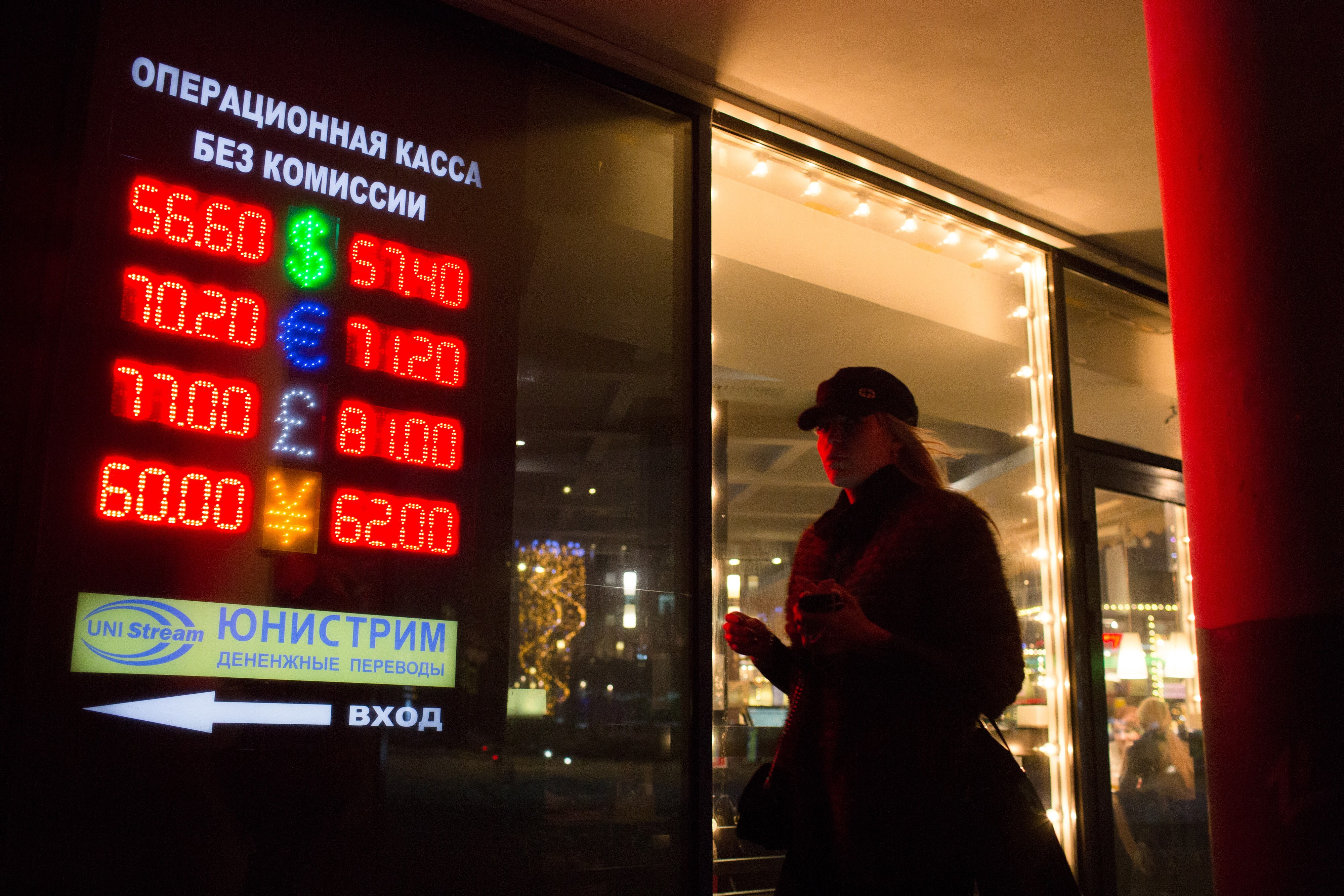
(Bloomberg) -- Russian stocks had their biggest drop in four years and the ruble slumped the most in the world after the U.S. slapped new sanctions on Kremlin-connected billionaires and tensions with the U.S. spiraled following the latest chemical attack in Syria.
The benchmark MOEX Russia Index sank 8.7 percent on Monday, the steepest slide since March 2014, when Moscow's annexation of the Crimean peninsula triggered international penalties. The ruble and local bonds had their biggest drop since 2016 and the cost of insuring sovereign notes against default was set for the sharpest increase since December 2014.
Investors pulled out after the U.S. on Friday escalated penalties against Russia for meddling in the 2016 election by sanctioning dozens of Russian tycoons, companies and key allies of President Vladimir Putin. On top of that, U.S. President Donald Trump warned of a “big price to pay” in response to reports of a chemical attack outside Syria's capital, saying President Vladimir Putin and Iran “are responsible for backing Animal Assad.”
“We haven't seen such a united, mass retreat from Russian assets for a long time,” Kirill Tremasov, director of the analysis department at Loko-Invest said by phone. “The situation is ever more reminiscent of 2014.”
Market Snapshot
- The ruble tumbled 3.3 percent to 60.1625 against the dollar by 4:34 p.m. in Moscow, set for a a three-day 4.5 percent fall
- VTB Bank PJSC slumped as much as 12 percent after its Chairman Andrey Kostin was included in the U.S. sanctions list; Polyus PJSC declined more than 23 percent after Suleiman Kerimov, whose son controls Polyus, was also sanctioned
- Russian five-year credit-default swaps climbed 15 basis points, or 12 percent, on Monday
- 10-year ruble bonds fell for a second day, lifting the yield 21 basis points to 7.28 percent, the highest since January, as trading volumes surged
- The United Kingdom's Financial Conduct Authority on Monday suspended trading of En+ shares
READ MORE: Russia Says Israel Carried Out Missile Attack on Syrian Base
President Donald Trump's move on Friday adds to a succession of actions by the U.S. and its allies in recent weeks over the poisoning of an ex-spy in Britain. The Russian government was racing to come up with measures to assist tycoons hit by the latest penalties, according to a senior official involved in the process.
‘Had Enough'
Shares plunged in Oleg Deripaska's aluminum giant, United Co. Rusal, and holding company En+ Group Plc, which were both sanctioned along with their billionaire owner. Tycoon Viktor Vekselberg was also subject to penalties.
“Investors finally realized how badly things are turning out for Russia,” said Vadim Bit-Avragim, a money manager at Kapital Asset Management LLC in Moscow, who's selling Russian shares today. “It seems like the U.S. has had enough. Foreign investors have to exit sanctioned companies, but they saw this order as a signal to exit all Russian stocks. Investors are afraid that now any Russian company is at risk of sanctions. Traders are closing limits on Russian shares because they're seen as toxic assets.”
To contact the reporter on this story: Ksenia Galouchko in Moscow at kgalouchko1@bloomberg.net.
To contact the editors responsible for this story: Celeste Perri at cperri@bloomberg.net, Alex Nicholson, Dana El Baltaji
©2018 Bloomberg L.P.

-
Why Amazon And Flipkart Are Struggling To Beat Meesho In India's Smaller Cities

With 274 million users and lowest-cost logistics, Meesho is defending its value commerce crown against giants like Amazon and Flipkart.
-
High US Salaries, No Green Card Certainty: The Financial Calculation Facing Indian H-1B Families
The suspension of PERM processing at eight technology employers does not cancel existing H-1B visas. What it does is force a question many Indian families have been avoiding: is the US salary worth tying your career and family plans to one employer?
-
Swiggy vs Eternal: Food Delivery's Two Rivals Are No Longer In The Same Race
Eternal is building a private AI assistant, dark.ai. Swiggy is still working out how to make Instamart pay, with an operating loss of Rs 895 crore in the July-September quarter while Blinkit stayed profitable.
-
Where You Live Shapes How You Get To Work | The Reason Why
Two-wheelers are the most popular way to get to work in India, accounting for nearly 43% of workplace commutes.
-
Unhedged Position: Can India See An Indonesia-Style Time Correction?
The Nifty is trading below levels it first clocked in 2024. Is there, then, as I have suggested in the headline, potential that the current time correction drags on painfully for the next three-five, even ten years?
-
Navigating Friction And Energy Realities: An Analysis Of Marco Rubio's October Visit To India
Occurring at a critical juncture marked by stalled trade negotiations and escalating geopolitical pressures over global energy supplies, the visit offers a profound window into modern US-India relations.
-
India Exports Capital. Why Not Export Trusteeship?
The big question, then, is whether India can build an institution that global borrowers, investors, banks, and lawyers can trust, even without an Indian connection.
-
France's Economy & Politics Are In Crisis | The Reason Why
Let's look at how the French economy and politics evolved under Nicolas Sarkozy, Franois Hollande and Emmanuel Macron.
-
You May Inherit The Business. You Must Earn Its Credibility.
Succession tests the founder's ability to share authority as much as it tests the next generation's readiness to assume it.
-
Signing Deals Is One Thing; Making Them Work Is Another | The Week In Whys
Sometimes, things don't turn out as planned. Indian companies have lost some bids to rivals, some projects won't produce until 2030.










