SEBI Went Extra Mile For This InvIT's Listing, But You Won't Be Buying Anytime Soon
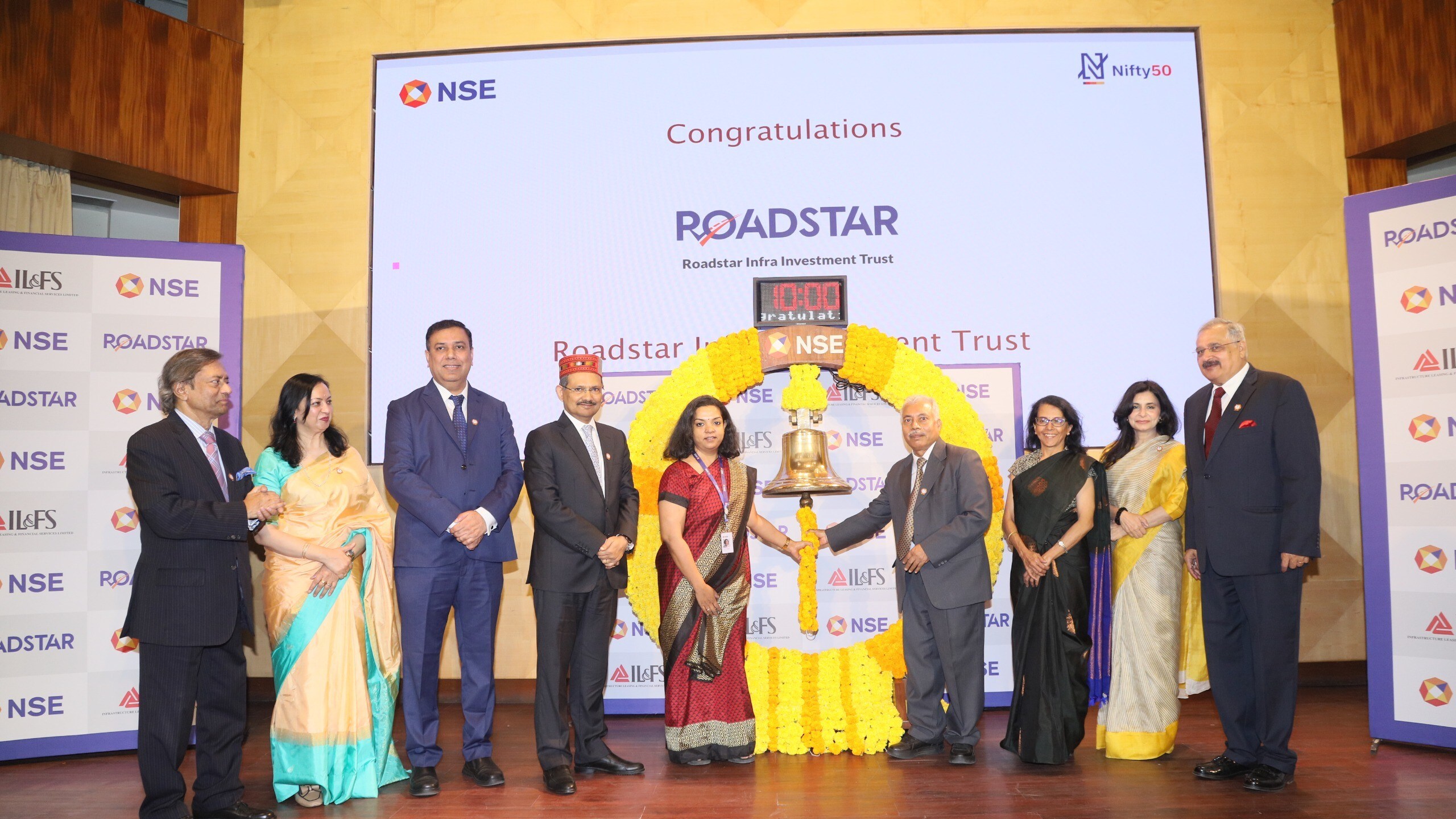
Long-beleaguered IL&FS Group's Roadstar Infra Investment Trust, which listed on the exchanges on Tuesday, is an infrastructure investment trust that has no scope currently for retail participation.
Instead, the InvIT's entire idea was born out of the parent's need to pare debt. And the Securities and Exchange Board of India played a key role in facilitating this unusual market debut, according to top executives at the group.
"SEBI granted a lot of of exceptions to us," IL&FS Chairperson Nand Kishore said at the trust's listing ceremony.

IL&FS Chairperson Nand Kishore at Roadstar Infra Investment Trust's listing ceremony (Photo: NSE India/X)
SEBI 'Large Exception'
"This is the first time an InvIT has been used as a mode of resolution of stressed assets," Danny Samuel — chief executive of Roadstar Investment Managers, the trust's investment manager — told NDTV Profit. "SEBI granted many exemptions through master circular and InvIT regulations without going beyond its scope."
Six assets of Roadstar were moved into the InvIT in tranches from 2021 to 2024, which is not what usually happens. The common way of doing things is where the sponsor sets up the InvIT and transfers ownership of the underlying infrastructure assets to the trust. The trust then issues units to investors, according to Samuel. "So during the whole process, assets kept moving. This was a large exception."
He said the InvIT listed without raising any funds and units were issued against the debt of IL&FS Group. "We went to SEBI and said that we have a lot of creditors and intend on distributing units to the eligible ones."
An InvIT usually raises funds rather than pare debt by issuing units to investors and those funds are then primarily invested in the trust's assets.
Samuel pointed out that SEBI's conditions for the InvIT's listing required IL&FS to move on from its role as the trust's sponsor once its three-year lock-in ends.
"IL&FS has very limited capability to support the trust's plans of funding and expansion. And thus, we will look for strategic investors to come into the InvIT as the current sponsor will have to exit from the role," the CEO added.

The Barwa Adda Expressway, one of Roadstar Infra Investment Trust's six assets (Photo: company website)
InvIT To Pare Debt
Faced with weak responses to individual road-asset monetisation efforts, the IL&FS board chose the InvIT route in 2019 as it offered better valuations for creditors. Six road assets, instead of the originally planned 11, were subsequently transferred to the InvIT.
The InvIT listed on the exchanges on Tuesday following a 2022 nod from the National Company Law Appellate Tribunal for an interim distribution framework. The trust claims an enterprise value of Rs 8,595 crore, while having a market cap of around Rs 4,500 crore.
The debt-laden infra leasing company had begun distributing Rs 5,000 crore to its eligible creditors as part of its ongoing restructuring in February. This interim distribution comprises Rs 3,500 crore in InvIT units and Rs 1,500 crore in cash.
Of IL&FS group's resolution target of debt worth Rs 61,000 crore, Rs 43,000 crore is now resolved.Danny Samuel
No Scope For Retail Participation?
"Units worth Rs 3,550 crore were allocated to eligible creditors as public holding, while the sponsor and other IL&FS Group entities retain 22%," Samuel said.
While the 200-plus creditors will likely be holding on to their units to get their due of the distribution, the sponsor lock-in is for a period of three years. This implies that the InvIT, despite being publicly listed, will not be seeing much retail participation any time soon.
Thus, the company's cash flows from an estimated Rs 1,100-crore revenue this year, will only be distributed to the creditors, including Bank of Baroda, Canara Bank, State Bank of India, ICICI Bank Ltd., DBS Bank, LIC Mutual Fund and IndusInd Bank Ltd.
Overall, the InvIT market is a developing one, and Samuel expects to see more retail participation in the future.

-
High US Salaries, No Green Card Certainty: The Financial Calculation Facing Indian H-1B Families

The suspension of PERM processing at eight technology employers does not cancel existing H-1B visas. What it does is force a question many Indian families have been avoiding: is the US salary worth tying your career and family plans to one employer?
-
Swiggy vs Eternal: Food Delivery's Two Rivals Are No Longer In The Same Race
Eternal is building a private AI assistant, dark.ai. Swiggy is still working out how to make Instamart pay, with an operating loss of Rs 895 crore in the July-September quarter while Blinkit stayed profitable.
-
Where You Live Shapes How You Get To Work | The Reason Why
Two-wheelers are the most popular way to get to work in India, accounting for nearly 43% of workplace commutes.
-
Unhedged Position: Can India See An Indonesia-Style Time Correction?
The Nifty is trading below levels it first clocked in 2024. Is there, then, as I have suggested in the headline, potential that the current time correction drags on painfully for the next three-five, even ten years?
-
Navigating Friction And Energy Realities: An Analysis Of Marco Rubio's October Visit To India
Occurring at a critical juncture marked by stalled trade negotiations and escalating geopolitical pressures over global energy supplies, the visit offers a profound window into modern US-India relations.
-
India Exports Capital. Why Not Export Trusteeship?
The big question, then, is whether India can build an institution that global borrowers, investors, banks, and lawyers can trust, even without an Indian connection.
-
France's Economy & Politics Are In Crisis | The Reason Why
Let's look at how the French economy and politics evolved under Nicolas Sarkozy, Franois Hollande and Emmanuel Macron.
-
You May Inherit The Business. You Must Earn Its Credibility.
Succession tests the founder's ability to share authority as much as it tests the next generation's readiness to assume it.
-
Signing Deals Is One Thing; Making Them Work Is Another | The Week In Whys
Sometimes, things don't turn out as planned. Indian companies have lost some bids to rivals, some projects won't produce until 2030.
-
FOMC Wall, PERM Suspension, Hospital Stocks | Talking Points This Week
A PERM suspension would directly affect green-card sponsorship rather than H-1B visas, so the near-term earnings impact could remain relatively limited. The key question is whether this marks a new phase in US scrutiny of Indian IT.









