Renowned Global Investor Howard Marks Turns ‘More Cautious Than Usual’ On Global Markets

It's Howard Marks' first trip to India. The legendary investor and co-chairman of global investment management firm Oaktree Capital spent two weeks touring the country that he described as a ‘teenager', versus ‘senior citizens' Europe and Japan, and ‘mature' USA.
“A teenager's best years lie ahead,” he said in an interview to BloombergQuint, adding that he didn't know India well enough to discuss asset classes or investment approaches. But he reiterated that India has left a positive impression on him.
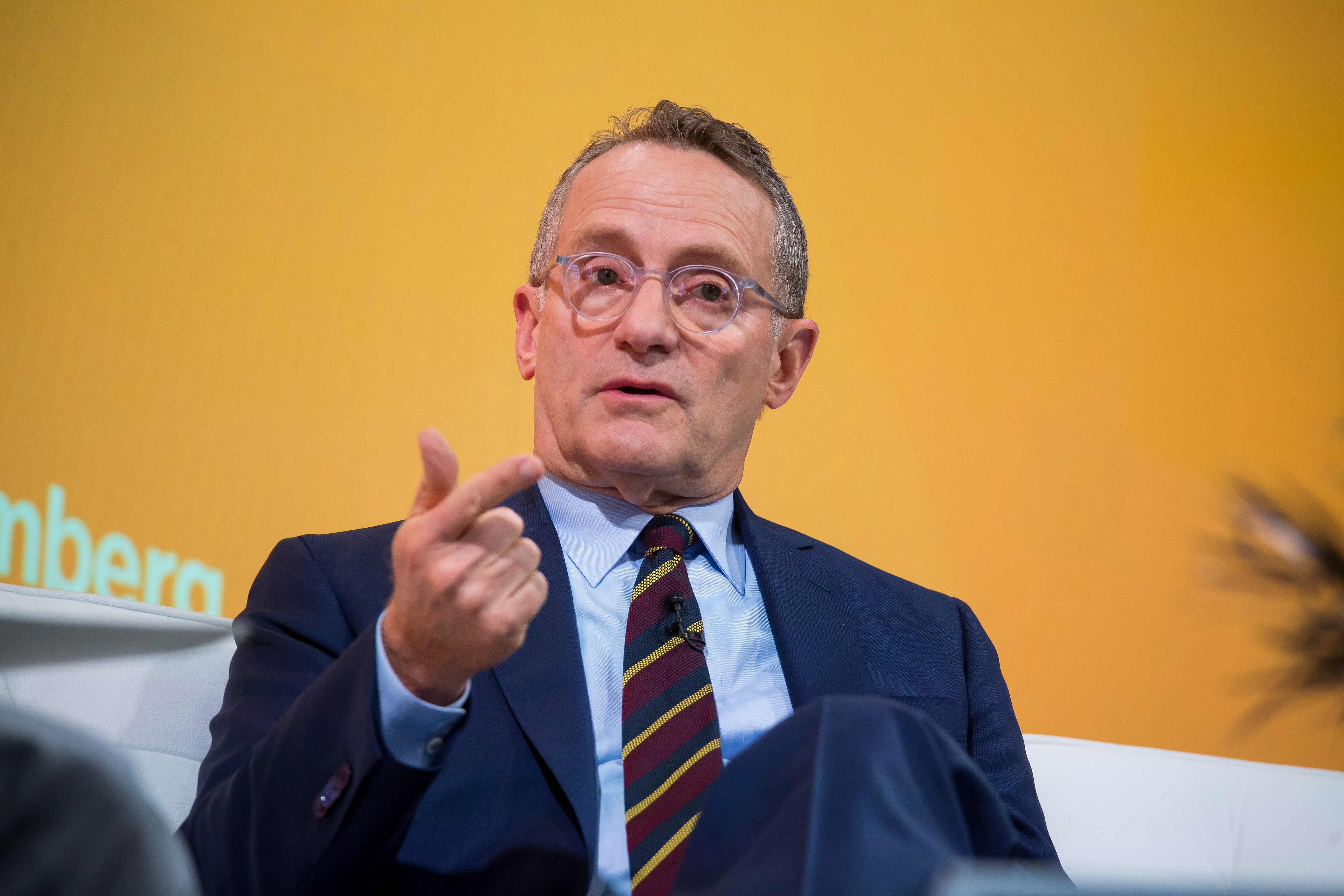
Positive though is not quite how he feels about the global economy and markets. Marks described himself as an intrinsically cautious person before adding, “I'm more cautious than usual nowadays”.
“First of all, the important thing at any point in time is to say 'how should you strike the balance between aggressiveness and defensiveness'. Investors have to have both. Most people say ‘well, I don't want to lose a lot of money, but on the other hand, I don't want to miss all the opportunity'. You have to balance. What is the balance that you strike? When the opportunities are better and the prices are lower and the outlook is unappreciated, you should be aggressive. When the prices are high and the psychology is high and the outlook is likely to disappoint, you should be defensive.
Today as I look at the world, I see a high level of uncertainty. I see many things around the world we don't know the outcome of, macro-wise. Interest rates and thus prospective returns on most assets that are low. Prices that are full, I'm not saying bubble-ish, but high, or full-to-high. And most investors engaging in risky behaviour to try to get high returns in a low return world. If you look at that combination, that's an unattractive combination. It tells me that we should favour defence over offence today. Balancing the two, but with a bias towards defence.”
Why Credit Markets Mr. Marks?
Marks' acquaintance with credit markets was serendipitous. He recounts a story from the time when he was Director of Research at Citibank at the young age of 29 - the bank lost big in equities, the department was reshuffled and Marks was offered a position in the bonds department.
I took that to start a convertible bond portfolio and then ahigher bond portfolio. So it wasn't some masterstroke. I just seized theopportunity that was presented to me.
This was the 80s and he stuck with the credit markets as he moved to The TCW Group and then when he founded Oaktree Capital in 1995.
Currently, of the over $100 billion in assets under management at Oaktree only 4 percent is invested in equities, the rest in debt, convertibles and real estate. Marks says one can't be good at everything.
Interestingly, if Oaktree's equity bets are miniscule compared to the total portfolio its technology bets amount to zero. The firm doesn't invest in technology shares, bonds, anything. “Technology is revolutionary but challenging,” says Marks. And it's not so easy to be on the right side of a revolution he adds.
Our approach is to emphasise sectors where theoutcome is more predictable. ‘Change the world' is not synonymous to successful investing. Westayed away from technology. It is not our expertise and it is not somethingthat we feel that we can predict with consistency.
Howard Marks' Investment Mantras
Marks, known for his aphorisms, prefers talking about investment philosophy than what the Federal reserve will do regarding intrest rates, where commodity prices are headed or the impact of President Trump's policies on the economy.
In his recent memo to investors titled Expert Opinion Marks writes “Of course there are no “facts” regarding most future events, just opinions. Experts – especially people who are paid to be experts – often couch their statements as facts, but that doesn't mean they're sure to come true”.
In the same note there's a caustic section on The Importance Of The Macro in which Marks rues the fact that “analysts seem preoccupied with central bank behavior, government actions, trends in interest rates and currencies, and the movement of markets, as opposed to the fortunes of individual companies”.
He writes that when asked such macro questions he responds by saying “How would I know, and why do you care?”
Forewarned by the memo, this reporter did not venture any macro questions and instead asked Howard Marks to list the cardinal rules of investment.
1. It's not what you buy, it's what you pay that determines the succesful investor. Investment requires not buying good things, but buying things well, buying things at fair to discounted prices. Value, that's number one.
2. To be a superior investor you must think different from others.
If you think the same, you'll act the same. If you act the same, you'll perform the same. That is not the road to superior investing. Dave Swensen of Yale says that superior investing requires the adoption of idiosyncratic positions which are uncomfortable. You have to be out of the consensus in order to exceed the consensus.
3. You have to be unemotional.
You cannot become more excited as things rise and buy more. You cannot be depressed as things fall and sell. You might consider selling high and buying low but certainly not the reverse.
4. And finally, you must look for excessives.
You must look for extremes. When psychology is extreme and unanimous. When everbody concludes either that the internet will change the world, and that buying any internet stocks holds the key to success, or when people conclude that Lehman Brothers (failure) presages the end of the world and the financial system can collapse. Those are extremes from which we can make money and they don't arise much more than once in a decade. But you must be alert to them.
The interview with Howard Marks was done on location the Enam Holdings conference hosted by Akash Bhanshali.

-
Navigating Energy Crossroads: S Jaishankar's Call For Diversified Supply Chains At G20 Ministerial Meeting

As geopolitical fault lines continue to test maritime trade routes and commodity flows, Jaishankar's message remains pertinent: true economic resilience requires open markets, protected transit lines, and a genuine commitment to multilateral cooperation rather than coercion.
-
Indians Are Travelling, But Not Every Journey Is A Holiday | The Week In Whys
Pilgrims, patients and working women are the real travellers, and the system hasn't quite caught up with them.
-
Getting To Work Costs Women More | The Reason Why
It is not just about women paying more than men. It is about women paying much more in cities than in villages.
-
AI Bias In Investing Cannot Be Eliminated, But It Can Be Governed
Framing is a particularly important example as identical financial information presented in terms of gains rather than losses can lead an LLM to reach a different assessment.
-
Joining The Dots | Dark Skies, Steady Diya: Why Hope Holds This Diwali
With war, a weak rupee and foreign outflows weighing on sentiment, policymakers at the NDTV World Summit and market veterans at NDTV Profit Ignite: Diwali Edition offered the same advice: stay invested and filter out the noise.
-
The Curious Case of Equitas Small Finance Bank And A CEO Who Quit For Stock
PN Vasudevan believes persistent investor concerns over a perceived conflict of interest had become a governance overhang on Equitas Small Finance Bank's stock, even as the lender improved profitability and asset quality.
-
Talking Points This Week: AI Cash Burn, A Tiger Comeback And An India That Still Finds Its Own Path
India is not immune to higher oil or tighter global liquidity, yet its earnings base is broader, its domestic policy levers are still available.
-
Foreign Investors Own Half Of HDFC Bank and ICICI Bank. An LTCG Cut Could Matter Most Here
Foreign portfolio investors have US$115 billion parked in HDFC Bank, ICICI Bank. If the government cuts long-term capital gains tax, Jefferies says returning foreign money could land here first.
-
'Never Seen This Level Of Negativity': Sandeep Tandon Says The Next Rally May Be Closer Than You Think
Veteran investor Sandeep Tandon says foreign selling is easing, large-caps are due a comeback and mid-caps are crowded, while he turns positive on gold, power and pharma this Diwali.










