Q3 Results: Axis Bank’s Profit Jumps More Than Twofold On Other Income

Axis Bank Ltd.'s quarterly net profit surpassed estimates aided by a jump in other income to Rs 4,001 crore.
Net profit jumped 2.3 times year-on-year to Rs 1,681 crore in the quarter ended December, the private lander said in its exchange filing, That compares with Rs 1,251 crore consensus estimate of analysts tracked by Bloomberg.
The bank's other income, which included gains from securities' transactions, commission earned from guarantees/letters of credit, fees earned from providing services to customers, selling of third-party products, ATM sharing fees and recoveries from written off accounts, among others, jumped 54 percent year-on-year.
Net interest income, or core income from operations, rose 18.4 percent to Rs 5,604 crore—also higher than the Rs 5,414 crore estimate. Net interest margin stood at 3.47 percent compared with 3.36 percent in the previous quarter.
Asset Quality Improves
Asset quality of India's fourth-largest private lender improved during the quarter. Gross non-performing assets ratio stood at 5.75 percent compared with 5.96 percent in the last quarter. Net bad loan ratio stood at 2.36 percent compared with 2.54 percent in the July-September period.
The lender made a contingent provision of Rs 600 crore towards “potential slippages” from the “BB & Below” (lower-rated) pool of corporate loans. Total slippages during the quarter stood at Rs 3,746 crore.
Asset Quality Divergence
The bank has received an indicative list from the Reserve Bank of India relating to asset quality divergence for the financial year ended March 2018.
We have not received the final report from the RBI on the divergence, but we proactively approached them to seek details. The RBI told us formally about the two accounts which we had already classified as NPA earlier. They also asked us to make additional provisioning, which we have done.Amitabh Chaudhry, MD & CEO, Axis Bank
Here's what the bank said:
- The bank has been asked to classify two accounts as NPA, with an outstanding amount of Rs 225 crore, which constituted less than 0.7 percent of last year's slippages.
- Both of these accounts have already been downgraded in the first half of the ongoing financial year.
- The bank has been asked to make additional provisions of Rs 100 crore on two accounts already NPA as of March 2018.
- This provision has been incorporated in the third quarter's financials.
The bank witnessed multiple management changes, the most important being the departure of Chief Executive Officer Shikha Sharma, in the three months ended December. Sharma was replaced by Chaudhry, former managing director and chief executive officer of HDFC Standard Life Insurance Company, effective Jan.1.
Other Highlights
- Domestic loan growth stood at 18 percent, year-on-year.
- Retail loan book grew 20 percent.
- Retail advances are now 49 percent of total advances of the bank.
Plan Ahead
Axis Banks laid out its strategy for the next three financial years that involves increased focus on wholesale banking and scaling up its subsidiaries, while continuing its momentum in retail banking.
Our goal is to deliver 18 percent return on capital sustainably.Axis Bank Presentation
This is expected to be accomplished through these three ways:
- Risk normalisation: Reduce credit cost below long-term average.
- Business mix optimisation: Portfolio choices based on risk-adjusted return on capital.
- Improvement in operating efficiency: Reduce cost to assets to 2 percent.
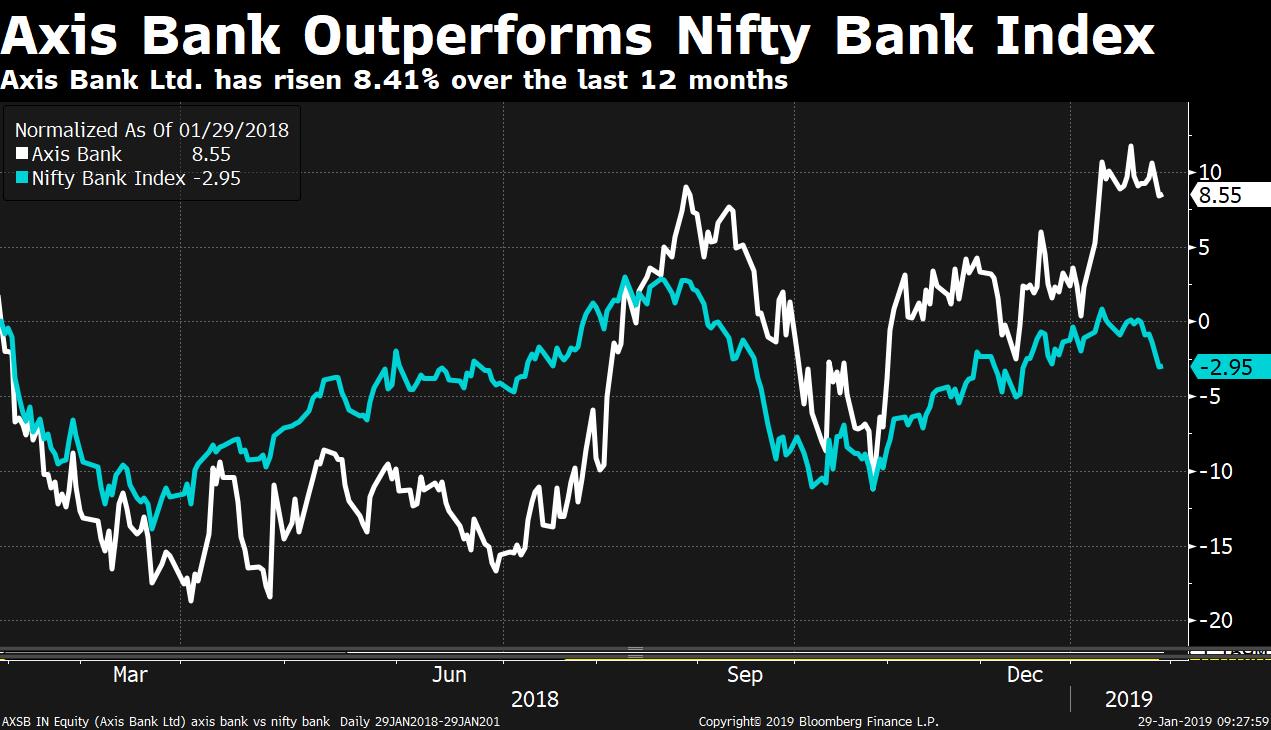
Shares of Axis Bank rose 1.99 percent before the results announcement. That compares with a 0.09 percent decline in the NSE Nifty 50 Index. The stock has risen 8.41 percent over the last 12 months compared with a 3.10 percent fall in the NSE Nifty Bank Index. The bank was the second-largest gainer on the index.
Watch the Axis Bank management decode its quarterly earnings.

-
Ten Things I Learnt This Samvat

Patience can be a trap. Cheap stocks can stay cheap. Leverage can wipe you out. What did Samvat 2082 teach us? Niraj Shah writes on 10 lessons from the year gone by.
-
Talking Points This Week: Tech Nerves, FII Buying, And A Faraway Banking Shock
The global markets are not shining this Diwali. The exception in the large markets is, India.
-
Midterm Rally Lasted A Day. The Hard Reality Of A Divided US May Last Two Years | Opinion
Between a contested AI boom, a debt ceiling that arrives in 2027 and a president with every incentive to act alone, the next two years may prove more volatile than the first day's rally suggests.
-
Blue Wave Will Derail the AI Trade but Won't Dismantle the AI Era | Unhedged Position
The Democrats' sweep of the US Congress will see politics collide with economic forces both over the long and short term.
-
It's Time To Take The GST Council's Bet On Trust Global
Payment records can prove India's services exports, and clear, proportionate rules can bring foreign digital sellers into the tax net.
-
Opinion | India at 38: From Innovation Overperformer to Innovation Powerhouse
India now has 453 VC-backed deep science startups, 18 of them late-stage, after 117 percent growth since 2020. Laurus Labs, at USD 9.3 billion, is the most valuable deep science company in any middle-income economy outside China.
-
Navigating Energy Crossroads: S Jaishankar's Call For Diversified Supply Chains At G20 Ministerial Meeting
As geopolitical fault lines continue to test maritime trade routes and commodity flows, Jaishankar's message remains pertinent: true economic resilience requires open markets, protected transit lines, and a genuine commitment to multilateral cooperation rather than coercion.
-
Indians Are Travelling, But Not Every Journey Is A Holiday | The Week In Whys
Pilgrims, patients and working women are the real travellers, and the system hasn't quite caught up with them.
-
Getting To Work Costs Women More | The Reason Why
It is not just about women paying more than men. It is about women paying much more in cities than in villages.









