Powell Sees Rates Higher For Longer, But Market Doesn't Buy It
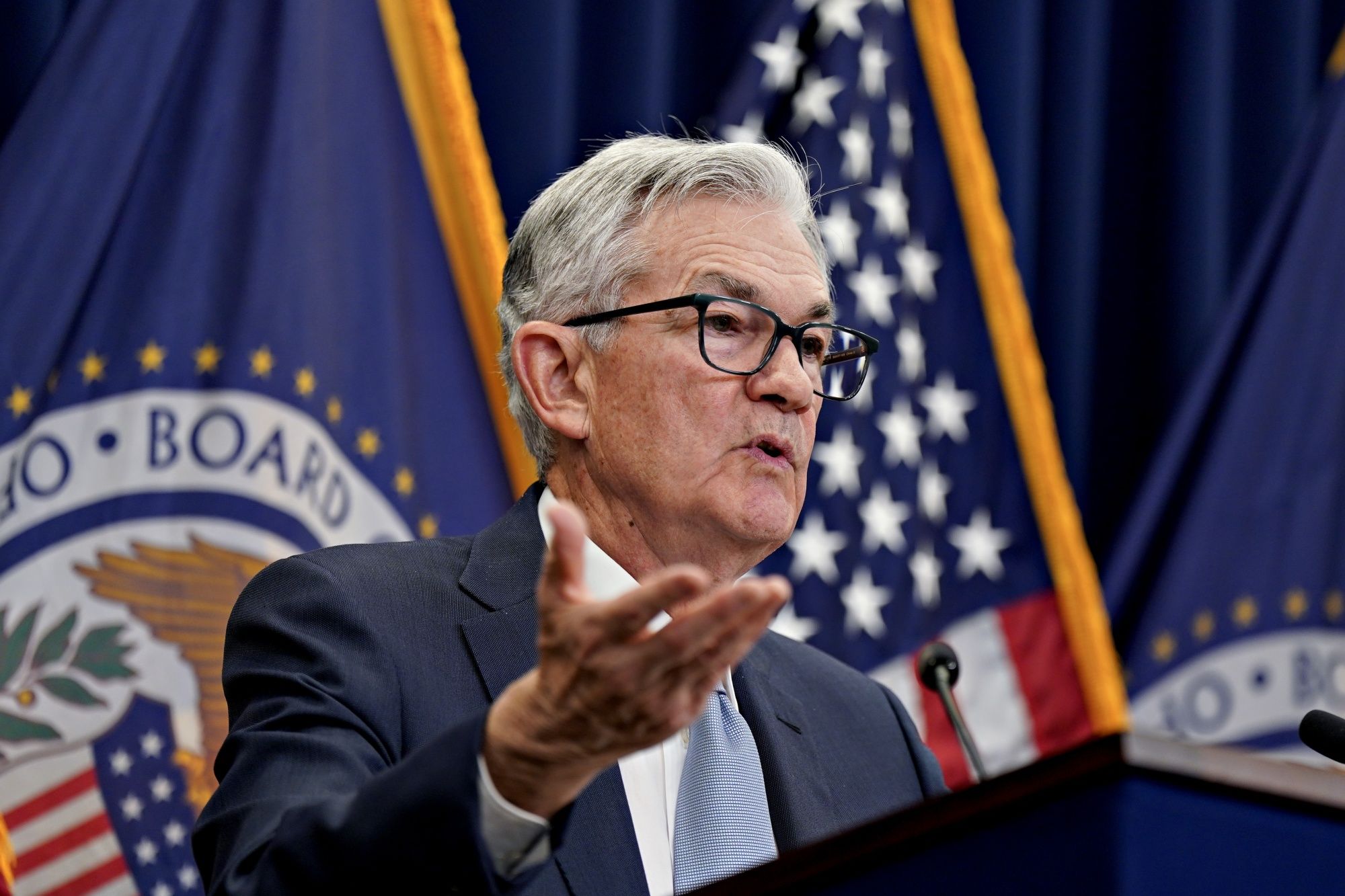
(Bloomberg) -- Federal Reserve Chair Jerome Powell says the central bank has more work to do in raising interest rates and vanquishing inflation. Investors on Wall Street seem to see the outlook for 2023 differently.
In a 45-minute press conference after the Fed hiked rates by 50 basis points to the highest level since 2007, Powell sought to dispel any notion that the central bank would back away from its fight to bring down inflation despite ebbing price pressures and mounting fears of job losses and a recession.
“We still have some ways to go,” he said on Wednesday after the Fed released forecasts of further rate increases next year. “We will stay the course until the job is done.”

After buckling on what was initially seen as tough-love message from the Fed, bond prices reversed course as investors bet that the central bank would execute a U-turn next year and eventually end up cutting interest rates as the economy falters.
“The market is not buying the Fed's increasingly hawkish position that they are going to raise rates to a higher-than-expected level and keep them there,” said Lindsey Piegza, chief economist at Stifel Nicolaus & Co. “The market clearly thinks inflation is going to be on a much more desirable path than the Fed is anticipating.”
Powell affirmed the Fed's determination to reduce inflation to its 2% goal — it is currently running three times that — and made clear that the central bank is not contemplating cutting rates next year, no matter what investors might think.

The Fed won't reduce rates until it's “really confident that inflation is coming down in a sustained way,” he said. And “that will be some time.”
What Bloomberg Economics Says...
“The most striking part of the updated SEP is how unified the committee is on the need to raise rates more aggressively – significantly higher than the 4.8% terminal rate markets had priced in ahead of the meeting. It's also clear that officials recognize the amount of expected tightening will push the economy into recession.”
— Anna Wong, David Wilcox and Eliza Winger (economists)
— To read more click here
While welcoming recent signs that price increases may have peaked, Powell zeroed in on what he called the “extremely tight” job market and the pressure that higher wages would put on companies' labor costs and ultimately inflation.
”It's all about the labor market,” former New York Fed President and Bloomberg columnist William Dudley told Bloomberg Television. “They have to slow the economy down sufficiently to generate enough slack in the labor market so wage trends come down to be consistent with 2% inflation.”

That message might not go over well with some Democratic Party lawmakers who have already complained about the impact that the Fed's repeated rate increases will have on the jobs market and the economy.
Wage increases are currently running about 5% per year, or about 2 percentage points faster than Powell reckons is consistent with the getting inflation back down to 2%.
In projections released after the conclusion of their two-day meeting, Fed policy makers do see inflation falling in 2023, to 3.1% by the end of the year, according to their median forecast. But that will come at the cost of higher unemployment – it increases to 4.6% in the median outlook from 3.7% in November – as economic growth limps along at a 0.5% pace.
“I wish there were a completely painless way to restore price stability,” Powell said. “There isn't.”
To help cool down inflation, policymakers see themselves raising rates another 75 basis points next year – above the level that investors are betting on. Powell pointed out that 17 of 19 Fed officials wrote down a peak rate of 5% or more next year. After Wednesday's increase, the Fed's target range for the benchmark federal funds rate is 4.25% to 4.5%.
While Powell shied away from saying a recession was in the cards, two policymakers penciled in a downturn in gross domestic product next year, according to the projections released by the Fed.
”It does appear like there's a continued push toward a harder landing within the Fed's forecasts, even if they're not noting that the baseline is you get a recession,” Matthew Luzzetti, chief US economist for Deutsche Bank Securities. “The rise in unemployment rate that they forecast, you've never seen happen without a recession.”
Powell at one point in the press conference did allow that the Fed may be nearing the end of a credit-tightening campaign that has seen the central bank raise rates from near zero at the start of the year. “Our policy is getting into a pretty good place,” he said.
But he immediately added that policymakers have a long ways to go to restore price stability to the economy.
The Fed “still has an unwavering focus on getting inflation back to target,” Wrightson ICAP LLC chief economist Lou Crandall said.
--With assistance from , , and .
More stories like this are available on bloomberg.com
©2022 Bloomberg L.P.

-
High US Salaries, No Green Card Certainty: The Financial Calculation Facing Indian H-1B Families

The suspension of PERM processing at eight technology employers does not cancel existing H-1B visas. What it does is force a question many Indian families have been avoiding: is the US salary worth tying your career and family plans to one employer?
-
Swiggy vs Eternal: Food Delivery's Two Rivals Are No Longer In The Same Race
Eternal is building a private AI assistant, dark.ai. Swiggy is still working out how to make Instamart pay, with an operating loss of Rs 895 crore in the July-September quarter while Blinkit stayed profitable.
-
Where You Live Shapes How You Get To Work | The Reason Why
Two-wheelers are the most popular way to get to work in India, accounting for nearly 43% of workplace commutes.
-
Unhedged Position: Can India See An Indonesia-Style Time Correction?
The Nifty is trading below levels it first clocked in 2024. Is there, then, as I have suggested in the headline, potential that the current time correction drags on painfully for the next three-five, even ten years?
-
Navigating Friction And Energy Realities: An Analysis Of Marco Rubio's October Visit To India
Occurring at a critical juncture marked by stalled trade negotiations and escalating geopolitical pressures over global energy supplies, the visit offers a profound window into modern US-India relations.
-
India Exports Capital. Why Not Export Trusteeship?
The big question, then, is whether India can build an institution that global borrowers, investors, banks, and lawyers can trust, even without an Indian connection.
-
France's Economy & Politics Are In Crisis | The Reason Why
Let's look at how the French economy and politics evolved under Nicolas Sarkozy, Franois Hollande and Emmanuel Macron.
-
You May Inherit The Business. You Must Earn Its Credibility.
Succession tests the founder's ability to share authority as much as it tests the next generation's readiness to assume it.
-
Signing Deals Is One Thing; Making Them Work Is Another | The Week In Whys
Sometimes, things don't turn out as planned. Indian companies have lost some bids to rivals, some projects won't produce until 2030.
-
FOMC Wall, PERM Suspension, Hospital Stocks | Talking Points This Week
A PERM suspension would directly affect green-card sponsorship rather than H-1B visas, so the near-term earnings impact could remain relatively limited. The key question is whether this marks a new phase in US scrutiny of Indian IT.









